As we spend the year commemorating the centennial of Central Library, it's also necessary to acknowledge a less celebratory, but still important milestone—the 40th anniversary of the 1986 Central Library Fire. The blaze, which ignited shortly before 11 a.m. on April 29, took over seven hours to extinguish and claimed roughly 400,000 books due to fire, smoke, or water damage. The tragic event...
LAPL Blog
Latest Posts
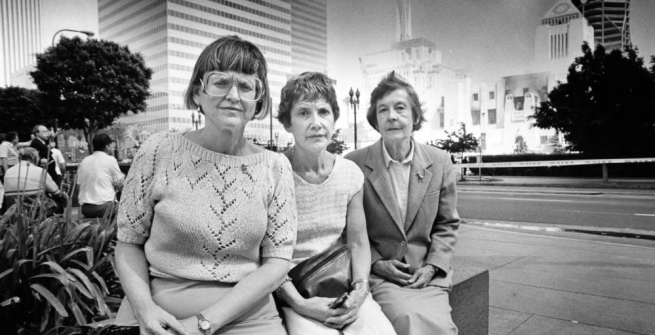
Librarians Billie Connor, Helene Mochedlover, and Katie Leidich sit across the street from Central Library during the Fire. Leo Jarzomb/Los Angeles Herald Examiner Collection
Pages

Short and Sweet: Celebrate World Poetry Day With Haiku
In 1999, the United Nations selected March 21st as its official World Poetry Day. The idea was to set aside one day each year to celebrate poetry’s unique ability to express the deepest and most universal aspects of the human condition.
Scandal in the Stacks!
Chances are if you have heard of any of the early women City Librarians of Los Angeles Public Library, you may know about Mary E.

Where Did People Go to Find Irish Bacon and Cabbage in Los Angeles?
Los Angeles isn't the usual place you think of for wearing of the green, (we're still brown from the drought), but nevertheless, St. Patrick's Day is Saturday, March 17.

Celebrate Pi Day With These Mathematical Reads
It’s not the loneliest number, but it might be the most famous. Pi (or π) is commonly defined as the ratio of the circumference of a circle to its diameter.

Strong Female Protagonist: Women in Comics
The comic book world has long been the domain of men. Both in readers and writers. That is slowly changing, and it’s good news!

World’s Strongest Teenager: Interview With the Director of "Supergirl"
At first glance, Naomi Kutin looks like a typical American teenager—until you see her squat a barbell over twice her body weight.

The Eye and the Image: Women Photographers of Los Angeles
Photo Friends, Friday, March 2, 2018
As March is Women’s History Month, it is only appropriate to celebrate some of the women who helped document Los Angeles – big events and small moments – for all to see.

African American Mystery Writers and Their African American Detectives
They work in Watts, Chicago, Oakland, and Harlem, go on vacation in Provincetown, MA, and return home to Otis, South Carolina (pop. 5,000). They include an Ivy League professor, an ex-CIA agent, a volatile ex-cop, a journalist, a domestic worker, an attorney, a Ph.D.

The Liberator: Librarians Work to Preserve Early 20th-Century L.A. African American Newspaper
The Liberator is an early 20th-century Los Angeles African American newspaper, whose owner and editor, Jefferson Lewis Edmonds, was formerly enslaved and spent twenty years in bondage before Emancipation.

The Golden State Mutual Life Insurance Company
In 1920s Los Angeles, insurance companies considered black Americans to be either uninsurable or extremely high risk. As a result, black people were routinely denied coverage or charged exorbitant premiums.