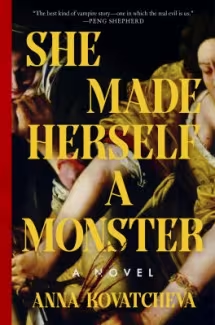
Interview With an Author: Anna Kovatcheva

Anna Kovatcheva was born in Bulgaria and now lives in Brooklyn. She holds an MFA in fiction from New York University. Her chapbook, The White Swallow, was selected by Aimee Bender as the winner of the Gold Line Press Chapbook Competition; her short fiction has been anthologized in Best American Nonrequired Reading and has appeared in The Kenyon Review and The Iowa Review. Her debut novel, She Made Herself a Monster, was completed while Anna was in residence at the Virginia Center for the Creative Arts, and she recently talked about it with Daryl Maxwell for the LAPL Blog.
What was your inspiration for She Made Herself a Monster?
In Slavic folklore, vampires don't necessarily look like Dracula or his pop cultural descendants. Yes, they're malevolent revenants who feed on blood, but their presence may be more acutely felt with something like a crop failure or a plague—existential threats that people of the time were unable to explain or manage.
Enter vampire hunters: experts who could identify and dispose of the monsters in order to restore the natural order. Socially, the vampire is a scapegoat. It provides a handy explanation for the threat, and its very existence is the promise that if you can eliminate the monster, you can restore your community. The vampire's burial serves the same purpose as a witch burning, but it doesn't have to harm a living person.
I became very interested in the idea of a "vampire hunter" who knows that she's perpetrating a fraud, but who believes that it's for the greater good and operates by a strict moral code. What would it be like to follow such a person about her work, and then what would happen if she met someone who needed her help in a very urgent and specific way, running counter to her morals? That's how Yana and Anka first took shape.
Are Anka, Yulia, Yana, Minka, Kiril, the Captain, or any of the other characters in the novel, inspired by or based on specific individuals?
There are certainly historical analogues for all of them. There were real vampire "seers" like Yana who helped identify revenant corpses in Slavic countries, similar to witch hunters and inquisitors. There were also, of course, traditional healers like Minka, and the newly minted physicians like Kiril who sought to replace them. (I recommend the classic Witches, Midwives, and Nurses by Barbara Ehrenreich and Deirdre English as a primer on how that happened in the West.) There's a subplot inspired by the historical figure of Giulia Tofana, though I'd suggest readers hold off on learning more about her until after reading the novel, to avoid possible spoilers!
As far as whether any of the characters are based on specific individuals, the most honest answer I can give is that all of them are me, in some capacity or another. Fitzgerald wrote that "Writers aren't people exactly. Or, if they're any good, they're a whole lot of people trying so hard to be one person." On my best days, I hope to have Yana's cleverness, Anka's resilience, Yulia's cunning, and Minka's caring. Certainly, I share some of their fears and anxieties as well. As for Kiril and the Captain, it was important to me that even my antagonists have positive qualities, overshadowed though they are by inexcusable behaviors: for all their many faults, both of them really do care about the well-being of their community, and that's something I can sympathize with.
How did the novel evolve and change as you wrote and revised it? Are there any characters or scenes that were lost in the process that you wish had made it to the published version?
My one regret is that Anka and Yana weren't interested in pursuing more of their romantic relationship on the page. I wrote many variations of more explicit romance between the two of them, but none of it ever felt quite right given the scope of the story and the characters' concerns in the moment. I'm a very character-driven writer, so as hokey as it might sound, I had to let them lead me where they wanted to go. They did give me a strangely charged tooth-brushing scene (a direct homage to the tooth-filing scene in Sarah Waters' Fingersmith) culminating in a blink-and-you'll-miss-it kiss, so I'll take that as a win.
She Made Herself a Monster has a strong fairytale quality (especially some of the stories within the novel). Do you have any favorite fairy tales? If so, what are they?
When I was a kid, I had a cassette tape of Bulgarian folktales for children that I listened to over and over. A number of the myths and stories from that tape made their way into She Made Herself a Monster. Upon seeing Anka for the first time, Yana imagines her as a samodiva, the Bulgarian name for vili or wilis, dancing forest spirits who lure unsuspecting men to their doom. Late in the book, Kiril recalls a story of a girl who bathes in a golden river and emerges shining like gold—that was on the tape, too, and was a particular favorite of mine.
Do you have a favorite vampire story (novels, films, or television)? A least favorite? One that is so bad it is fun?
Oh, there are so many. I have a lifelong love of Buffy the Vampire Slayer—I'm pretty much always somewhere in the midst of a Buffy rewatch. An incomplete list of favorites movies includes Only Lovers Left Alive (2013), The Lost Boys (1987), The Hunger (1983), Bram Stoker’s Dracula (1992), and Girl Walks Home Alone at Night (2014). Two recent, more off-beat entries in the genre that I loved: Humanist Vampire Seeking Consenting Suicidal Person and The Vourdalak, both from 2023. And of course, for anyone who hasn't seen it yet—yes, Sinners (2025) really is that good.
On the book side: Carmilla, specifically the 2019 edition edited by Carmen Maria Machado. Dracula really does hold up—a fun way to revisit or experience Stoker's classic for the first time is the Dracula Daily substack that emails you the letters, journal entries, etc. the make up the epistolary narrative in "real time" from May to November. I do also love Interview with the Vampire (and the recent TV adaptation, for that matter!) For a more recent fave: Woman, Eating by Claire Kohda.
Same question for witches (or women who are simply accused of being a witch)?
Again, so many! Off the top of my head:
I, Tituba by Maryse Condé is excellent, and essential reading for those like me who grew up very into the Salem Witch Trials. Also on the subject of Salem, but very different, is We Ride Upon Sticks by Quan Barry—a very fun novel about a girls' field hockey team in the 80s who make a deal with the devil to win championships. The Familiar by Leigh Bardugo dives into small miracles and a more folkloric magic in ways that I really loved. Everyone Knows Your Mother is a Witch by Rivka Galchen is a great book about a witch panic and the demonization of women. And while Stephen King's Carrie isn't about witchcraft in the usual sense, I do think she and Anka would have a lot to talk about.
For films, I loved The VVitch (2015). The Craft (1996) is a feral-girl classic for a reason. The Love Witch (2016) is great campy fun, and Suspiria (1977) is still stunning to look at almost fifty years later.
If/when She Made Herself a Monster is adapted to film or a series, who would your dream cast be?
I'd love to see Anka and Yana played by young unknowns. A friend recently pointed out that since Connor Storrie was able to learn enough Russian for Heated Rivalry in a week, surely Bulgarian would be a cinch, and he'd make a great Kiril. We already know he's excellent as a vulnerable jerk, so I'd love to see him fully lean into playing an antagonist who thinks himself the hero.
Yulia’s physical appearance is an intentional nod to Tilda Swinton’s Eve in Only Lovers Left Alive—today I could easily see Anya Taylor Joy or Mia Wasikowska in the role. The Captain needs a particular blend of charisma and physical menace—Adam Driver could be great there. And for Minka, I keep thinking of Eartha Kitt’s legendary take on Madame Zeroni in Holes… Does this production have access to a time machine?
As a debut author, what have you learned during the process of getting your novel published that you would like to share with other writers about this experience?
Not everyone will like or understand what you're doing, and that's okay. While querying, I received a few very kind and thoughtful revise-and-resubmit responses, but with feedback that would have significantly reshaped the book, moving it far from what I wanted it to be. It's okay to say no—it's your book. It's worth holding out for the agent and editor who can imagine the best version of the story you want to tell, who will work with you to bring that into being.
What's currently on your nightstand?
Currently I’m reading The Hounding by Xenobe Purvis, which is great. Waiting in the wings: Lost Lambs by Madeline Cash; Ghost Wall by Sarah Moss; and I’ve also been rereading The Hobbit in fits and starts when the mood strikes.
Can you name your top five favorite or most influential authors?
Nabokov and Calvino were both very formative and continue to be so—Laughter in the Dark and The Castle of Crossed Destinies are also on the nightstand pile right now. Favorites writing today include Melissa Febos, Lauren Groff, and Carmen Maria Machado.
Was there a book you felt you needed to hide from your parents?
Not that I can recall. Fortunately, my parents were very permissive of anything I wanted to read, which proved to be a highly effective means of both keeping me occupied and turning me into a weird-girl writer. (For any parents out there looking to nurture the same in their kids, I recommend the approach!)
Can you name a book you've bought for the cover?
I'm a full-time graphic designer, so this happens pretty regularly, if I'm honest—often with books I already own and then find in nicer editions. Recently, I treated myself to the Penguin Clothbound edition of Lolita, a bright yellow binding covered in the silhouettes of vintage road signs. It's maybe the closest published cover to Nabokov's original brief, roundly ignored by most publishers, which explicitly asked that there be no depiction whatsoever of a girl on the book's jacket.
Is there a book that changed your life?
Too many to count—what else are books for? The first to come to mind is The Blind Assassin by Margaret Atwood, which blew the top off my understanding of genre when I was twenty years old.
Can you name a book for which you are an evangelist (and you think everyone should read)?
Wylding Hall by Elizabeth Hand is criminally underrated, in my opinion. Here's the elevator pitch: decades after the mysterious disappearance of their lead singer, the surviving members of a 1970s British acid folk band reflect in interviews on the summer they spent in a haunted English country house working on their sophomore record. Expect gorgeous prose, disturbing bird imagery, and no easy answers.
Is there a book you would most want to read again for the first time?
The Secret History by Donna Tartt is always worth revisiting, but I often wonder what it would feel like to experience it for the first time again.
What is the last piece of art (music, movies, TV, more traditional art forms) that you've experienced or that has impacted you?
I have a serious answer to this, and also a deeply silly one.
A few months ago, my partner and I visited Dia Beacon, a large-scale installation art gallery in New York. The basement level of the museum is currently devoted to a massive exhibit on the series of "Lifeworks" of Tehching Hsieh, whose work revolves around brutally demanding year-long performance art pieces. One year, he voluntarily committed himself to solitary confinement in a wooden cell of his own construction, which is on display in the gallery now. Another, he punched a time clock every hour of every day for an entire year. From 1983 to 1984, Hsieh and fellow artist Linda Montano spent 365 days tethered to each other by an 8-foot rope around their waists, afforded no privacy but also not allowed to touch each other. The sight of the artifacts and daily records of these art projects was very powerful. I felt a sort of time dilation in looking at them—the span of a year filling a room, the daily labor both dramatically condensed and calling attention to itself all at once.
On a lighter note, I recently attended a screening of a notorious flop, 1984's fever dream Rhinestone, which details Dolly Parton's mission to turn Sylvester Stallone into a bonafide country star in order to win a bet against her horrible boss (no, really). It screened at a local theater in celebration of Dolly's 80th birthday, and in their opening spiel, the curator noted that we were probably the largest audience to ever assemble and watch Rhinestone in a room together. It's not good, but I had a tremendously fun time, and I think the rest of the crowd did, too.
Art is many things—it can be demanding and heady, but it can also be gleeful, silly, and social—and I think both modes are equally important.
What are you working on now?
It's still shaping up, but I'm writing a novel about doppelgängers and grief set in a place that resembles (but isn't quite) Y2K-era rural Virginia.