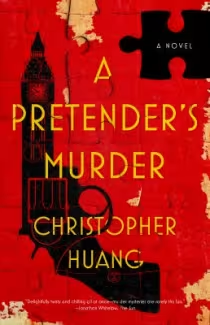
Interview With an Author: Christopher Huang

Christopher Huang grew up in Singapore, an only child in a family tree that expands dramatically sideways at his parents' generation. He moved to Canada after his National Service, studied architecture at McGill, and settled down in Montreal, apparently for good. His first novel, A Gentleman's Murder, was named a 2018 Foreword INDIES Book of the Year and is in development for television. He is also the author of the standalone mystery Unnatural Ends. A Pretender's Murder is his third novel, and he recently talked about it with Daryl Maxwell for the LAPL Blog.
What was your inspiration for A Pretender’s Murder?
I initially started with an idea about Eric Peterkin's sister, Penny, joining some schoolfriends as a bridesmaid at a wedding, and somehow it became this completely different thing. Mostly, I wanted to focus more on the women who lived through the First World War on the home front. A Gentleman's Murder, was very male-centric, being based around a gentlemen's club, and I felt I needed to balance that somehow. I mean, it's not only the fighting men who are affected by war.
Are Col. Russell, Lady Alice Russell, Madam Eliot, Flora Grace, Lucy Russell, or any of the other characters in the novel inspired by or based on specific individuals?
To a very, very small extent... four out of the six wives of Henry VIII: Catherine of Aragon, who was everything a queen should be; Anna of Cleves, who walked away with a fortune; Anne Boleyn, a sexy and intelligent women who challenged the status quo; and Kathryn Howard, basically a child navigating the world of adults. There's also a little bit of Katherine Parr's intellectualism mixed into Flora Grace, and Jane Seymour's image as "mother and wife" in Lady Alice as well, so maybe all six are contained in these four. But I can't say it's a direct inspirational relationship. It's more that I came up with these four women independently, recognised a certain similarity, and then proceeded to keep the idea of Henry VIII's wives in the back of my head as I wrote these four women. Also, I spent a lot of time listening to the soundtrack of Six: The Musical...
How did the novel evolve and change as you wrote and revised it? Are there any characters, scenes, or stories that were lost in the process that you wish had made it to the published version?
I know I made a few false starts on this. As I said, I initially had an idea about Penny's schoolfriends being bridesmaids, and I had a prologue of Penny watching as one of them left the school after her father's death in the War. I had to step back from that one and reconsider the actual plot of the story. Another false start focused on Eric dealing with one of the club attendants, Thomas Harvey. In the end, I figured out that we really needed to begin with Colonel Russell front and centre. There used to be a scene in which a doctor gives Eric a vaccination shot for tetanus, reflecting on how the vaccine hadn't been developed yet in the War, and soldiers had to receive monthly antiserum shots instead. It's interesting trivia, but not exactly relevant to plot, theme, or character, and you've got to cut what you can. The book's long enough as it is!
How familiar were you with the Victorian Spiritualism Movement of the 19th century prior to writing A Pretender's Murder? Did you have to do a bit of research? If so, what was the most interesting or surprising thing you learned during your research?
I'm familiar only as far as knowing that such a thing existed. I remember reading David St. Clair's Child Possessed when I was about thirteen or fourteen. When I was about seventeen, I was briefly interested in the more general occult movements of the era, touching on Aleister Crowley and the Order of the Golden Dawn, but mainly focused on the mythology surrounding the Tarot. I concluded back then that the Tarot is really a fancy Rorschach Test: what you see in it is a reflection of what your subconscious wants to say, not magic at all. None of this research was done "for the book," per se, but a lot of it went into the character of Avery Ferrett. I'd decided long ago that Avery's favourite psychic, Madame Davidova, was a fraud. So all I had to do was figure out a few theatrical tricks and make her sound impressive to the other characters. It wasn't as if there were any scientific rules to follow.
Have you ever attended, or participated in, a seance? If so, can you tell us about it?
No, and I probably wouldn't.
Do you believe in ghosts? Have you ever had an encounter with something paranormal?
Well... I do think there's something out there beyond the reach of our current science. My mother grew up in a house that had been used for interrogations and executions during the Japanese occupation of Singapore, and she has stories of inexplicable happenings there. Randomly swinging shutters, strangely frequent small fires... Apparently, my great-grandmother, once, hearing a thumping sound while praying her rosary, turned around to see a turbaned Sikh head roll past the doorway in the hallway outside. But the house is gone now, and with it, any paranormal activity. For personal experience: I went on a class trip to Indonesia once, and I remember being unable to sleep one night because every time I lay down, I felt as if something was sucking me into the bed. I ended up taking a walk around the hotel and being caught by a teacher, who left me alone when I told her my problem. I thought it was indigestion until, in a class discussion when we got back, the teacher said, "And Christopher felt something, didn't he?" But maybe it really was indigestion. Who knows. I honestly believe that it is far better to approach these things with a healthy helping of skepticism.
I believe I saw the portion of Rome's Londinium wall you write about in the novel on Tower Hill the last time I was in London. Did you visit any sections of the wall when you were in London? If so, which ones?
I visited that portion of the Roman wall, too! I know there are pieces elsewhere, but I didn't get around to visiting them. I do remember seeing signs and markings pointing out where they were and how to get to them, though.
In your Historical Notes, you describe yourself as someone who has a fondness for all things British. What are some of your favorite places in England? A place that you believe someone visiting shouldn't miss?
Every time I visit some part of the UK, I think, "This is the place where I would like to live." Pickering in North Yorkshire, Faringdon in Oxfordshire... the last place I visited was Sandown, on the Isle of Wight, and the island as a whole has so much going for it. The beach there is lovely, and I deeply regretted not packing my swimming trunks.
A Pretender’s Murder is your 2nd novel with Eric Peterkin, following 2018's A Gentleman’s Murder. What are your plans for the series?
This wasn't in my original plan (not that I had much of one beyond 'keep writing'), but you may have noticed that in each of these two books, Eric visits his parish church and takes note of the stained glass windows depicting scenes from the Book of Tobit. (It's not in the Protestant Bible, unfortunately, but the Catholic Bible puts it right after Nehemiah, and the Anglicans put it in a separate section called the Apocrypha.) In A Gentleman's Murder, it was the first story beat, Tobit digging graves for the destitute dead; in A Pretender's Murder, it's the next story beat, the plight of Sarah. I think I'm going to continue down the story of Tobit from here on, each Peterkin mystery drawing inspiration from another successive part of the Book of Tobit. The Peterkin mysteries seem to also always grow out of something that happened during the Great War, but there's only so far a formula like that can take you. Once the "Tobit Cycle" is done, it may be time to skip forward a decade and look for some other focus than the First World War. Or perhaps to shift perspective and have someone else as the main character, watching or helping Eric Peterkin solve the mystery.
The last time we spoke, in 2023, about your novel Unnatural Ends, you told us you were working on a television adaptation of A Gentleman's Murder? Any news you can share with us about that?
No, unfortunately. I leave that mostly to my publisher to work out, and I'm afraid that saying too much might jinx the whole thing!
What's currently on your nightstand?
The last thing I finished was The Erlking’s Court by Neal Bailey; The next thing on my reading pile is I Died at Fallow Hall by Bonnie Burke-Patel, and then there’s Can You Solve The Murder by Antony Johnston. I also have a mug of water in case I wake up thirsty, and one of those brass candle holder things with a handle on one side.
What is the last piece of art (music, movies, TV, more traditional art forms) that you've experienced or that has impacted you?
The Backstreet Boys' "Show Me The Meaning Of Being Lonely". No, I'm not a Backstreet Boys fan: I just happened to hear this in passing one day and realized, "Oh! THAT'S what's going on with [character name redacted] which means THIS is what must happen next." So there's a chapter in Peterkin 3 that's entirely written with that song playing on a loop.
What are you working on now?
Peterkin 3! The next story beat in the Book of Tobit has Tobit's son Tobias on the road accompanied by the angel Raphael in disguise, which seems to imply something involving Eric's friendship with Avery. I shouldn't say too much more in case drastic changes have to be made over the next few drafts, but there will be fighter pilots, a closer look at Eric's occupation as a reader for a small publishing house, and the fraudulent spirit medium Madame Davidova.