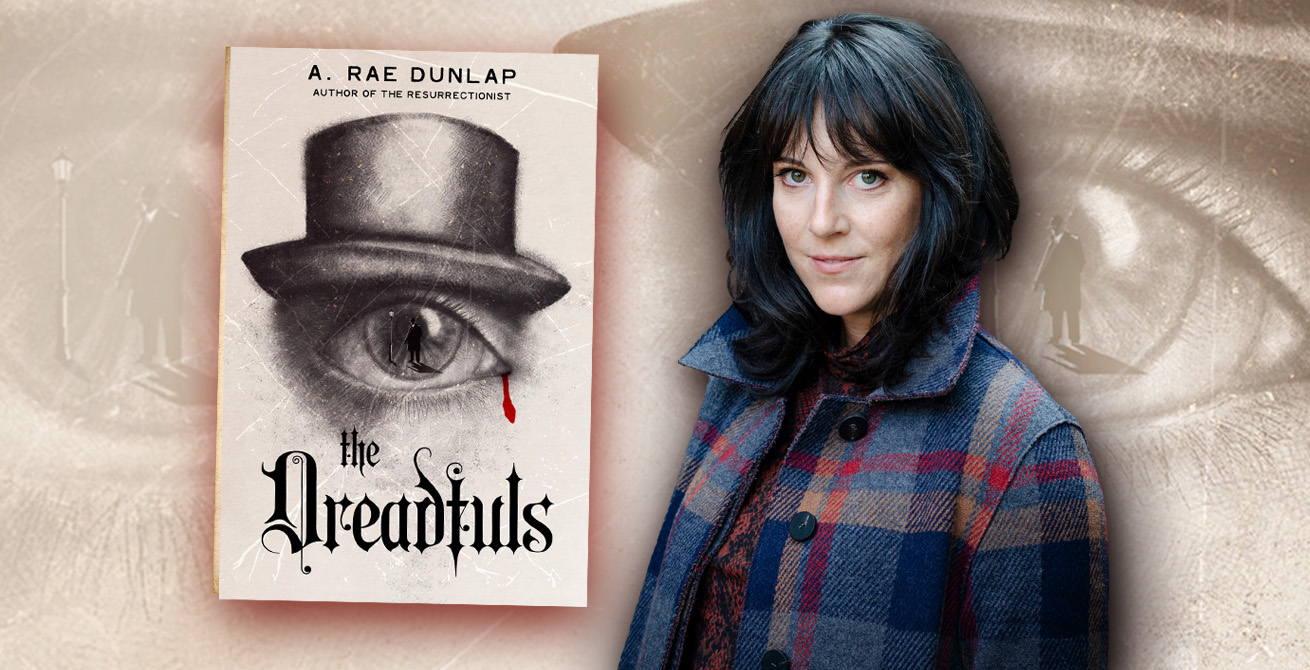
A. (Amanda) Rae Dunlap studied film and Victorian literature at Northwestern University and spends her days as a trailer editor at Disney, bringing to life the magic of the world’s most influential storytellers for audiences everywhere. Born and raised in Okemos, Michigan, she now lives with her husband in a small mountain town in Southern California. Her latest novel is The Dreadfuls, and she recently talked about it with Daryl Maxwell for the LAPL Blog.
What was your inspiration for The Dreadfuls?
This book is, at its core, a love letter to penny dreadfuls and Victorian pulp. Both stylistically and in terms of content, it borrows heavily not just from Revelations of a Lady Detective (which is quoted in the text at length), but also from other famous series of the time: A String of Pearls, Varney the Vampire, Dick Turpin, Adventures of a Notorious Burglar, Spring-Heeled Jack, The Mysteries of London, and Black Bess, to name a few. I wanted fans of this genre to find Easter eggs scattered throughout, to emphasize the way the protagonist’s love for this ‘low-brow’ literature shapes her reasoning and actions for the better.
In your Author’s Note, you tell how Noah’s father and Miss Kaye are both inspired by, or based on, historic figures. Can you tell us a bit about how you learned of them and how/why you chose to include them in The Dreadfuls?
In researching the crimes of Jack the Ripper, I was struck by how many suspects were of Jewish ethnicity. True, Whitechapel had a large Jewish population at the time, but Jews still only accounted for a fraction of the residents there. Diving deeper, my suspicions were confirmed: The investigators on the case did not believe that a “proper Englishman” could commit so heinous a crime, and therefore, the predictable factors of antisemitism, xenophobia, and homophobia clouded their judgment of the case. In real life, Jacob Levi was a butcher from Whitechapel who suffered from mental health issues. Though he's rarely considered a prime suspect in this case, the suspicion surrounding him served as a perfect microcosm for the greater issue of antisemitism at large, and his inclusion in the book as a peripheral character felt natural and significant.
Without giving too much away, Miss Kaye’s story is my favorite true crime case of all time. I’ve been obsessed with this murder since I first heard about it, and the stranger-than-fiction story of her life has always captivated me. I knew from the start that I wanted to involve her in this narrative, to dig deeper into the perplexing nuances of her case and offer my two cents on the outcome.
Are any of the other characters in the novel inspired by or based on specific individuals?
Yes, indeed! Reverend Samuel Barnett is a real figure, famous for his work in social reform in London’s East End during this period. While hardly portrayed as a hero in my narrative, Barnett was an advocate for the poor and disadvantaged. He opened evening schools for adults, coordinated charity work in the neighborhood, and established the Children’s Country Holiday Fund. He was a towering figure on the Whitechapel scene during this era.
Perhaps most importantly, Whitechapel Hall is real—sort of. It’s based on Buck’s Row Board School, a building which still stands on Durward Street in Whitechapel today (and has been converted to condos, of course). The site was gifted to the local church in 1861 for the construction of a school, a common social initiative at the time. While not a reform school, the institution did provide lower-class children with public education. It remained in operation until 1910.
How did the novel evolve and change as you wrote and revised it? Are there any characters or scenes that were lost in the process that you wish had made it to the published version?
One weird thing about me as a writer is that I write to an outline. Religiously. Before I type the first word on the page, I have the story completely set from beginning to end (including a word count for each section). This is apparently strange, but I only discovered this after my debut novel was released and I began discussing the process with other writers. Ultimately, I blame my mother, a 7th-grade English teacher, for my obsession with outlines and metrics.
If I could change anything, I would self-indulgently have made this book 700 pages long and spent much more time interacting with the other girls at the school! A reform school setting is rife with drama, and I was constantly tempted to turn my gaze inward to the interpersonal conflict among the pupils, but ultimately that wasn’t the point of this particular story. Victorian pulp is all about fast-paced action and grand adventures, and I wanted to honor that in my writing.
In your Author’s Note, you also describe how you "hate" Jack the Ripper (both the individual who committed the crimes and the case itself). Given that, what drew you to write a fictionalized account of the case?
As a true crime enthusiast, what draws me to a particular crime is rarely the nature of the crime itself, but the social, economic, and political conditions that conspired to allow it to happen. Reading The Five: The Untold Lives of the Women Killed by Jack the Ripper (2019), by Hallie Rubenhold, her modern account centering the victims turns the traditional narrative of the case on its head. In humanizing the Ripper’s victims and contextualizing their lives within the social and economic conditions of London at the time, Rubenhold drew me back to the case after years of turning up my nose at it.
I’m guessing you may have had to do a bit of research about Jack the Ripper and London, specifically Whitechapel, in the late 19th century? If so, how long did it take you to do the research and write The Dreadfuls?
The research for this one took over six months. Because I knew so little about the case to begin with (for the aforementioned reasons), I had to start from scratch to wrap my head around the material facts of the case.
I started with the basics first: The Complete Jack the Ripper, by Donald Rumbelow, which, until recently, was considered the "bible" of Ripperologists, and a decade’s worth of Ripperologist magazine. I followed those up with some robust online sources, from the updated 1988 FBI profile to conspiracy-laced Reddit threads. Throughout all of it, one thing stood out: misogyny, homophobia, xenophobia, and antisemitism had dominated this case for well over a century. It made me determined to assess the case from a new angle, and to draw attention to the way prejudice derailed prior investigations.
What was the most interesting or surprising thing that you learned during your research?
That Whitechapel wasn’t just a derelict slum! Census records from that era documented a neighborhood that blended classes, races, and ethnicities into a vibrant, diverse community. Portraying that through my protagonist’s eyes was a real delight.
The case of Jack the Ripper is still unsolved, well over a century since the murders were committed. The crimes have captured the attention and imagination of our culture in a way few crimes do, and there are still people researching and speculating as to the identity of the killer. Do you have a favorite of the existing books and/or documentaries about Jack the Ripper?
I’ll turn it back to The Five: The Untold Lives of the Women Killed by Jack the Ripper (2019), by Hallie Rubenhold. While it doesn’t offer any revelations about the perpetrator, I think it’s the most influential volume about this case from the last decade.
Do you have a least favorite? (I realize that you may not want to address this one, and if that is the case, please don't. But I also realize it might be so bad that it could be fun to answer?
The FBI report from 1988! It’s mind-bogglingly regressive, commenting upon the apparent unattractiveness of the victims, describing their lifestyle in derogatory terms, leaning on outdated assumptions about the anatomical knowledge of the killer, and blaming domineering maternal figures for their sociopathic offspring—YIKES. The fact that this was drawn up during the era of "modern" policing and psychological profiling is even more disturbing.
Jack the Ripper has become something almost everyone knows something about (like the Black Dahlia murder, the Zodiac Killer, or the Manson Family). What is it about these unsolved crimes that continues to fascinate us (even if they were committed over a century ago)?
I think the media frenzy surrounding these crimes contributed to their infamy. The way the media reported on these cases (and in some instances, even interacted with the killers themselves) brought them to life in the public consciousness.
If/when The Dreadfuls is adapted to film or a series, who would your dream cast be?
I’d love to see Frankie Corio (Aftersun) as Dell, and a de-glammed Princess Andre (influencer) as Pippa. And Carrie-Anne Moss as Miss Kaye!
What’s currently on your nightstand?
Fiction: Crux, by Gabriel Tallent. Non-Fiction: The Girl with the Crooked Nose, by Ted Botha
What is the last piece of art (music, movies, TV, more traditional art forms) that you’ve experienced or that has impacted you?
A few of my friends still take ballet classes as adults, and their studio recently had a recital. It was so inspiring to see women pursuing their passions into adulthood, despite the pressures of everyday life. It’s a reminder that we’re all lucky to make art.
What are you working on now?
My next novel, The Boneseeker! More queer true crime historical fiction, releasing next year with Kensington.