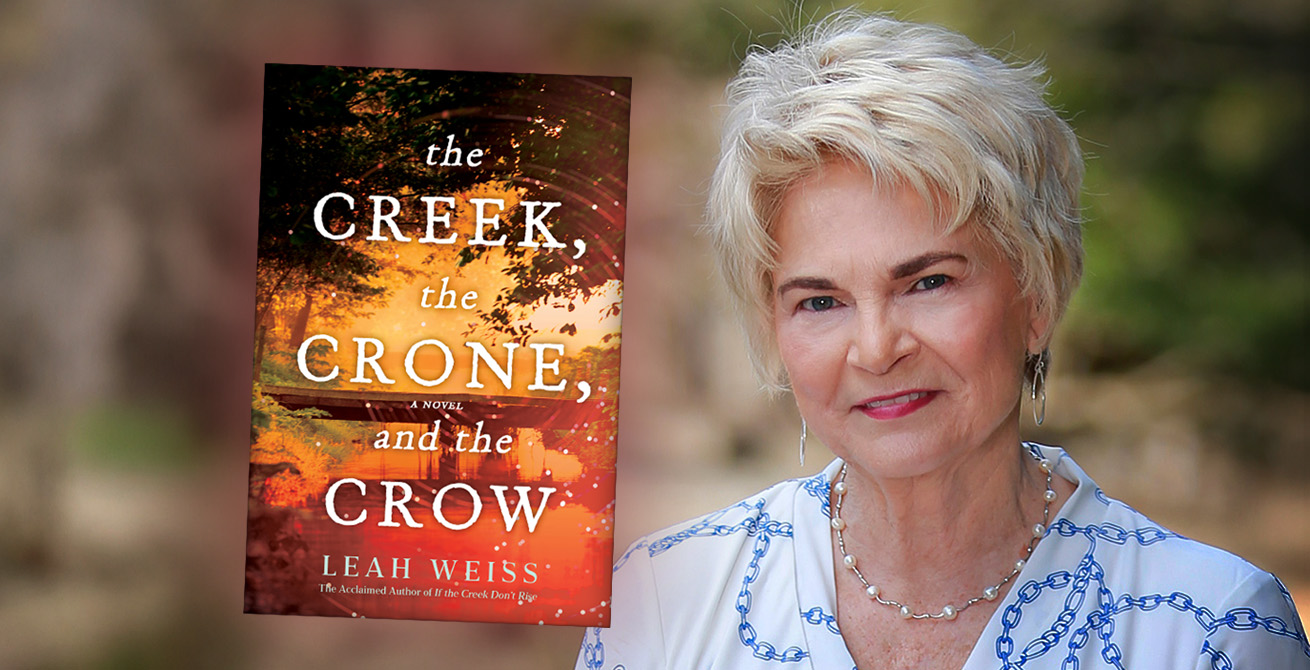
Leah Weiss is an acclaimed southern writer living in Virginia. Her debut novel If the Creek Don't Rise was released in 2017 and selected as Library Reads, Indie Next, and SIBA Okra Pick. It was honored as a 2018 finalist for the Library of Virginia's Literary Fiction and People's Choice Awards and nominated for the Southern Book Prize. Her second novel, All the Little Hopes was released in 2021 and was a Library Reads, BAM's December 2021 book club choice, and named a Best Book for Fall 2021 by Country Living Magazine. It was a 2022 finalist for the Library of Virginia's People's Choice Award. Her latest novel is The Creek, the Crone, and the Crow and she recently talked about it with Daryl Maxwell for the LAPL Blog.
What was your inspiration for The Creek, the Crone, and the Crow?
This is my third book, and it was written to answer the question readers often ask: What happened to my favorite characters in Creek and Hopes, the ones I can't forget? I never planned to write a loose trilogy that could connect two different worlds, but this book exists because readers wanted to know more. So did I.
Are Birdie, Kate, Lydia, or any of the other characters in the novel, inspired by or based on specific individuals?
Because I have lived almost eight decades, I have been influenced by countless people I know or have read about, and my characters are composites. The only character written about someone specific was Eli Perkins, the preacher in If the Creek Don't Rise. My Uncle Willis was a Baptist minister for over fifty years and the family comedienne. He was the fourteenth child in my mama's extended southern family. His kindness, firm faith, and jokes were the only ties between him and the fictional preacher.
Same question for Theresa (because I think there may be a story there)?
I love this woman! She is a welcome relief to the story on so many levels. The outlandish clothes match a boisterous and confident personality. Compared to Kate and Lydia, Theresa moves through life with self-assurance and no self-doubt—at least that's our impression over the five days she's in Little Switzerland. I wonder what we'd discover if we spent more time with her? As you wrote, there may be a story there. We do know this: she cannot move through life unscathed.
How did the novel evolve and change as you wrote and revised it? Are there any characters or scenes that were lost in the process that you wish had made it to the published version?
This book was a challenge, mostly because I thought I knew where it was going. The first working title was Finally There and included a spiritual retreat built of glass on a mountaintop. There were references to the psychics and channelers of the time, such as Jeane Dixon, Jane Roberts, Esther Hicks, and Edgar Cayce. I created that world for Lydia Brown and the culture of 1980, but my editor saw it as a distraction from Birdie's Books of Truth and the simplicity of Baines Creek, and she was right. In that first surgery, I reworked the format, cut 100 pages, focused on Birdie, and clarified the muddled parts. In a second major rewrite, I cut more pages and reworked characters who, once more, were distracting from the point of it all. I believe the willingness to perform major surgeries is my superpower.
I know that there were/are a lot of communities like Baines Creek in Appalachia. Is Baines Creek inspired by a specific place or specific places? If so, are they places you've visited?
Appalachia covers thirteen states. Writing a story set there required that I pinpoint where and who I was writing about. An hour northeast of Asheville, I attend the Wildacres Writing Workshop every summer outside Little Switzerland. That familiar geography provided the grounding and inspiration for Place in my books. I explored backroads that crossed through creeks and ended in shadowy hollers. In some places, there was an air of danger. I loved writing about the danger, but I used caution when I explored.
Do you believe in ghosts? Have you ever had an encounter with something paranormal?
I am a scaredy-cat. I could never bring myself to read The Exorcist when it came out in the 60s because I knew it would live forever in my mind. And my Catholic-school upbringing from grade school through college did a number on my imagination. But yes. I believe in ghosts, though I've never seen a filmy apparition pass through walls. What I did witness was the movement of an inanimate object that defied logic, and it was witnessed by three of us. My love Jim Butler had died 10 months earlier after an arduous cancer battle that he lost. It was Christmas 2006, and I was given a 14" tall Santa dressed in fishing gear as an homage to Jim because he was a great fisherman. That night, the Santa sat on a kitchen counter while we watched home movies of Jim fishing and cracking jokes. Even beyond the grave, he made us laugh, and when we laughed especially loudly, that Santa on the counter moved ninety degrees to face us. Three of us were witnesses, and we squealed in excitement and knew without a doubt that Jim's big spirit was among us.
Do you remember when you first read The Lion, the Witch, and the Wardrobe? Is it your favorite of C.S. Lewis' works? If not, what is?
I've always been aware of the series but didn't read it as a girl. Decades back, my son was enamored with the series in middle school. Because C.S. Lewis's spiritual quest is tied to the fantasy world, when I began my third book, I finally read the series. It made sense to link those classics to my underlying spiritual theme. When the glass retreat center, channelers, and psychics were removed, a clearer connection between Mr. Lewis's books and characters became apparent: both of my narrators benefited from believing in Narnia.
The Creek, the Crone, and the Crow deals a bit with archives, special collections, and rare books/manuscripts. How familiar were you with their processing and preservation prior to writing your novel? Did you need to do a bit of research? If so, what was the most interesting or surprising thing you learned while doing your research?
I am so grateful I write in the age of Google, documentaries, and podcasts. Doing research for this book (like my other two) is an anticipatory journey of discovery. When I began book 3, I wanted to find little-known truths in Appalachia to be the heart of my story, and I did something very smart: I reached out to author and friend Tommy Hays (retired Director of The Great Smokies Writing Program) and asked if he knew someone in the library system who could help me unearth those truths. It had to be someone who loved witches, healers, and the folklore of a dark and mysterious world. That search eventually led to Ross Cooper in Special Collections at Appalachian State.
Every day, Ross fed me links to a variety of articles. Weeks had gone by when a curious one appeared in my inbox: a page from an Illuminated Manuscript had been found in Appalachia—that is, a page from a handmade book created five hundred years before across the sea. This seed of historical truth was inspiring. Later, Ross sent another curious article: The 900-Year-Old Nun With Blue Teeth. The blue was traces of lapis lazuli used to embellish Illuminated Manuscripts. The fact that a woman was credited for an ancient work of art was a massive discovery. Women have usually been written out of history. Linking Baines Creek to its homeland across the sea was the next logical step. It had taken months, but I had found truths that could tie Birdie and Appalachia to a believable history.
Similar question regarding the Elcho Priory and Euphemia Leslie. How did you first learn of the Priory and Leslie? Did you need to do research? What was the most interesting or surprising thing you discovered during your research?
Once I had the legitimate link to the Middle Ages and Illuminated Manuscripts, the Appalachian tie to Scotland was evident. And the logical search for priories in Scotland led me to Elcho and its glorious women's history that existed against all odds. It was a goosebump discovery that fit perfectly in my quest. It was almost as if that unique history was waiting to be unearthed. I've come to believe that in the process of writing, when you respect your characters and their story, gifts arrive. The priory and Euphemia were miracle gifts.
If a movie was made of The Creek, the Crone, and the Crow, who would be your dream cast?
What a fun question. I'm ready to buy my dress for the Premier! Here's my wish-list of talent:
Birdie Rocas (Margo Martindale), Kate Shaw (Geena Davis), Lydia Brown (Anne Hathaway), Jack Reynolds (Matthew McConaughey), Gus Flannery (Julia Butters—I had to look that one up), Eddie Dillard (a young Tom Holland), Eli Perkins (Dustin Hoffman), Sadie Blue (Brittany Murphy), Aunt Marris (Sissy Spacek) and Granny C (Laura Linney).
What’s currently on your nightstand?
The Correspondent by Virginia Evans, Man’s Search for Meaning by Viktor Frankl, The Marriage Bed by Tommy Hays. The Mad Wife by Meagan Church, American Dirt by Jeanine Cummins, A Family of Great Falls by Debra A. Daniel and The Hills Remember: The Complete Short Stories of James Still.
Can you name your top five favorite or most influential authors?
Rick Bragg, Rosamund Pilcher, Markus Zusak, Barbara Kingsolver, Pat Conroy. They enlist the craft of writing in remarkable ways.
What was your favorite book when you were a child?
Nancy Drew books made me feel smart and powerful when I figured out the mystery before the end of the book. It was heady stuff for a girl of twelve to test her deductive thinking and succeed. I loved the admiration from Nancy's father for his daughter's talent.
Was there a book you felt you needed to hide from your parents?
When I was nineteen, I came upon a faded copy of Lady Chatterley's Lover by D.H. Lawrence. This was in 1966, when the world of books, music, and movies was being carefully censored, and I knew instantly it was a banned book, which meant I must read it clandestinely. What I remember most (as I skimmed the pages looking for the racy stuff) was how hard I had to look. What I failed to see was that the shocking lesson wasn't the sex act, but rather the idea that a woman could seek to pleasure herself.
Is there a book you’ve faked reading?
Not outright, but I've been on the outskirts of academic discussions about classic books I never read, and maybe my silence implied I had read them.
Can you name a book you've bought for the cover?
Very recently, it was The Book Thief’s twentieth anniversary edition. It's one of my favorite books, and I remember marveling when I first read it at the decision by Markus Zusak to make Death the sympathetic narrator. The new celebrated edition is an understated work of art.
Is there a book that changed your life?
In college I read Ayan Rand's Atlas Shrugged, It prompted interesting arguments with my dad who was a traditionalist and me, the naïve. And in my fifties, it was The Four Agreements by Don Miguel Ruiz. I thought I'd found the key to happiness when I read the agreements, but what I discovered was the steady struggles I face daily, being human and falling short.
Can you name a book for which you are an evangelist (and you think everyone should read)?
I was a child in the South in the fifties and sixties when Civil Rights and integration impacted my daily life. Harper Lee's To Kill A Mockingbird features racial injustice and the goodness of one man doing the right thing. That was a brave and necessary book for the times and remains so today. It flavored many of my political leanings.
Is there a book you would most want to read again for the first time?
Not really. I believe that when a book is great, the second and third reading is even more enjoyable. The reader uncovers more careful layers that the writer labored over that they missed the first time around. I’ve read Shell Seekers by Rosamund Pilcher, three times. It has appealed to me in every stage of my life, but from different POVs.
What is the last piece of art (music, movies, TV, more traditional artforms) that you've experienced or that has impacted you?
My home is an artist's home. There are clay sculptures and stained glass I made, and art glass and furniture by my son, pottery by my daughter-in-law, and lots of paintings collected over a lifetime. Recently, I returned to the RAD (the River Art District) in Asheville and came upon the studio of artist Jaime Byrd. She combines colorful paintings with Augmented Reality that, when viewed with a tablet or phone, the paintings come alive. How is that even possible?
What is your idea of THE perfect day (where you could go anywhere/meet with anyone)?
It would be 1954 at Sunday dinner at Nana and Pop's four-room, flat-top house on Wells Road. I am seven and my sister five and Mama and Daddy are in their prime. We stay through the afternoon and into the evening with never a glance at a clock or a whisper of leaving. The grownups sip on High Balls (bourbon and Ginger Ale), and we children sip on Low Balls (Ginger Ale and a maraschino cherry). We eat Nana's perfect fried chicken, creamed potatoes, and angel biscuits, and listen to new family stories we commit to memory. Then Pop moves to the piano, and Daddy picks up his trumpet. They play songs like Sentimental Journey, Don't Fence Me In, and Paper Doll, and we all sing harmony, even my little sister and me. That happiness was so commonplace in my childhood that I thought it was the way everyone lived. I thought it was the way I would always live. Thank goodness I can remember.
What is the question that you're always hoping you'll be asked, but never have been?
In my late fifties, I began writing with the goal of being published. I am seldom asked if I regret waiting so late in life to become a writer.
What is your answer?
It takes me about four years to write a book and get it published, so beginning earlier would have given me time to write more books. But there is no guarantee I would write wiser words or more memorable characters or hit my stride and maintain it. I may have been lured by money to meet a deadline that affected the quality of the book. Instead, I ended up writing three successful books in my seventies, which hugely pleases me, but my writing happened when it was meant to happen. When I had huge blocks of time to fill after losing two loved ones to cancer. When all my life experiences counted for something.
What are you working on now?
I cut my writing teeth on short stories, and I'd like to return to that format for a spell. I may expand on Mama's personal stories I wrote when I was learning the craft. I may write about some of the minor characters in my books so I understand them better. I have to practice my craft in order to hone it, and if I become complacent, the writing will become stale. Maybe I have a fourth book in me.
It's been my pleasure to answer your thought-provoking questions. Thank you for asking me to participate.