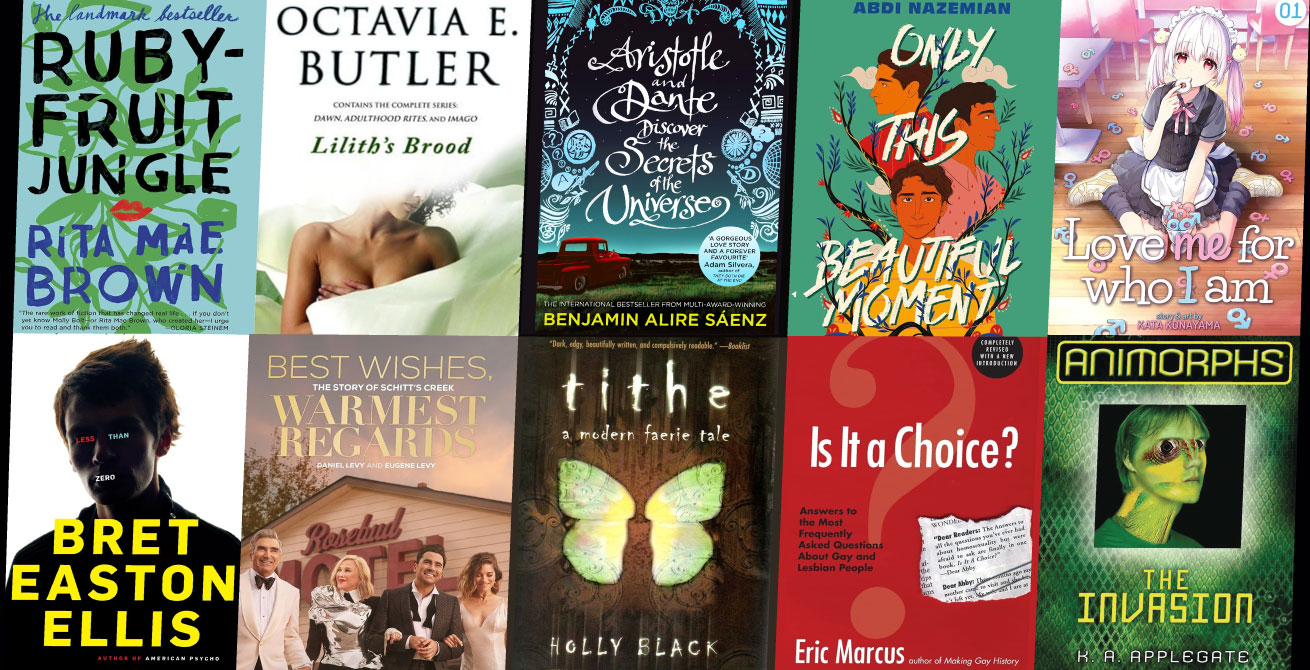
If someone identifies as part of the LGBTQ+ community, there’s a strong possibility they grew up without role models who reflected their gender identity or orientation. It’s possible they didn’t "meet" another person like themselves until they picked up a book. This discovery can be life-changing for the queer reader who just realized their experiences are more common than they thought, or that the path they thought they had no choice but to take in relationships and gender expression was not the only one.
The Los Angeles Public Library’s LGBTQIA Services Committee was given a survey asking staff to recall the first book they read that made them feel represented as LGBTQ+ readers. They were also asked to describe their reactions to seeing themselves reflected in a book. The booklist below contains the recollections several of us chose to share, along with links to the books (some of them newer editions) in the library catalog.
But what if you’ve never come across a character or story in a book that reminded you of yourself? Or maybe you found something close but not quite? Maybe the only queer book you ever read had a sad ending, and you want something more uplifting? Use your Los Angeles Public Library card to try out the reader’s advisory database, NoveList, where you can search for books that almost got it right (including nonfiction), and then find their read-alikes. You can also search for tags like "nonbinary" and "hopeful." We also have LGBTQIA booklists on our website. And if you don’t have a library card, or if you live outside of Los Angeles, where you can’t get access to certain LGBTQIA+ titles, try out Read Freely, where you can get a digital card and read from home.
And if you still can’t find that book that speaks to you, then maybe it’s time for you to write it!
A series about a group of tweens who gain the ability to morph into animals and fight aliens might seem a bit odd to list, but the character Tobias, specifically, was so much more to me than just one of the gang. At the end of the first book, Tobias becomes stuck in the body of a hawk, with the brain of a boy (as called in the series, a "nothlit"). Through some complicated plot machinations, he gains the ability to morph again from hawk into another form. As someone who didn't fully understand the difference between her brain and the body she lived in, I understood all too well the joy of knowing you have the wrong body, but maybe you could change, even if just for 1 to 2 hours.
We get installments of the series from his point of view, and in those, we see his inner struggle with the life he has to live. The way he has to force himself to live in a way he is disgusted by just to survive, sometimes his thoughts wander to how long he can keep living in this body. Taking the wider look at the series, it's no surprise that even before I had the words to know who I was, I felt at home with this character, with this idea of changing your body and the yearning to get stuck in a body that felt like home.
Aristotle and Dante was the first book that I read where I truly felt represented as a Latino-Gay man. From start to finish, I felt like this book touched upon different themes that I related to (i.e., religious upbringing, Mexican-American background, being the only gay person in school, town, and family). The book was about a Mexican-American teenager growing up in the 1980s and falling in love with his best friend, all while figuring out his own sexuality.
This book was monumental for me in the sense that it brought me complete happiness and joy when I finished it. Through the tears of completing this novel, I realized how much I cherished this story and how it instantly shot to the top of my favorite reads. Up until this point, I had not picked up a book that I related to as much as this one. It was a magical moment for me to see how much of myself I saw in this story. This book is a YA novel, and I sadly didn't know about it until I was in my early 20s. I wish I had read this book when it came out when I was a teenager, because I feel like it would have helped me tremendously on my coming-out journey. To this day, this book remains my favorite of all time. 1000/10 would recommend to anyone.
I identify as Queer because I am an amalgamation of a couple of identities—I am panromantic and asexual. I can only think of this one book with Pan representation. Schitt's Creek, the show, was the first and only time I saw myself in the character of David, whose pansexuality was perfectly summed up with "I like the wine and not the label." That was the first time I thought (in an internal shout), "That's me, exactly!" But, then, it wasn't completely me because I always knew that I was Asexual. But I was able to say I'm Panromantic (or "Panamorous"), and I was thrilled to know who I am finally. So, Best Wishes, Warmest Regards: The Story of Schitt's Creek would be the book I would highly recommend... along with the show.
Now, there aren't too many books with asexuality either. Aside from a character in Alice Oseman's beautiful Heartstopper series, I found the nonfiction Asexual by Jeremy Quist to be a nice, concise read. One thing that works for me is knowing that any character in any book that is not in any type of sexual relationship may actually be asexual (or even "Panama"—panamorous/asexual), so, in that way, I have plenty of peers and heroes between the pages.
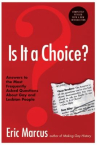
In 1993, I was a 14-year-old with so many questions about my sexuality, and I wondered if I might like girls. This was pre-Internet, so I couldn't just look it up discreetly. My parents often took my brother and me to bookstores to purchase any books we wanted. I saw this book and asked if my dad would buy it for me. Without hesitation, he said yes, and when I went home to read it, I realized the feelings I had were normal, rational, and nothing to be afraid of. After reading the book, I still didn't know if I was a lesbian, but I knew it was okay to question it and not be sure.
They live in a world shaped by casual nihilism, passivity, and too much money in a place devoid of feeling or hope. When Clay comes home for Christmas vacation from his Eastern college, he re-enters a landscape of limitless privilege and absolute moral entropy, where everyone drives Porsches, dines at Spago, and snorts mountains of cocaine. He tries to renew feelings for his girlfriend, Blair, and for his best friend from high school, Julian, who is careering into hustling and heroin. Because it was set in Los Angeles and places where I used to hang out on Melrose and Sunset Blvd, it brought home many of my repressed feelings.
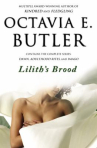
Octavia Butler is the author who rekindled my love of science fiction. While Lilith's Brood/Xenogenesis series is not overtly queer, I felt a deep connection to the Oankali, whose society and culture include a third gender (ooloi) that plays a central role. In addition, the unique family and relationship structures (polyamorous relationships including one male human, one female human, one male Oankali, one female Oankali, and one ooloi Oankali) Butler describes in the series intrigued and resonated with me. Butler departed so thoroughly from the cis-masc sci-fi authors I had grown up with, offering me a new understanding of what science fiction can be.

It was the first time I saw a trans character in a manga who found community with other trans people.
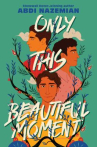
Wow, this book hits close to home: I live next to Westwood in "Tehrangeles," and I first visited Iran as a teenager with my father, who was born there, while I was born here in L.A. County! This book is an intergenerational tale of a son, a father, and a grandfather across time and countries (the U.S.A. and Iran). The book shows how they all grew up at different times and dealt with different types of relationships as young adults.
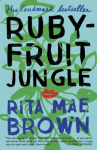
Molly Bolt is a sharp, outspoken girl growing up poor in the American South. She quickly realizes she doesn't fit the expectations around her—especially when it comes to gender roles and sexuality. She's openly attracted to women from a young age and refuses to hide it, which brings her into conflict with her family, school, and society at large. My take—I was a tomboy growing up in 1970s and 80s Iowa, where 100% of the population (it seemed) was heterosexual. Our Human Development teacher talked about all sorts of sexuality, to the point of inappropriateness, except for homosexuality. I felt like a disappointment and an outsider, and this book showed me that maybe it wasn't as abominable as I thought. It truly opened my eyes.
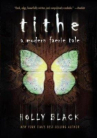
Holly Black's dark, angsty faerie tale introduced me to quite a few concepts that were eye-opening at the ripe age of 12. One of these was a secondary character who is revealed to be gay (and into sadomasochism, no less— the early 2000s were a very different time for YA). Even though things end rather poorly for him, I found myself fascinated by this boy who liked boys and felt a strange kinship in that, even as I thought of myself as a girl at the time. Re-reading it much later, I was surprised to find how minor a plot this was in the scope of the story. I had spent so much time turning the knowledge over and over in my head, feeling certain that I had to keep it a secret even if I didn't understand why, that it became central to my recollection of the book. It wasn't a great representation of gay people, nor did it perfectly reflect my own experience, but even so, it was the barest glimpse for me into a different world. It was the smallest suggestion that somewhere, out there, there might be a different way for me to be.