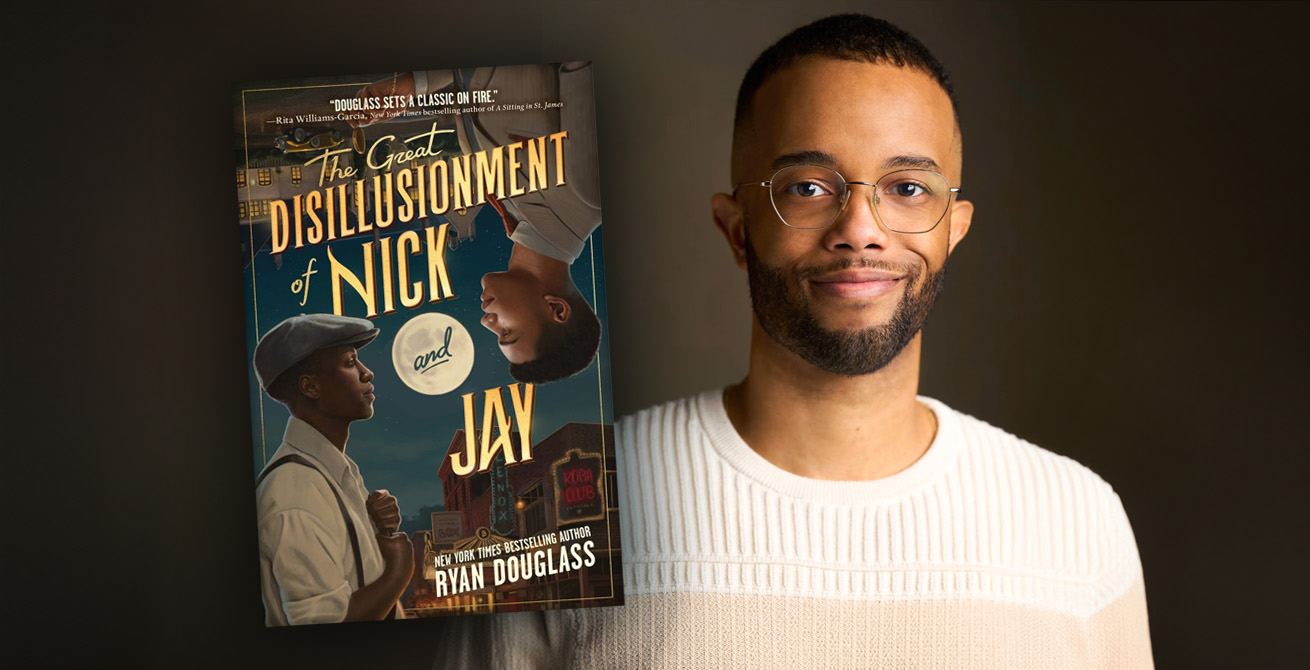
Ryan Douglass is a queer author and poet from Atlanta, Georgia. He is the New York Times bestselling author of The Taking of Jake Livingston, and his short fiction appears in All These Sunken Souls and Night of the Living Queers. His poetry is featured in Poemhood: Our Black Revival and He/She/They/Us. When he's not writing, he's probably baking something sweet or making a playlist for a story he hasn't written yet. His latest novel is The Great Disillusionment of Nick and Jay, and he recently talked about it with Daryl Maxwell for the LAPL Blog.
What inspired you to reimagine F. Scott Fitzgerald's The Great Gatsby?
Gatsby entering public domain felt like the perfect opportunity to explore what about this story made it a classic. It's a staple in high school English classrooms, likely because it captures this familiar longing for luxury, wealth, and ease that we experience a lot in American culture, despite our upbringing. This book is taught to students from all backgrounds, so it only felt natural to imagine it in a way that centers Black people and people of color, who are also chasing the American dream.
Are Nick, Jay, Daisy, Zihan, or any of the other characters in the novel, inspired by or based on specific individuals (beyond their literary counterparts)?
The characters themselves aren't inspired by real people, but their emotional truths are real. The way they show love is modeled after how my family and friends have shown love to me, so in that sense, they are inspired.
How did the novel evolve and change as you wrote and revised it? Are there any characters, scenes, or stories that were lost in the process that you wish had made it to the published version?
The novel started with an unconventional structure and a mix of styles. It was a mood book focused mostly on feelings and atmosphere. My editor helped in developing a throughline for the plot that allowed me to keep the vibes intact while giving the reader a sharper storyline to follow. As for deleted scenes, there was a car chase scene around the casino portion of the book that was trimmed for the final version, likely for the best. Some of my interest in spectacle comes from being a movie buff, but the cinematic style doesn't always translate well to novels.
How familiar were you with the US in the early 1920s in general, and the Tulsa race massacre and the Harlem Renaissance specifically, prior to writing The Great Disillusionment of Nick and Jay? Did you need to do a bit of research? If so, how long did it take you to do the research and write the novel?
I'd been studying the Reconstruction era for years before starting this project, because I was working on a historical set in the late 19th century back in 2018. That research gave me a preliminary understanding of how schooling worked in the period, how Black Americans interacted with white Americans, and what they were focused on in art, faith, and politics at the time. I learned more about Tulsa and Harlem while working on the novel, and I studied speech and language patterns in books by African-American writers from the early 20th century. I started the novel in late 2022 and finished it in 2025, so it took about three years to complete.
What are some of the most interesting or surprising things that you learned during your research?
The research was the most interesting when I saw glimpses into the joy of the 1920s. It's easy to think of Black American history as this huge site of trauma and subjugation, but the 1920s were actually a vibrant decade for Black thinkers, artists, and LGBTQ individuals. One of my favorite things was watching short comedy films made by Black people in the 1910s and realizing how timeless Black humor is in all circumstances.
Is The Great Gatsby your favorite of F. Scott Fitzgerald’s works? If not, what is?
It's not. If I had to choose a favorite, I'd probably pick one of his short stories, Winter Dreams. I love Fitzgerald's prose, and this piece really showcases what a wordsmith he is. It pulls you through a lot of tension, yearning, longing, and doubt in a short space, and it feels like a darker, more grounded version of what we see in Gatsby.
Do you remember when you were first exposed to The Great Gatsby? Was it the book or one of the films? If it was one of the films, which one?
I distinctly remember reading this in 11th-grade English and being excited about diving in. I wanted to read more classics at the time. I was underwhelmed after my first read because I couldn't relate to the characters or their dilemmas. And then years later, I watched the Gatsby movie with Leonardo DiCaprio and thought it was okay, but was also disappointed with that because I thought it'd be more subversive.
Do you have a favorite of the film adaptations?
I have only seen the one with Leonardo DiCaprio and Tobey McGuire.
Were you intimidated by the idea of reimagining such a well-known novel and its characters?
I was intimidated at the beginning because I was looking at it as something that had to do everything the original did and more. But over the course of writing it, that mountain became more manageable because I was having so much fun with this new version. I understood the task as my personal interpretation of the work's strengths and shortcomings, and an opportunity to highlight what I thought was fun or thought-provoking about the time period.
We lost F. Scott Fitzgerald in 1940. If you could ask him something, what would it be?
I would ask him if he felt conflicted about how seductive his work made wealth and power look, or if he doesn't care about his ideas being flattened in popular culture. "Gatsby-esque" is used as shorthand for a desirable sense of luxury or access and kind of ignores the dark subtext in the work, so I'd ask if that's in line with what his expectations were or if it annoys him to see his ideas commercialized in that way.
Is there something you wish you could tell him?
I'd tell him that experiencing the density of his writing certainly challenged me to pack more complexity into my sentences.
Have you ever visited Greenwood, Oklahoma? Harlem in New York City? If so, when did you go? Do you have any favorite places? A hidden gem that someone visiting for the first time should not miss?
I have been to both places transiently, so driving through or riding the train. I went to school in New York, so I've seen Harlem, but never spent considerable time there. Same with Tulsa—I've driven through during a brief stop in Oklahoma.
I want to go back because I'm drawn to how both places carry their histories. In Oklahoma, there is a clear preservation of Native American culture, and I enjoyed that a lot because it's different in the Southeast. In Harlem, I would love to visit the community spaces still standing today that keep Black history alive, like the Schomburg Center.
Do you have a theory regarding why the works of F. Scott Fitzgerald, in general, and The Great Gatsby specifically, continue to be popular with readers, writers, and filmmakers?
I think the iconography of it all comes from the fact that people are drawn to social access and wealth, but also the idea of reinventing themselves. It's like a fantasy out of our ongoing individual and collective crises. I think it still represents what it did when it first came out—a fantasy of possibility and the yearning for an easy life.
What's currently on your nightstand?
A lamp, a notebook, and a copy of The Haunting of Hill House by Shirley Jackson, which is more of a fixture than something I'm actively reading.
Can you name your top five favorite or most influential authors?
I’m most influenced by James Baldwin, Langston Hughes, Samuel R. Delany, Toni Morrison, and Alice Walker. They are deep thinkers who've done lasting work.
What was your favorite book when you were a child?
I had several, but I’ll go with The Perks of Being a Wallflower. It introduced me to the Beat generation, and for that I am grateful.
Was there a book you felt you needed to hide from your parents?
Every book about gay people was hidden from my parents and returned to the library immediately when I was finished.
Is there a book you've faked reading?
None that I pretend to have read that I've never touched, but there are several I've stopped reading when I felt I'd seen enough. I wouldn't call those books unread per se. I don't think every book needs to be finished by everyone who picks it up.
Can you name a book you've bought for the cover?
Manhunt by Gretchen Felker-Martin. It left me desperate to understand the meaning of that image.
Is there a book that changed your life?
The Fire Next Time by James Baldwin was a life-changer.
Can you name a book for which you are an evangelist (and you think everyone should read)?
I think everyone should read The Black Panthers Speak so that more people can become familiar with the history of Black political work in the United States that rested outside the current ideological binary. There's so much movement work that has been flattened or distorted by the way history is taught to us in schools, and it just doesn't paint the most realistic image of the complex fabric of American history.
Is there a book you would most want to read again for the first time?
Runaways, Volume 1. Total classic, and it was the height of storytelling at the time I read it.
What is the last piece of art (music, movies, TV, more traditional art forms) that you've experienced or that has impacted you?
The Boyfriend on Netflix. It's Japan's first gay dating show, and I wish I had more people to talk to about it and to cry and swoon with over it. I’ve also really enjoyed Sinners recently. It's the only movie I've ever seen seven times in theatres and is such a beautifully made, culturally rich piece of art.
What is your idea of THE perfect day (where you could go anywhere/meet with anyone)?
I like days where I can spend a good balance out in nature and then indoors. I'd want to experience something natural, like a large expanse of open field, a lake, or a beach, and then spend the rest of the time enjoying a satisfying meal and hanging out with someone I care about. Something intimate, quiet, and present.
What is the question that you're always hoping you'll be asked, but never have been?
I always wish more people asked what I'm listening to, because I do so much music curation but don't get to talk about it a lot in literary spaces.
What is your answer?
I'd enthusiastically announce I'm expanding my catalogue of 80s rock, and just learning that I'm a big fan of The Cure. I'm also listening to a lot of Lorn, who always manages to show up on the playlists of my speculative works. It's very atmospheric and immersive music.
What are you working on now?
I'm finishing up edits on my next YA horror, which comes out soon, and working on drafting an adult book. I'm also ironing out the kinks of a YA sci-fi project that I've been developing for a few years. I'm pleased with where my craft journey is going, and I'm having a lot of fun.