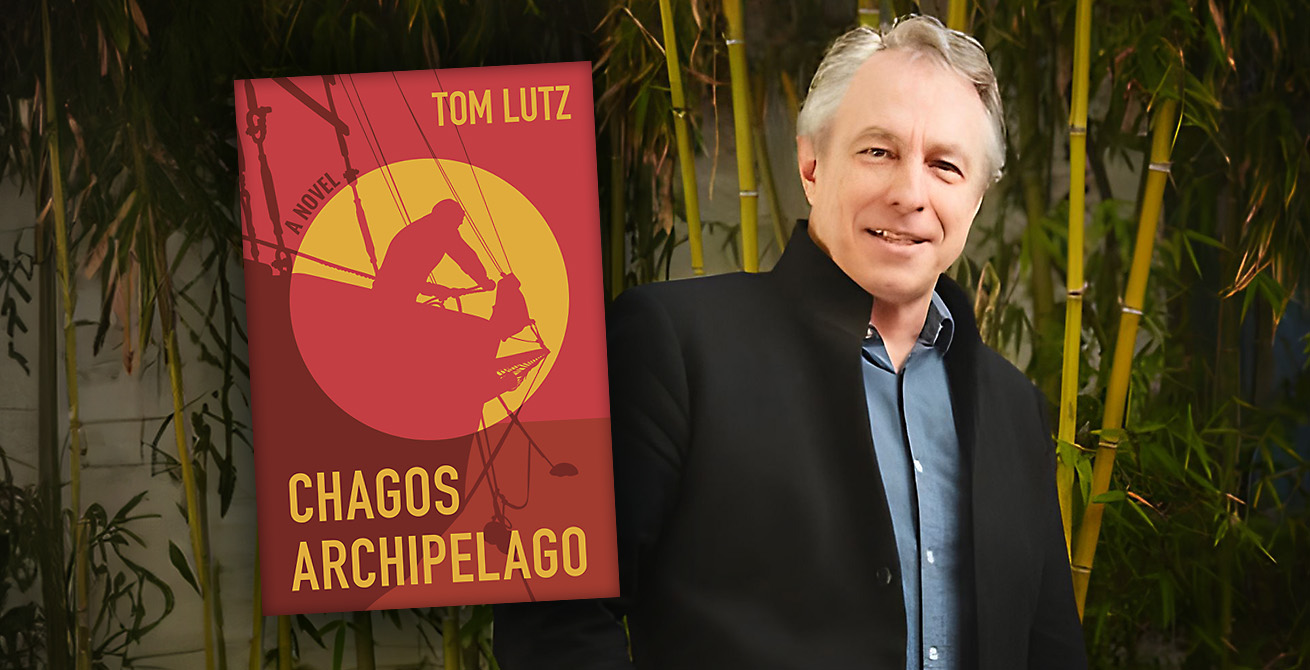
Tom Lutz is the author of many books on literature and culture, as well as several books of travel writing and two novels. He taught, formerly, at UC Riverside, the University of Iowa, CalArts, the University of Copenhagen, and Stanford. He now lives in the French countryside with his wife, the writer and critic Laurie Winer, and their two expatriate cats. His latest novel is Chagos Archipelago and he recently talked about it with Daryl Maxwell for the LAPL Blog.
What was your inspiration for Born Slippy?
I had a young man who worked for me back in the 1980s, when I was building houses and doing remodeling, and he told fascinating stories. In the years that followed, he stayed in touch and lived a quite wild life, not unsimilar to that of Dmitry, and could tell a very good story. He started to turn into a character in my head and became the nucleus of the book. I originally thought of Frank as a Nick Caraway-like figure, and Dmitry as the Gatsby. But over time, Frank's role grew, and Dmitry became the villain. Needless to say, once all the alchemical processes of fiction-writing took over, Dmitry became less and less like his real-world model, or at least he became an exaggerated version. The real person never killed anyone (that I know of…)
Did you know when you finished Born Slippy you wanted to write another book with Frank? What was your inspiration for Chagos Archipelago?
It definitely occurred to me as I was finishing, and so I was careful not to kill off anyone who I might want to bring back. Part of the inspiration for Chagos was a visit I made to the Indian Island of Mauritius, where a writer named Ariel Saramundi first told me about the archipelago's history and the US military base there.
Are Frank, Dmitri, Monica, Alain, Skye, or any of the other characters in the novels inspired by or based on specific individuals?
Yes, they all are—I find it helpful to imagine someone I know as I get started, to keep them grounded in a firm reality. But then, of course, they morph into someone else entirely, and the original is left behind. In early drafts, I used their model's real names, but as they changed, I renamed them. Dmitry, I explained. It would be unkind to say who the assassin was based on, I think, but Skye was originally based on a friend who died young from ALS, although she is now unrecognizable even by her closest friends, and Alain on a young man I knew in Madagascar. Frank shares some biographical details with me, and perhaps a certain Candide-like inability to see what is happening around him….
How did the novels evolve and change as you all wrote and revised them? Are there any characters or scenes that were lost in the process that you wish had made it to the published version?
I began my writing life as a literary critic and historian (well, that's not accurate, because I wrote a few stories and tried to write a novel in my 20s, but did not get very far. I went to graduate school in literature with the idea that I would get a day job as a professor to support my novel-writing. Then, cut to many, many years later, I finally returned to fiction.) Anyway, as a scholar, I clocked many writers talking about the way their characters would take over the novel and start writing themselves, as it were. I was never sure whether to believe that or not, but as I was writing these books, the characters really did take on a life of their own, and they would sometimes say something that just cracked me up—I'd be typing and laugh out loud, happily surprised by what they were saying.
I very rarely changed large sections of the text or excised scenes. I did, with the first book, write it in first person, change to third, then change it back to first, and finally back to third. And as I started to think of a possible sequel—for both books—I let a few characters live who had been killed off in earlier drafts.
Your biography says that you are Professor Emeritus of the Department of Creative Writing at UC Riverside. Does your work teaching writing inform or influence your work as a writer? If so, how?
I think that I was stymied for a long time, as a fiction writer, because of my literary study. When I sat down to write fiction, Henry James and Patricia Highsmith were looking over my shoulder and smirking. While teaching, I saw quite a bit of truly terrible student writing and decided, okay, I'm happy to be in the middle of the pack—I can write better than most people on earth, and I don't have to be as good, much less better than the best. That kind of thinking got me started, but once I was underway with the first novel, I found myself having so much fun that I accidentally, as a byproduct of the pleasure of being lost in that process, forgot to worry.
You were also the founding editor-in-chief and publisher of the Los Angeles Review of Books. You were also the founder of The LARB Radio Hour, The LARB Quarterly Journal, The LARB Publishing Workshop, and LARB Books. Can you tell us a bit about how you became involved in, and your work on, LARB?
After two decades as a scholar, I got a job in a creative writing department (at CalArts, then UCR) and worked running programs—I worked as a director of one MFA program, got another one started, then became chair of the department, just because at the time there was nobody else to do it—and it turned out it made me a bit of a unicorn, a creative writer who could also do administration. This led to some job offers elsewhere, which led to a very nice retention offer. I ended up as a Distinguished Professor, as you said, and thus had arrived at the top of the ladder. At that point, I felt immense gratitude for my good luck and decided I needed to do some serious community service in response. It happened to be when all the Sunday supplement book reviews were folding as newspapers found themselves retrenching, and I saw that there was a need to replace that part of the literary conversation with something new. Thus L.A. Review of Books. The others were natural outgrowths of that venture—it was a crazy decade for me, teaching, chairing the department, working 60 hours a week to get LARB off the ground and keep it in the air—and I think that is why the writing seemed less and less like work and more and more like pleasure, like me-time.
You are also the Director of UCR's Writers' Week, the longest-running, free literary event in California. Can you tell us a bit about your involvement with this?
Writers Week had always been a very small operation, a half dozen or so writers that were usually friends of the directors who had come before me. In part because I was running LARB at the same time, I was in contact with many writers across the country and the globe, and with publishers as well, and so it grew and grew. We also started an annual LARB/UCR Lifetime Achievement Award (given to Maxine Hong Kingston, John Rechy, Margaret Atwood, Ngugi wa Thiong'o , Percival Everett, Juan Felipe Herrera, and others) and the winners would be the headliners. Then my colleague Allison Hedge Coke got involved, and she is a fund-raising wizard and supreme connector, so it grew to 30 writers a year. It now seems to have regained a more reasonable size since we two maniacs are no longer in control…
Your biography says that you currently live in St.-Chamassy, France. What drew you there from Southern California? Do you have any favorite places? A hidden gem that someone visiting the area should not miss, but would only learn about from a resident?
We (my wife and fellow writer Laurie Winer and myself) spent a sabbatical year wandering the globe (as I wrote Chagos Archipelago and 1925: A Literary Encyclopedia) looking for where we would live after I retired. We wanted a new chapter, a new set of experiences and challenges and pleasures, and when we got to this place, it felt right. Few people know that this is where Josephine Baker, the African American dancer and singer who was the sensation of Paris in 1925, bought a castle and raised her "rainbow family." It is now a quite nice museum of her life and work.
If Born Slippy and/or Chagos Archipelago were going to be adapted in a film or series, who would your dream cast be?
This is a tough one—they are such real people to me… But Frank: a young Brad Pitt, more in his Coen brothers’ Burn After Reading mode than his rugged hero persona; Mónica, a young Penelope Cruz; Alain, a young Michael B. Jordan; Skye, a young Cameron Diaz; Dmitry, a young Jude Law. So I guess it would have to be made 15 years ago and have a very large budget...
You've written works of fiction and non-fiction, along with critical essays on literature, culture, politics, the arts, and travel. Is there a format that you prefer over the others? A topic you prefer to explore in your writing?
I love all of it. For a while, I alternated between academic writing and general market writing, then between fiction and nonfiction. And I always work on two books at the same time, so that if I stop enjoying one, for whatever reason, I hop over to the other. I'm a bit of a book slut, I guess, I love them all.
Is there something you haven't done yet but are hoping to have the opportunity to try?
I am retired, so I can truly do whatever I want, minute by minute. So I am doing it! I've built a music studio in the barn, I'm playing in the local blues scene, I'm writing, traveling, eating the best food in the world, and drinking the best wine. As Bob Dylan wrote, "I can't help it, if I'm lucky..."
What's currently on your nightstand?
I've been reading Martin Walker, a local policier writer, whose chief of police character is based in the town next to ours, and I just finished The Bookstore, by a novelist I recently met, Deborah Meyler. I just listened to half dozen Trollope novels and I’m now listening to Moby Dick.
Can you name your top five favorite or most influential authors?
No, it would be easier to name my top 100...
What was your favorite book when you were a child?
The Black Stallion, the complete Sherlock Holmes, The Columbia Viking Desk Encyclopedia, and Harriet the Spy.
Was there a book you felt you needed to hide from your parents?
That’s private...
Is there a book you've faked reading?
I still haven’t finished Proust.
Can you name a book you've bought for the cover?
The Cloud of Unknowing, by an anonymous 14th-century monk.
Is there a book that changed your life?
Again, easier to list a hundred than name one.
Can you name a book for which you are an evangelist (and you think everyone should read)?
Same answer!
Is there a book you would most want to read again for the first time?
Because I taught literature, I got to (had to) reread books many times, and in a way, they are always new. As in the case of Moby Dick, I continue to revisit them, and each time it feels like a first time.
What is the last piece of art (music, movies, TV, more traditional art forms) that you've experienced or that has impacted you?
I just watched a performance of Prince playing "While My Guitar Gently Weeps" at an awards show with an all-star band, and that led me down a rabbit hole of Prince performances. What a stupendously talented artist!
What is your idea of THE perfect day (where you could go anywhere/meet with anyone)?
I would love to jam with Prince.
What is the question that you're always hoping you'll be asked, but never have been?
What is to be done?
What is your answer?
Kindnesses.
What are you working on now?
A third novel in the series, let's call it Still Slippy, and a book called The Cloud of Unknowing, which, like my book Aimlessness, is a philosophical essay.