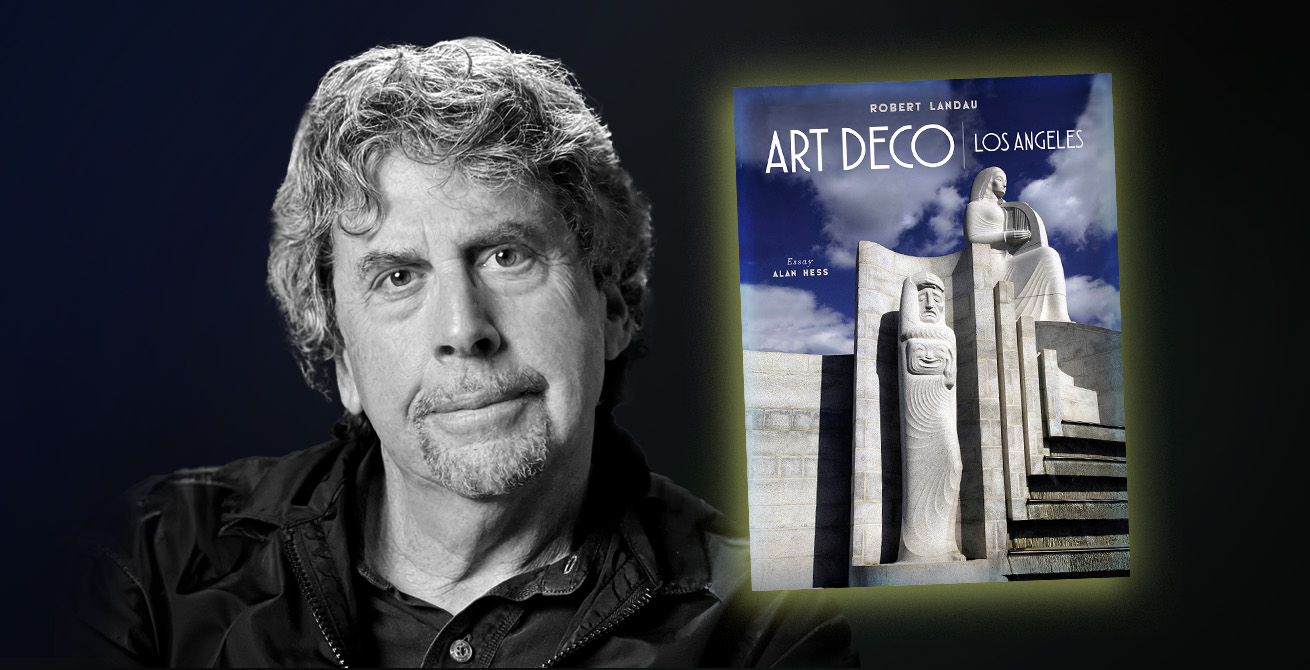
Robert Landau is a photographer and author of several visual books, including the internationally acclaimed Rock 'N' Roll Billboards of the Sunset Strip. His photographs have been shown all over the world. A native Angeleno, his take on L.A. is distinctively passionate and journalistic. His latest book is Art Deco: Los Angeles and he recently talked about it with Daryl Maxwell for the LAPL Blog.
What was your inspiration for Art Deco: Los Angeles?
I have been photographing L.A. for many years now. Growing up here, and then having the opportunity to travel the world through my work as a professional photographer, I developed a sense that Los Angeles was unique and didn't look like other cities. I seemed to be drawn to seeking out one-of-a-kind elements in the environment- things that seem like they probably wouldn't exist anywhere else.
In the 1970s I was living just above the Sunset Strip and it was the hand-painted billboards depicting iconic Classic Rock stars on the boulevard that caught my eye, and became the subject of my earlier book from Angel City Press titled Rock 'N' Roll Billboards of the Sunset Strip. Those billboards were posted briefly and then routinely painted over and replaced almost as quickly as they had appeared. After that, I focused for several decades on photographing other aspects of the L.A. environment, including storefronts, buildings, statues, signage, and the like. It was only in retrospect, going through my archives about a year ago, that I realized, somewhat to my own surprise, that Art Deco had played such a huge role in my work.
The two books are similar in that both examine subjects that are artistic and reflect aspects of L.A. culture and the times that produced them. They are different because the billboards were up for about a month before vanishing, and the majority of Art Deco buildings in the book are still there some 100 years later.
At the beginning of the Afterward, you state quite clearly that you are an urban landscape photographer and that you do not have a professional background in architecture. But I'm guessing you may have done some research or simply learned a bit about Art Deco in the process of working on this book. What is the most interesting or surprising thing that you learned while working on Art Deco: Los Angeles?
Yes—I have now home-schooled myself a bit on this subject, and I've learned a great deal in conversation with Alan Hess, but still, the most surprising thing to me is just how many amazing structures from the period, primarily the 1920s, 30s and 40s, that are represented in my book, have survived! This is no doubt a testament to the longevity of their visual appeal and ongoing relevance. A few of the great ones got away, I think of the Pan Pacific Auditorium, where I attended events like Auto Expos as a teen, and which I photographed just before it went up in flames.
How was Alan Hess selected to provide the historical information on Los Angeles' relationship with Art Deco? Had you worked with him before, or was there some other factor?
Alan and I are roughly the same age and seem to share a similar geographic background and a mutual fascination for modern and contemporary Southern California culture. Our lives and publishing interests seemed to have crossed paths many times over the years without intersecting, and I already had a shelf full of books he had written or contributed to. When we realized this book would need an informed written architectural perspective as a foreword, Angel City Press editorial director Terri Accomazzo suggested Alan, with whom she had previously worked, and my answer was—Bingo! Fortunately for us, this was a subject that Alan had been thinking about and was eager to write about.
Not only is Alan thoughtful and delightful to work with—I have learned a great deal from him. Getting back to your last question about surprising lessons learned working on this book: among the things I learned from Alan's essay is how, for a period of time, Art Deco fell out of favor and was scorned by critics espousing modernism, before being re-evaluated and appreciated again.
You also describe how, after decades of taking photos in/of/around Los Angeles, you amassed a sizable collection of Art Deco images. How large is that part of your work? What was your process for selecting the photos for the book? How many of your photos did you decide to include, and how many did you decide to leave out?
I began shooting images of Los Angeles in the late 1960s, and I was a late convert to digital photography, so the vast majority of photographs I've made in my lifetime are on film; either black and white negatives or color transparencies. When Terri first suggested the idea to me, based on a few framed prints she had seen in my kitchen, she asked if I had many more on the subject. I didn't know, but told her I would look.
Going through that archive takes time, but once I began, it wasn't long before I realized that there were thousands of related images. The problem was that they weren't always filed where it was obvious. For example, there is a photo in the book of Moxley's Dog and Cat Hospital on Highland Ave. that I shot in the late 1970s. The building from 1930 featured a beautiful sign of a large dog standing sentry on its roof, and that slide was in a file titled simply "Signs." Many others were filed by their location, like "Downtown."
At the direction of Frans Evenhuis, who designed this book as well as several others we've worked on together including the Rock 'N' Roll Billboards, we began the selection process by making postcard-sized print-outs of all the photos under consideration—which at that point was maybe six or seven hundred—and laid them out in every possible open space in his studio. Little by little, as we were working on other things and over a period of weeks, we began to group the similar ones together while slowly starting to eliminate the lesser and repetitive ones.
We had a target of 208 pages, but we didn't want to cram in as many as possible. We wanted to give these images room on the page to breathe, so in the end, there are somewhere in the range of 120 photos in the book. Many of the images contain great details, so we decided that those would be either full page for the verticals, or double page spreads for many of the horizontals, in order to really highlight that aspect. Our selection process was based on rating the quality or rarity of the subject, the quality of the photograph, and then the relevance of the image to the overall design.
Over the years, I've returned repeatedly to many of these buildings, usually at different times of day with different light, and focusing on different angles or details. So, many of the locations are represented in the book with multiple images, while others I shot did not wind up making it in at all. There are always difficult decisions to be made, but in the end, we tried to choose what we thought were the strongest images that best fit our criteria.
What is it about Art Deco buildings that captures your eye when you are taking photos?
First of all, the originality- they just don't look like anything else in the landscape, as so many contemporary buildings do. Then it's a combination of the shapes, colors, materials, ornamentation, sometimes, occasional humor, and the overall energy they give off.
What are your favorite Art Deco buildings in Los Angeles, past or present?
As much as I like some of the lesser visited examples in the book, for instance Burbank City Hall, which looks nice on the outside, but is amazing on the interior with its Deco stairwell and Hugo Ballin murals—my first choice is still the Eastern Columbia Building. This blue and gold high-rise on Broadway in downtown L.A. is stunningly elegant and would stand out on any street anywhere.
If you could magically restore an Art Deco building, or buildings that have been lost, what would/they be?
I never got to see the Atlantic Richfield building in person, but viewing historic photos makes me wish I had. Since I have personal memories of being at the Pan Pacific Auditorium, and also because of where it was located, and the fact that it was almost saved and most likely would be serving a significant cultural function now, makes that one sting a bit more.
Do you know why Art Deco, after a century, is a style that continues to be popular, possibly more now than ever, with architects, artists, and the general public?
I don't think it's nostalgia—I think the art deco style is intrinsically cool, perpetually modern, and even potentially timeless. There's an element of fun and daring in its appeal.
Have you ever photographed any cities other than Los Angeles? If so, where and when?
Yes—Paris for one. I would go to visit my father there, who, after closing his gallery in Los Angeles (The Felix Landau Gallery), moved to Paris. I spent a great deal of time visiting in the 1980s and 90s. The earliest photographers I admired were French or Europeans living in Paris, like Eugene Atget, Andre Kertesz, Brassai and others. Their black and white images of the Paris street scene inspired me to look at the urban landscape as a source for making images. I began shooting L.A. in black and white before deciding that color was a key component of what made Los Angeles different from other cities.
Also, my wife is Turkish and has family in Istanbul, so I've spent a good bit of time there as well. These cities, compared to Los Angeles, are old if not ancient, which gives them a historical depth that I really appreciate. But they also make me appreciate what is new, different, and exciting about Los Angeles.
You also describe in your afterward how you focused for a number of years on the hand-painted billboards promoting rock albums on the Sunset Strip because of their spectacle and their ephemeral nature. You collected those photos in a book, Rock 'N' Roll Billboards of the Sunset Strip, in 2016. Can you tell us a bit about your photos and the book?
I may have touched on this earlier, but by chance, I was living a block from the Sunset Strip in the late 1960s and throughout the 1970s. This is the period where I was first getting into photography and looking to explore the L.A. street scene with my camera.
I would walk out the front door with my camera and head down to The Strip with my camera and there would be these ant-sized men installing, painting and touching up gigantic images of the Beatles and all the classic rock stars of that era whose music I was listening to. Based on cutting-edge album cover art, the best billboards then were all hand-painted with photo-realistic precision by trained craftsmen, then posted on the Sunset Strip for several weeks before being dismantled, whitewashed, and painted over with newer messages.
I realized that if I didn't take photos of the ones I liked best, they might be gone and replaced the next day, so I began documenting them whenever I could. This era lasted into the early 1980s and, more or less, ended when MTV arrived. Promotional dollars for music were diverted from arty billboards on the Strip to flashy videos on TV screens.
Do you have a favorite (or favorites) of the billboards you photographed?
What I liked about these billboards is that they were not really about selling records. Many record companies at that time were located on or near the Strip, and giving their top artists a billboard was a way of feeding egos and cementing relationships.
Quite often, these billboards would have no advertising copy and could be difficult to decipher except by insiders and fans.
An example of this is the billboard for the Rock Opera, Tommy by the band The Who. It appeared with no text and a giant photo-realist depiction of two chrome eyeballs on a color field at the heart of the Sunset Strip. After a few weeks, the name Tommy was added, and fans understood it was a record about a deaf, dumb, and blind pinball wizard.
Another favorite was the billboard for the Beatles, Abbey Road which is on the cover of the book. Again, no advertising copy, just a great visual with the band crossing Abbey Road and their recognizable and shaggy heads extending off the top of the frame into the blue California sky.
What's currently on your nightstand?
The book is Easy Riders, Raging Bulls.
What are you working on now?
I'm working on organizing a traveling exhibition of prints from Art Deco Los Angeles for museums and galleries.
