Interview With an Author: Terence Keel

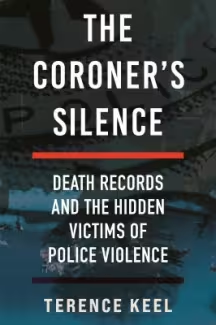
Terence Keel is a professor of human biology, society, and African American studies at UCLA. His latest book is The Coroner's Silence: Death Records and the Hidden Victims of Police Violence and he recently talked about it with Daryl Maxwell for the LAPL Blog.
What was your inspiration for The Coroner's Silence?
I am often asked this question, and usually I respond by saying it was the public murder of George Floyd. Which is true. But it was also the culmination of witnessing Floyd, Sandra Bland, Eric Garner, Breonna Taylor, Philando Castillo, Freddy Gray's death. Together, all of these cases helped me see clearly, for the first time, how state violence could erase someone's life but create the impression that the victim was responsible. Remember, Floyd's autopsy claimed that his preexisting heart condition instigated "cardiopulmonary arrest, complicating law enforcement subdual." Translation: Floyd had a bad heart that made it hard for police to arrest him so they used more force. If a medical examiner could write this despite millions around the world witnessing Floyd's public murder, then what about people who die at the hands of police in the shadows? Without cameras or witnesses? I wrote a book sharing what I discovered while searching for an answer to these questions. The problem is worse than you can imagine, and we have to catch up with communities fighting a crisis hiding in plain sight.
How long have you been researching police violence and occurrences of in-custody death? How long did it take you to write The Coroner's Silence?
I started research for this book in 2020. The writing began in 2023. But data gathering continued up until the end. It took five years to finish The Coroner's Silence.
What was the most interesting thing you've learned from your research? The most surprising or unexpected thing you've learned?
I learned that every day at least 5 people die at the hands of law enforcement, either during arrest or in jail. We will only learn the names of 3 of those people. This is because of laws that prevent disclosure of death records, increase policing, fail to collect data on state violence, and tear the social safety net.
I also learned in my lab that between 2000-2020 police killed at least 32,104 people during arrest. This is more than twice the number of all official executions in our nation's history, going back to 1608: 16,047. Finally, I learned that Black and Latino men are most likely to die during police encounters. However, white men make up the largest number of total victims of police violence. There are more white people in the United States than any other population. But we don't often make what should be an obvious connection: dying in police custody spares no one. This doesn't mean our criminal justice system isn't racist. It just means that more people are killed by police than we realize. And our death investigators are leaving the public vulnerable to lethal police violence when they are silent about the true costs of using force against civilians.
I've always been a fan of the television show Quincy, in which Jack Klugman portrays the titular character, a Los Angeles Coroner who seeks out the truth, no matter where his findings take him, to reveal the cause of death for the person that week. Any chance you're a fan of the show? Are there any real coroners within our system that seek to expose the truth about the deaths they are investigating?
I've spoken to a number of medical examiners and coroners who have told me off the record that they know this system is broken and that their work is compromised by the influence of police. I've also discovered cases of medical examiners rejecting the stories of police about the people they kill, classifying cases as homicides instead of an accident or natural death. When investigators classify cases as homicide, it gives families and communities more of a fighting chance at justice. This is because the official death records implies that the police willfully killed someone under their watch. But many investigators face intimidation from law enforcement when they do this. And they shared with me fears about speaking against police violence because they recognize they are disconnected from communities that might stand in solidarity with them. Our collective failure to pay attention to lives lost to police violence has a force multiplier effect: the less we care, the worse the system becomes.
Do you have a favorite fictional coroner (from books, television, or film)?
My favorite fictional forensic investigator is Dexter Morgan. His character provides a profound critique of coroners, law enforcement, and our comfort with using death to create justice. Dexter is a forensic investigator, an agent of the state, working for the Miami police department. He is also a serial killer that lives by a code: he disappears people he believes aren't worthy of cycling through our criminal justice system. Dexter manipulates data, facts, and forensic details that make jails, courts, and criminal trials unnecessary. He is constantly upending the justice system he works for—he cuts up his victims and hides the evidence. Dexter is judge, jury, and executor.
In the real world, medical examiners that cover for police also participate in the deaths they investigate. They do this by gathering evidence that favors law enforcement and then making the victims responsible. Dexter's ritual of forcing victims to see how their actions led to his saran wrapped death alter mirrors the justifications used by coroners who say past health history or behavior is the real reason people die in police custody. Like Dexter, medical examiners also dismember people on their dissection tables, cutting open rib cages to remove hearts and lungs, breaking open skulls to examine brains—sometimes they are not returned to the body. Death investigators perform medical and legal rituals designed to reveal the truth. But it is a bloody, violent one.
I think the dark brilliance of Dexter is the show's ability to expose something deep within us: sometimes we can't tell the difference between justice and violence.
You are the founding director of the BioCritical Studies Lab. Can you tell us a bit about your work with them and how you became involved?
UCLA Lab for BioCritical Studies explores the complex interactions between human biology and society. We are a team of researchers, graduate students, community organizers, journalists, and affiliated faculty working across multiple academic institutions. We are interested in how structural discrimination shortens the lives of vulnerable people. Within the lab is the Coroner's Report Project, where we have gathered and analyzed over 1000 autopsies of people who have lost their lives during arrest or while in jail. I founded the lab in 2020 and wanted to know how many more people died like "George Floyd." Soon after, I met Helen Jones of Dignity & Power Now, here in Los Angeles. Helen's son, John Horton, had been beaten to death inside Men's Central Jail, in downtown Los Angeles—his death was made to appear as if it were a suicide. Helen taught me and my lab how to read an autopsy for a story it does not want you to know—how to fill the coroner's silence with the truth.
You are also a professor of human biology, society, and African-American studies at UCLA. Does your work teaching inform or influence your work as a writer? If so, how?
I've taught the history of science and medicine at a public university for 14 years. What I've learned is that science education is crucial for democracy. The Coroner's Silence builds on my earlier work demonstrating how and why race has no basis in modern science and is instead a political and social concept for controlling populations and establishing racial hierarchies in our society. When death investigators weaponize the biology of police victims they are participating in the same tradition of racial science that use race to erase the social and political conditions creating illness, disease, and early death. As an educator, I think it is important that matters that have significant implications for how we see and treat each other in democracy be made accessible to people beyond the classroom.
Towards the end of The Coroner's Silence, you document/describe some steps that have been taken in California, Los Angeles specifically, to bring in-custody deaths out of the shadows. You also document your attempt to start similar efforts in Maryland. What would you like to see done in Los Angeles to further the efforts that have been started?
Several things. We know jails in Los Angeles are lethal. Men's Central Jail (MCJ) has been described by the ACLU as a medieval dungeon, and Attorney General Rob Bonta has filed a lawsuit against the County for violating the constitutional rights of the people inside. If we want to save lives, we have to stop nonviolent offenders from stepping into jail. We especially want people suffering from mental health conditions and substance abuse to be offered conditions of care, not punishment. In 2021, the Los Angeles County Board of Supervisors voted to close Men's Central Jail. It hasn't been. And every year since 2021, a new record has been set for deaths inside the county jail. So, the first thing that residents of the County want to see is MCJ closed.
Additionally, the County needs a third-party review system that analyzes every autopsy written for people who die in police custody. Right now, my lab has been working with community partners through our Coroner's Report Project. But the scale of the problem far exceeds our resources and people power.
What would you encourage anyone reading your book, or this interview, can do to further your efforts?
Follow and support the work of the JusticeLA Coalition and the social justice organization Dignity & Power Now! Both of these groups have been a real force for change, organizing the public and helping create and sustain alternatives to policing and incarceration, like the CareFirst program.
What's currently on your nightstand?
Sameer Pandya's Our Beautiful Boys, a brilliant and timely novel about the crisis of masculinity told through the stories of teenage boys whose lives change after an unfortunate tragedy.
Can you name your top five favorite or most influential authors?
Frederick Douglass, James Baldwin, Octavia Butler, Herbert Marcuse, June Jordan.
What was your favorite book when you were a child?
James and the Giant Peach by Roald Dahl.
Was there a book you felt you needed to hide from your parents?
Anything by Karl Marx. My parents were not vocal critics of capitalism; they also didn't like the idea of people who condemned religion.
Is there a book you've faked reading?
I've never read Fyodor Dostoevsky's Crime and Punishment and perhaps neither have you, but I bet we could carry a dinner conversation about it.
Can you name a book you've bought for the cover?
Raven Used Bookstore in Harvard Square carries hard to find philosophy, history, and poetry books. When I was a graduate student, they would occasionally have copies where the press house produced covers that were upside down, inverted, or had some other imperfection. I bought a few of them.
Is there a book that changed your life?
James Baldwin's Notes of a Native Son. To really understand it I had to read Richard Wright, Ralph Ellison, Lorraine Hansberry, Dostoevsky. It was a book that put into words so many things I had felt in my bones about being a Black person in America.
Can you name a book for which you are an evangelist (and you think everyone should read)?
Frederick Douglass, My Bondage and My Freedom.
Is there a book you would most want to read again for the first time?
I've read Franz Kafka every year for about a decade because I was chasing the feeling of wanting to see how much I had changed since the first time I had read it. In a way, I was trying to see the book like I did the first time I read it—but you just can't.
What is the last piece of art (music, movies, TV, more traditional art forms) that you've experienced or that has impacted you?
The Elizabeth Catlett exhibit at the National Gallery of Art (NGA) in Washington, D.C. It was a marvelous retrospective, and the first time a woman of color was given a major exhibition at the NGA.
What is your idea of THE perfect day (where you could go anywhere/meet with anyone)?
Finding a small and quiet bungalow on the beach in Tulum with my wife.
What is the question that you're always hoping you'll be asked, but never have been?
What do I imagine death will be like?
What is your answer?
I'm not sure death is something we can know or experience. Thinking and perception depend on external and internal stimuli that we can only register while alive. It begs the question if we will know when we are dead. You can't exactly be aware of the absence thinking. Hume wrote some famous essays about this. It is a fascinating thing to wrap your mind around.
What are you working on now?
I am focused right now in getting the ideas from The Coroner's Silence out into the world. I believe our death investigation system can change, but it's going to require us to create something else. We have to see what is broken to design something better.