Interview With an Author: Theodora Goss

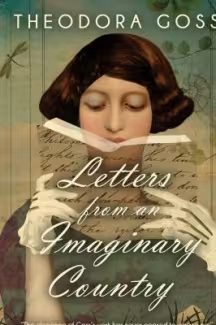
World Fantasy, Locus, and Mythopoeic Award–winning author and poet Theodora Goss was born in Hungary and spent her childhood in various European countries before her family moved to the United States. Goss is the author of the novel trilogy The Strange Case of the Alchemist’s Daughter, European Travel for the Monstrous Gentlewoman, and The Sinister Mystery of the Mesmerizing Girl. Her short story and poetry collections include In the Forest of Forgetting, Songs for Ophelia, and Snow White Learns Witchcraft. She has been a finalist for the Nebula, Crawford, and Shirley Jackson Awards as well as on the Tiptree Award Honor List. Goss's work has also been translated into fifteen languages. Currently, she teaches at several creative writing workshops and in written, oral, and visual rhetoric at Boston University. Her latest book is Letters From an Imaginary Country and she recently talked with Daryl Maxwell for the LAPL Blog.
What was your inspiration for Letters From an Imaginary Country?
There are two answers to this question, because "Letters from an Imaginary Country" is both the title of the collection and the title of a short story in the collection. The inspiration for the short story was actually the collection itself. I decided to call the collection Letters from an Imaginary Country, and then I thought, why don't I also write a story with that title? And the story is literally a series of letters to, from, or about the imaginary country of Thüle. Together, I hope those letters create a coherent narrative—or maybe an incoherent narrative that the reader has to put together like a puzzle. As for the inspiration for the collection, I pulled together the stories I had written, which were not just fiction but also metafiction. I think all the stories in this collection are in some way about telling stories and reflections on storytelling. At least that was the underlying idea. In a sense, they are all letters from imaginary countries.
What was your process for putting together this collection? How did you select the stories you would include out of all of the short stories that you've written?
I chose the ones that had metafictional elements, but that was not particularly difficult. I think that's the kind of story I naturally tend to write. In addition to being a writer, I'm also a university lecturer—I have a PhD in English Literature. So I tend to spend a lot of time thinking about stories from the perspective of an outsider. Writers live inside the story—academics look at stories from the outside. Being both, I seem to do both, although not always at the same time. I had just recently published a collection of retold fairytales called Snow White Learn Witchcraft, and then a large collection of fantasy stories, called The Collected Enchantments. I wanted this collection to be, at least in part, a reflection on fantasy and storytelling. And to be fantastical in various ways—in terms of structure as well as content.
Did you have any "aha" moments where you rediscovered a story that you knew had to be included? Were there any that you planned to include, but ultimately decided wouldn't be?
There was one story I planned to include that my very smart publisher decided did not quite fit. Instead, he said, "write a new monster story," so I did—that's The Secret Diary of Mina Harker. Since it's a monster story, it grew monstrously long—it's the longest story in the collection.
How did Jo Walton come to provide the introduction for this collection?
I very strongly suggested that the publisher ask her, and she very graciously accepted! I really wanted her to write the introduction because she has such a deep knowledge of fantasy and the literary tradition of the fantastic—I knew she would understand what I was trying to do and where I had (hopefully, maybe) succeeded. And of course I have enormous respect for her as both a writer and a literary critic—I love reading her reviews.
Many of the stories in this collection are epistolary (written in the form of journals, diaries, or letters) in style. There are so many famous novels and short stories that use this form (Dracula, Flowers for Algernon, 84 Charing Cross Road, The Perks of Being a Wallflower, just to name a few). Do you have any favorite epistolary novels or short stories?
I like stories that are told in unusual ways, so not just epistolary—there are lots of ways to fragment and mess with story structure. Dracula was a significant inspiration for all of my monster stories. I helped edit an academic version and became convinced that stories about monsters should be structurally monstrous as well. Other examples would be Frankenstein and Carmilla, neither of which are straightforward narratives. But I like anything that plays around with narrative structure and that is self-aware in some way—that is, aware of itself as narrative. A.S. Byatt’s Possession would be an example; so would Margaret Atwood’s The Penelopiad. I also absolutely adore Susanna Clarke’s Jonathan Strange and Mr. Norrell. It's not epistolary, but it's filled with footnotes. I love footnotes! There are a bunch in "The Secret Diary of Mina Harker."
A least favorite? (I realize that you may not want to address this one, and if that is the case, please don't. But I also realize it might be so bad that it could be fun to answer.)?
I don't think I have any least favorite stories? If I don't like something, I tend not to continue reading it. The novel I actually finished that I probably liked least was Walter Pater's Marius the Epicurean. I don't remember why I had to read it, and I actually love Pater's essays, but that novel just dragged.
You've written short stories, novels, and poetry. Is there a format that you prefer over the others?
No, I love them all—essays as well. They all give me pleasure in different ways. They let me do different things with language.
Is there something you haven't done yet but are hoping to have the opportunity to try?
I want to write a children's book. I've already got notes for one—it's just a matter of finding the time to sit down and write it!
You were born in Hungary, and you regularly visit (and possibly live part-time) in Budapest. You also live in Boston and teach at Boston University. Do you have any favorite places or locations in Budapest and/or Boston? Hidden gems that someone visiting should not miss, but would only learn about from a resident?
In Boston, it's Hall's Pond Sanctuary, which is a small nature preserve in Brookline. Most people don't even know it's there, but it has a pond, wetlands, and woods—there are so many birds, from catbirds to grackles to mallard ducks. There is a great blue heron that lives near the pond, and geese nest on a small island every year. In Budapest it’s the ELTE Füvészkert. ELTE is Eötvös Loránd University, and the Füvészkert is a botanical garden. Like Hall's Pond, it's a green space in the middle of the city. Since I mostly live in cities, I search out these sorts of green spaces. When I am in them, I always feel as though I can breathe more easily.
Is there a theme/idea for another collection that you would like to pursue or wish you had pursued in the past (and can talk about)?
I would love to write the further adventures of the Athena Club as a series of short stories!
The first piece of your work I read was "Mad Scientist's Daughter," when it was included in John Joseph Adams' anthology The Mad Scientist's Guide to World Domination. You went on to expand that story into The Extraordinary Adventures of the Athena Club trilogy. Is there any chance you'll be allowing readers to join The Athena Club on another adventure in the future?
I hope so! There are all sorts of things about their futures that I would like to reveal.
What’s currently on your nightstand?
Reading: A Very Short Introduction by Belinda Jack (for work), Things That Are: Essays by Amy Leach (which I haven’t started yet, but it was blurbed by David Abram, Tales of the Seal People: Scottish Folktales by Duncan Williamson, The Forgotten Beasts of Eld by Patricia McKillip (which I last read as a teenager), Understanding a Photograph by John Berger (for work), The Yearsk by Annie Ernaux, The Dawn of Everything by David Graeber and David Wengrow (also for work), and What Shall I Wear: The What, Where, When, and How Much of Fashion by Claire McCardell (which I already read, but haven’t put back on a bookshelf yet). My nightstand tends to have a large pile of books I want to get to.
What is the last piece of art (music, movies, tv, more traditional artforms) that you’ve experienced or that has impacted you?
I'm currently watching Ludwig, a British detective series, which is very, very good. But in August, I went to Vienna and wandered around the museums looking at Klimts, so that had a major impact, especially his gorgeous landscapes. There really is no last piece, because every single thing we see impacts us, at least if we pay attention, so we are being impacted on a daily basis. Part of the richness (and maybe also part of the problem) of living in our modern society is that we see art as soon as we go on social media. At least, the Facebook, Instagram, and Substack algorithms feed me a continuous stream of art and poetry, which is actually rather wonderful.
What is the question that you're always hoping you'll be asked, but never have been?
Why do you write short stories, when they get so little attention generally? After all, what everyone seems to want is novels...
What is your answer?
I love writing short stories. There are all sorts of ideas that want to be short stories, and writing at a shorter length allows me to explore them in really satisfying ways. Plus, trying something at shorter length allows me to see whether there is any more there—whether the short story might lead to a novel. The Athena Club books started with "The Mad Scientist's Daughter," which you mentioned above—that's the first story in this collection. I wrote an entire trilogy as a sort of prequel to that short story! I ended up traveling to London, Vienna, and Budapest to do research, so one short story turned into a great adventure, for me as well as for my characters. Also, there is something deeply satisfying about the structure of a short story. Novels are much harder to structure, and they tend to sprawl all over the place—that's part of the glory of a novel. But a short story can be like a poem. You can really focus in on the language and its possibilities.
What are you working on now?
A novel! It also started as a short story called "Pip and the Fairies." We’ll see how it works at longer length. But it’s fun to experiment with various formats. I really just love to mess around with words—I’m like a cook in the kitchen, getting flour on my nose. And maybe I’ll end up with a cake... we’ll see!