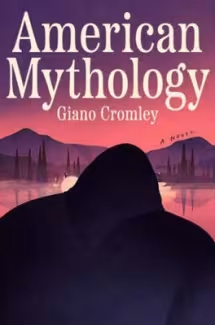
Interview With an Author: Giano Cromley

Born and raised in Montana, Giano Cromley is the author of two young adult novels and a collection of short stories. He is a recipient of an Artist Fellowship from the Illinois Arts Council and was a BookEnds Fellow with Stony Brook University. He is an amateur woodworker, a certified wildlife tracker, and an English professor at Kennedy-King College, where he is chair of the Communications Department. He lives on the Southside of Chicago with his wife and two dogs. His latest novel is American Mythology and he recently talked about it with Daryl Maxwell for the LAPL Blog.
What was your inspiration for American Mythology?
I’ve been fascinated by Bigfoot ever since, as a child, I saw the episode of In Search Of that dealt with the phenomenon. From then on, I knew I wanted to write a book about it. But every attempt I made felt off. After numerous false starts, I began to wonder if Bigfoot would end up being my white whale, always eluding me, just beyond my grasp. Then I struck upon my two protagonists, Jute and Vergil, and it was their relationship that helped me unlock the Bigfoot story I’d always wanted to tell.
Are Jute, Vergil, Rye, Vicky, Dr. Marcus Bernard, or any of the other characters in the novel, inspired by or based on specific individuals?
Dr. Marcus Bernard is very loosely based on a well-known Bigfoot researcher named Dr. Jeff Meldrum, who—like Bernard—is a professor at Idaho State University. It should be noted, however, that while my character Bernard is a morally dubious individual, I have it on good authority that Meldrum is a wholly kind and genuine person.
Additionally, my protagonists, Jute and Vergil, are based on two men featured in a documentary directed by Jay Delaney called Not Your Typical Bigfoot Movie. That film documents the lives of two down-and-out Bigfoot hunters, Wayne Burton and Dallas Gilbert, as they struggle to find Bigfoot and keep their friendship afloat. They were the initial inspiration for Jute and Vergil.
How did the novel evolve and change as you wrote and revised it? Are there any characters or scenes that were lost in the process that you wish had made it to the published version?
I did a plagiarism check between the first draft of this novel and the final draft, and it turned out that the two versions had an .8% similarity index. For all the non-English teacher folks out there, that means the two versions were 99.2% different—basically, only a phrase here or there survived from the original draft. During the process of revisions, I eliminated entire characters and subplots. And I’ve had about four different endings. In fact, some of my favorite pieces of writing I did for this project are no longer in the book because, at a certain point, I realized they no longer fit or made sense with the story I was trying to tell.
Your biography says that you were born and raised in Montana. Is Basic, Montana, the town where Jute, Vergil, and Rye are from, based on any real place(s) in Montana?
Basic, Montana, is a composite of several different Montana towns. Geographically, I imagined it in the spot where the ghost town of Elkhorn, Montana, now sits. Much of the mining history of Basic was also drawn from Elkhorn’s past. Unlike Elkhorn, however, Basic still has residents and an existing economic structure, so in that sense, it’s a lot like other Montana mining towns such as Butte and Anaconda. There is a poem by Richard Hugo called "Degrees of Gray in Philipsburg" which I think best approximates the feeling people in these types of towns have. They are dug in, and they’re not going anywhere, no matter what. That was the feeling I tried to replicate as I rendered Basic.
Same question regarding Ramsey Lake. Is it inspired by or based on a real location?
As a child, my family would go on annual backcountry camping trips in the Beartooth Mountains. One of our frequent destinations was Rock Island Lake, which, for my money, was prettier than almost any other place I’ve seen on the planet. It should be noted, however, that Rock Island Lake has—as far as I know—none of the mystical properties that Ramsey Lake has.
Do you have any favorite places in Montana? A hidden gem that someone visiting should not miss, but would only learn about from a resident?
One of the reasons I chose to set this story in the Elkhorn Mountains is that they’re an underappreciated mountain range. They don’t get the hype that a lot of the others get, such as the Beartooths, the Crazies, or the Bitterroots. Yet I think they’re just as lovely and majestic as any of those. So they would qualify as my hidden gem, as much as any mountain can be considered hidden.
Your biography also says that you’re the recipient of an Artist Fellowship from the Illinois Arts Council and that you were a BookEnds Fellow with Stony Brook University. Can you tell us a bit about both of these and your experiences with them?
The Artist Fellowship from the Illinois Arts Council was an almost magical event. I applied for it with a short story I’d written. I was informed a couple of months later that I’d won. And shortly thereafter, I got a check that enabled me to not teach summer school for a year and focus only on writing. No strings attached! How often does that ever happen for any artist? It was during that time that I began work on my first novel, The Last Good Halloween.
The BookEnds Fellowship was an utterly transformative experience. It’s a year-long novel incubator in which I was encouraged to see the first draft of American Mythology in ways I’d never considered. For the first half of the year, I worked with a group of two other writers as we helped each other on our manuscripts in order to do a complete revision. For the second half of the year, I was lucky enough to work with the amazing writer Karen Bender, who mentored me through a second complete revision. When I was done with the year, I’d taken a 144,000-word beast of a manuscript and transformed it into a much sharper 84,000-word novel that would eventually get sold to Doubleday. That would not have been possible without the BookEnds Fellowship.
How familiar were you with Bigfoot lore, sightings, and investigations prior to writing American Mythology? Did you have to do a bit of research? If so, how long did it take you to do the research and write your novel?
I’ve been reading books on Bigfoot for as long as I can remember. Once I started writing this novel in earnest, however, I began researching more methodically. I read hundreds (maybe thousands) of eyewitness encounters, and I’ve listened to enormous numbers of podcasts as well. Beyond that, I read a lot of books on Native American mythology, world mythology, and comparative religion. I wanted to understand how our idea of Bigfoot might fit into larger concepts of mythology and religion. And I must say, this was the most fun I’ve ever had doing research.
What was the most interesting or surprising thing that you learned during your research?
The Epic of Gilgamesh, one of the earliest recorded human stories, has what could best be described as a Bigfoot-type creature in it, called Enkidu. So I feel like American Mythology is in some fine literary company.
If/when American Mythology is adapted to a film or series, who would your dream cast be?
I’d be happy for pretty much anyone to play these roles, as long as they understood the story and what I’m trying to do with it. However, I think Woody Harrelson could be a good fit for Vergil or Dr. Bernard. And I always envisioned David Harbour playing the Jute character.
Are you a believer or a skeptic regarding Bigfoot? Have you ever experienced an encounter?
I believe there is something undiscovered lurking in the forests of North America. To me, there are too many eyewitness accounts to dismiss the possibility out of hand. I know many, possibly even the majority, might be misidentifications or hoaxes. But if even one of them is real, then it’s time to rewrite both the history and science books.
However, the incident that turned me into a true Bigfoot believer occurred in 2014 on a late summer night in Western Michigan. My wife and I had been staying in a cabin bordering the Manistee National Forest. Our last night there, we sat out back with our dogs as the fire in the firepit burned down to embers. A coyote pack was yipping nearby. The forest around us had taken on an impenetrable feeling.
Then, in the distance, we heard something different—a yell but also a howl, human but not-human. It was a soul-jangling sound, unlike anything I’d ever heard during a lifetime spent outdoors. As the first call ended, a second call picked up from the opposite direction and lasted a good ten seconds. This was immediately followed by a coyote screeching in acute distress, then a series of low, guttural sounds. That was when our Great Pyrenees, who’d been quietly sleeping by the fire all night, suddenly began snarling and lunging toward the tree line. Pyrs are known to have a highly calibrated aggression threshold. Differentiating between real danger and a false alarm is hard-wired into their DNA. I’d never seen him behave like that before or since.
I’ve run through a checklist of all the creatures known to reside in the forests of Michigan. I’ve listened to recordings of their vocalizations, and nothing captures the sound we heard that night so much as the Ohio Howl, one of the most well-documented Bigfoot recordings in existence. I know this incident falls far short of the burden of proof most people require for belief. But they weren’t there. They didn’t hear that unearthly sound or feel it chill their bones to the marrow. If they had been, they’d probably feel differently. For my part, I’ve been on a personal quest for Bigfoot ever since.
Are there other Cryptids (Nessie, Mothman, Jackalopes, Chupacabra, etc... ) that you hope are, ultimately, real, or do you believe they are also elaborate hoaxes?
Personally, I’m a huge fan of Mothman. In fact, there have been reports that he’s been spotted in the Chicago area, which would make him a local cryptid for me. So I’m always on the lookout.
As for whether they’re real or not, I can’t say. But new species of creatures are being found every day, and there’s still a lot of the world that hasn’t been explored. Isn’t it more fun to think those mysteries abound?
What’s currently on your nightstand?
Right now, I’m reading my friend Ben Tanzer’s latest book After Hours: Scorsese, Grief and the Grammar of Cinema. It’s a lovely meditation on Scorsese’s often overlooked classic, After Hours, and the ways it’s impacted Ben’s artistic and personal life. I highly recommend it.
Can you name your top five favorite or most influential authors?
Some of the authors whose books have had the greatest impact on me are: Richard Russo, Richard Ford, and John Irving. I had the tremendous fortune to study with Joy Williams, whose writing is a force of nature. And I got to see Tobias Wolff do a reading when I was in college, and I have ever since been trying to conjure the magic he does in his short stories.
What was your favorite book when you were a child?
My favorite book as a child was Mystery in the Night Woods, by John Peterson. It tells the story of two old friends, Flying Squirrel and Bat. Flying Squirrel is accused of kidnapping Miss Owl and has to clear his name. I got it from a book sale at the Billings Public Library, and I have read it more times than I can count. Several years ago, I picked up a copy from eBay, and I’m happy to report it still holds up!
Was there a book you felt you needed to hide from your parents?
My parents always encouraged me to read, no matter the book. I can still remember my mother coming home from the bookstore and giving me a copy of the newest buzz-worthy book that had just come out: Less Than Zero by Brett Easton Ellis. She didn’t realize that the themes in it might be a little too mature for my 12-year-old brain, but it wound up being a formative book for me.
Is there a book you've faked reading?
I’m a little self-conscious about not being well-read enough, so I’ll often nod as if I understand what people are talking about when they mention a book I feel like I should be familiar with. One book I’m not ashamed to admit I haven’t finished is The Recognitions, by William Gaddis, which I was supposed to read for post-modern literature class. I’m sure it’s brilliant, but I could not fight my way through it.
Can you name a book you've bought for the cover?
I’m certain it was the cover of Mystery in the Night Woods that first drew me to that book. Honestly, any book with anthropomorphic animals on the cover gets a strong yes from me.
Is there a book that changed your life?
Almost every book I read changes my life in some form or fashion. But I remember very clearly reading The Sun Also Rises by Ernest Hemingway and feeling like my whole life trajectory had changed. It was one of the books that first made me want to be a writer.
Can you name a book for which you are an evangelist (and you think everyone should read)?
Straight Man by Richard Russo is a book I often recommend to people. To me, it’s the perfect blend of humor and heart. I’ve never met anyone who read it and didn’t like it.
Is there a book you would most want to read again for the first time?
I love Billy Lynn’s Long Halftime Walk by Ben Fountain. It’s so lovely and moving, and the way he uses time—telling the entire story within the span of a Dallas Cowboys Thanksgiving football game—is virtuosic. I’ve re-read it a number of times, but I’d love to recreate that feeling of awe I had the first time I read it.
What is the last piece of art (music, movies, TV, more traditional art forms) that you've experienced or that has impacted you?
The Netflix series American Primeval loosely tells the story of the 1857 Utah War, which involved clashes between Mormon militia, Indigenous Shoshone, and US Military forces. The limited run series is a gory bloodbath (not unlike a great deal of US history) and is most assuredly not for the faint of heart. But the show depicts the poetry of violence in ways I found both bracing and illuminating.
There are no heroes in American Primeval. It’s a story filled with people who find themselves in impossible situations and respond with the only currency of value: brute force. Watching it, quite unexpectedly, turned out to be a panacea for my own mental distress brought on by a sense of living in a country that’s lost any sense of its ideals. The show reinforces the notion that those “ideals” were probably never more than a mirage.
Yet as I watched, I was reminded of something Flannery O’Connor once said about her stories: "[V]iolence is strangely capable of returning my characters to reality and preparing them to accept their moment of grace."
What is the question that you’re always hoping you’ll be asked, but never have been?
What was your favorite part of the process of writing this book?
What is your answer?
I started writing this book in February 2019 and finished the first draft in late 2020. Since then, I’ve been doing revisions—at least 7 total. Plus, I did several rounds of copyedits as well. Without question, my favorite part of that process was writing the first draft. I remember being so excited about scenes as I wrote them. I recall being nervous about hard sections I knew were coming up. But it was just a joyful experience—day in, day out, plugging away, creating something out of nothing.
What are you working on now?
I’ve started work on a new novel, also set in Montana. It follows a family who had a son go missing on a camping trip thirty years ago, but now it seems like he may not be missing anymore, and his adult siblings need to come together to figure out what’s going on. Like American Mythology, this one revolves around a legend that may or may not exist. The provisional title is Switchgrass, though that will likely change multiple times before it ever sees the light of day.