Interview With an Author: Alma Katsu

Alma Katsu is the award-winning, critically acclaimed author of eight novels. Her books have been nominated and won multiple prestigious awards. She has written two spy novels (Red Widow and Red London), the logical marriage of her love of storytelling with her 30+ year career in intelligence. She also writes novels that combine historical fiction with supernatural and horror elements. The Hunger (2018), a reimagining of the story of the Donner Party, was named one of NPR's 100 favorite horror stories, was on numerous Best Books of the Year lists, and continues to be honored as a new classic in horror. Her first book, The Taker (2011), was named one of the top ten debut novels of 2011 by Booklist. Her books have been translated into over a dozen languages, and several are in various stages of film and television development. Ms. Katsu is also a contributor to the Washington Post Book World, where she reviews thrillers.
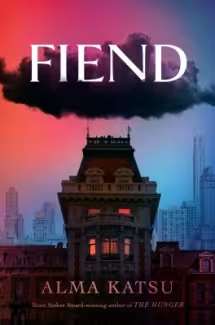
Alma Katsu was born in Fairbanks, Alaska, the daughter of an American-born father and a Japanese-born mother, and grew up in Massachusetts. She recently relocated from the Washington, DC area to the mountains of West Virginia, where she lives with her musician husband Bruce and their two dogs, Nick and Ash. Her latest novel is Fiend and she recently talked about it with Daryl Maxwell for the LAPL Blog.
What was your inspiration for Fiend?
I want to make people question our current obsession with the ultra-rich. Americans have always idolized the wealthy, but in the past decade or so, we've slipped back into this Gordon Gekko "greed is good," anything goes mindset. The Atlantic had a great article recently on how television is overwhelmingly about the rich, as though only the rich are worthy of our attention. Yet we know that some rich people have done terrible things to acquire and hold on to wealth, and we choose to not hold them accountable. The Sacklers, for instance, were a big inspiration for this story. It made me wonder what it would take for people to see or admit the truth—actual evidence of Old Testament-style evil?
Are the Berishas (Zef, Olga, Dardan, Maris, or Nora) or any of the other characters in the novel, inspired by or based on specific individuals?
There's the obvious nod to Succession, of course, but these characters came organically from the plot. I tried to imagine what the children from such a family—one with a thousand-year history of self-serving—would be like. What would've happened to them as kids to make them carry on the family tradition, and what the courage would it take to try to break the cycle?
How did the novel evolve and change as you wrote and revised it? Are there any characters or scenes that were lost in the process that you wish had made it to the published version?
Originally, Maris, the middle child, wasn't consumed with taking over as head of the family, and so it was possible for her to see the truth about her family. But—here I'm revealing the decisions a writer must make—that made her a passive protagonist doomed to react to things that happen to her, and it didn't suit the story. Readers generally don't find passive protagonists satisfying. I'm not sorry that Maris had to change fundamentally, as I love the way the story turned out, but she was a much more sympathetic character in the earlier version.
A crucial element of the plot of Fiend is how the Berisha children experienced their childhoods (collectively and individually). How do you remember your own childhood and your time with your parents as you grew up?
My childhood was nothing like the Berishas. My family was not wealthy or privileged in the least. But my upbringing was tempestuous and difficult in a different way. Like Zef, my father had a formidable temper. The Berisha siblings show classic signs of abuse, the compunction to appease, and negation of identity. I channeled some feelings from my childhood to create the Berisha siblings, even if our circumstances were completely different.
You know what Tolstoy said: "Happy families are all alike; every unhappy family is unhappy in its own way." Even though they have things in common with me and others, I think it's safe to say that the Berishas are a uniquely unhappy family.
There are many cultures whose histories and folklores include the idea of curses. How did you decide to make the Berishas Albanian?
While I can't get into this without giving away something of the plot, I can say that anger is central to the story. I've already mentioned that Zef, the father, has an epically bad temper. The entire Berisha bloodline has legendarily fierce tempers. I'd heard a long time ago that the blood feud originated in Albania, that they are a notoriously short-tempered people who, obviously, can hold a grudge. Now, is it fair to say one ethnicity is more short-tempered than all others? Of course not—but this one factoid was enough to make me decide to make the family Albanian.
Have you ever had an encounter with something paranormal?
When I was a child, I desperately wanted an encounter with the paranormal or supernatural. I wanted supernatural powers; I wanted to see a ghost. I grew up in a very spooky house in what seemed like the spookiest town in Massachusetts (and given that we're talking about New England, that's saying a lot). But I must say that no, while I've been in some very weird and spooky situations, none of them turned out to be truly paranormal.
If/when Fiend is adapted into a film or series, who would your dream cast be?
I'm happy to report that this isn't a hypothetical, as we optioned Fiend for a TV series shortly after we buttoned up the final version of the manuscript, literally days after the Los Angeles wildfires.
I have thoughts on actors for some of the roles, but not all of them. For instance, I can see Oscar Isaac as Zef. He's got the strong facial characteristics needed for this character: the piercing eyes, strong jaw, and prominent nose. He's handsome, but I think he's capable of displaying the character's evil core.
I can see Alia Shawkat as Maris. Maris adores her father and wants nothing more than to win his approval, and, ironically, she's the only one who takes after Zef, with his ethnic features. The Berishas have selectively bred themselves to a Western ideal, and Maris's sister and brother both take after their mother, a former model, while Maris is short and stockier, with wiry hair and an olive complexion.
Nora, like Dardan, takes after Olga: tall, slender, classically beautiful. She may have ideal European beauty, but she's also subversive and unconventional, which keeps her family off balance. I pictured Elizabeth Debicki, with her almost exaggerated Western beauty, as Nora.
Your biography says that prior to the publication of your first novel, you worked as an intelligence analyst for several US agencies. Does your work in intelligence inform or influence your work as a writer? If so, how?
Intelligence work and writing fiction may seem a funny mix, but I think my time in intelligence gave me certain helpful attributes. For one thing, in both lines of work, you have to be incredibly detail-oriented. You need to be able to focus, to really immerse yourself in what you're doing. That also translates to being able to sit for long amounts of time! I used to joke that a great intelligence analyst can't get bored easily and must have powerful sitting muscles.
Three of your previous novels, The Fervor, The Hunger, and The Deep, were about historical events or periods through a horror lens. Any chance you'll be taking readers back to another horror-infused historical novel in the future?
I hope so! Historical fiction is fun to write, even if it does require the extra work of all that research. I'd love to write about the settling of the Western frontier again. In writing The Hunger, I came to be amazed at how many stories-behind-the-story there are in American history and how little most of us really know. I tend to look at historical events as an intelligence analyst, as I would if the event were happening in a foreign country, without the biases of the narratives we grow up with as American citizens.
What's currently on your nightstand?
I'm reading King of Ashes by S.A. Cosby—it's great, which you always expect from Shawn. I just finished Laura Lippman's latest, Murder Takes a Vacation, a cozy mystery, which is a departure for her. I've never been into cozies, but I enjoyed this book a lot, so maybe I'm at the right time in my life for them. Next up is Daniel Kraus’ latest, Angel Down.
What is the last piece of art (music, movies, TV, more traditional art forms) that you've experienced or that has impacted you?
I thought the British TV show Adolescence was brilliant. The story was married to the narrative format in such a way that it led to greater insight and pathos for the viewer. Just great storytelling all around, which in turn inspires me to do better.
What are you working on now?
My next novel will be Horror that deals with technology. It's been interesting to write as I ended my intelligence career as a technology forecaster, looking at the societal impacts of emerging technologies. I'm grateful for the chance to merge these two interests, but let's see if it results in a compelling story! I've also been contributing to anthologies and find that I enjoy it a lot. It gives you a real sense of community in a profession that's largely solitary.