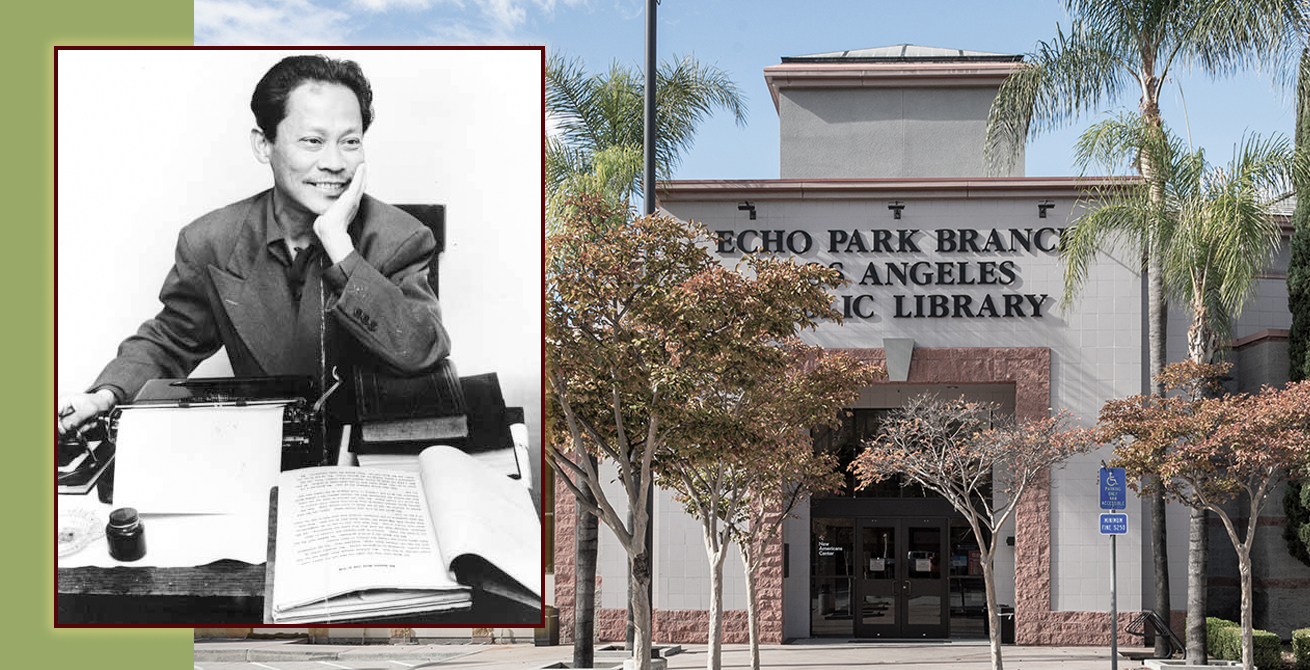
Carlos Bulosan was 17 when he arrived in Seattle in 1930. The son of farmers in Pangasinan, Philippines, he had little formal education and limited English. Like many others before and since, he wanted a better life. Moving up and down the Pacific coast, he did hard manual labor in canneries and farm fields. His first-hand experience as a migrant worker in an often hostile world inspired a lifelong commitment to human rights and union organizing. A slight man with weak health but a strong will, he was sometimes homeless, usually hungry, and always poor. And yet, within fifteen years, he would be a nationally known, best-selling author.
While living on Temple St. in Little Manila, Los Angeles, Bulosan made frequent use of the Central Library. He read voraciously and began writing works of his own: poems, essays, stories. He joined a circle of iconic L.A. authors, including his close friend (and fellow library fanatic) John Fante. In 1936, he was diagnosed with tuberculosis and spent nearly two years in the hospital. Reading and writing were his main occupations.
His most famous work, the novel/memoir America Is in the Heart (1946), describes his formative years in California during the Great Depression. It depicts both harsh realities and tremendous idealism. Despite all he endured, Bulosan believed in the American ideals of equality, freedom, and opportunity. Or at least, he believed in the pursuit of those ideals.
America is in the Heart may be the first Filipino-American novel, and is certainly one of the earliest written by an Asian American. Its influence still reverberates, as evidenced by Elaine Castillo's 2018 debut work of fiction, America is Not the Heart. It is so beloved by the members of the Carlos Bulosan Book Club of the Echo Park Branch that, for at least a solid year, it was all they wanted to read.
But in 1943, Bulosan first gained national exposure with an essay that appeared in The Saturday Evening Post to accompany the Norman Rockwell painting of the same name, "Freedom from Want." The painting depicts a white, gray-haired couple standing at the head of a dining room table crowded with smiling friends and family. The husband beams while the wife presents a giant roast turkey on a silver platter. They have everything that matters: food, shelter, togetherness, joy.
It is one of a series of paintings by Rockwell inspired by Franklin D. Roosevelt's 1941 Four Freedoms Speech, highlighting the rights most worth protecting against the advance of fascism: freedom of speech, freedom of worship, freedom from want, freedom from fear. But Bulosan's essay takes a different approach. He believes in those freedoms but does not yet possess them. He speaks for those who are not at the table, but perhaps made that meal possible.
We are factory hands, field hands, mill hands, searching, building, and molding structures. We are doctors, scientists, chemists... We are the living dream of dead men. We are the living spirit of free men.
But we are not really free unless we use what we produce. So long as the fruit of our labor is denied us, so long will want manifest itself in a world of slaves. It is only when we have plenty to eat—plenty of everything—that we begin to understand what freedom means.
As World War II ended and the Cold War began, Bulosan was blacklisted as a communist and his writing career dissolved. In poor health, struggling with alcoholism and with no gainful employment, he died in Seattle in 1956 of bronchopneumonia and, ironically, malnutrition. He was 42.
But since the republication of America Is in the Heart in 1973, Bulosan's stature has continued to grow. The Friends of the Echo Park Library (who also kick-started and developed a dedicated Philippine Heritage book collection for the branch) founded the Carlos Bulosan Book Club in 2017. More recently, they've actively campaigned for the Echo Park Branch, located in Historic Filipinotown, not far from where Bulosan lived, to be dedicated in his honor. This is now officially under consideration and open for public comment by March 10, 2026. We welcome your input.