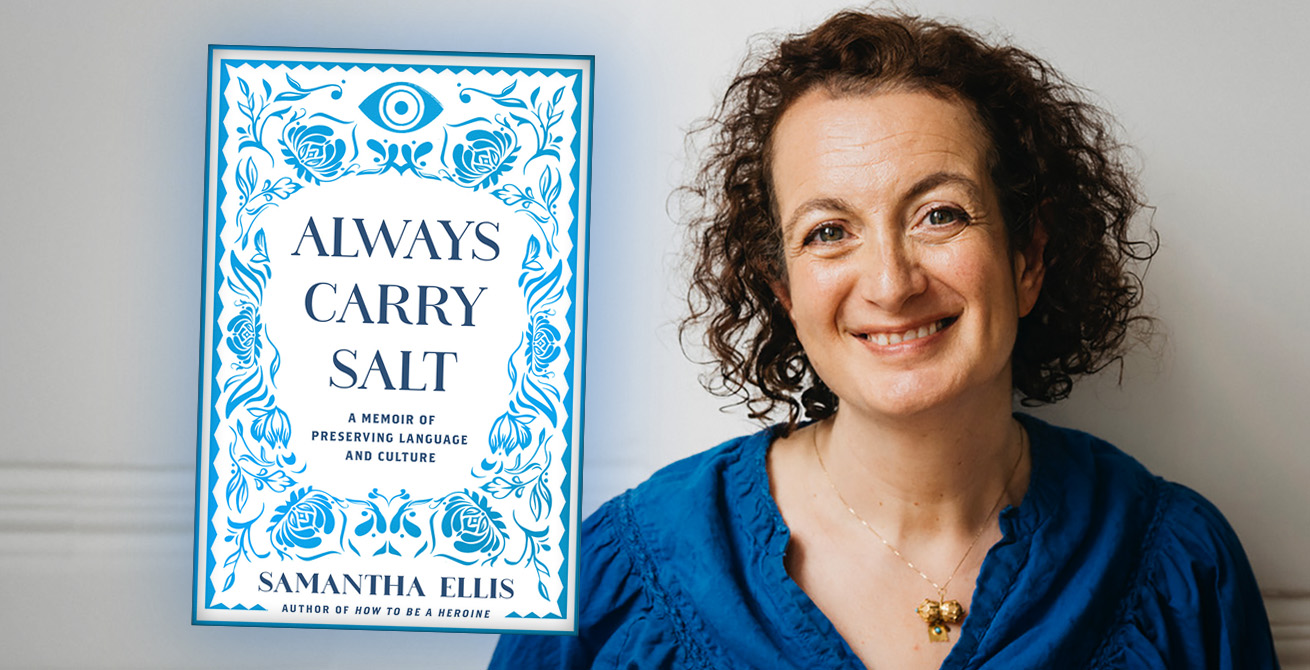
Samantha Ellis is a playwright, author, and journalist. The daughter of Iraqi-Jewish refugees, she grew up thinking her family had travelled everywhere by magic carpet. Her plays include Patching Havoc, Sugar and Snow, Cling To Me Like Ivy, and How to Date a Feminist, and she is a founding member of the women's theatre company Agent 160. Her journalism has appeared in the Guardian, the TLS, the Spectator, Literary Review and more. She worked on the first two Paddington films. She lives in London. Her other books include How to Be a Heroine: Or, What I've Learned From Reading Too Much (2015), and her biography of Anne Brontë, Take Courage: Anne Brontë and the Art of Life (2017).
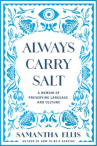
Her latest book (published in the UK as Chopping Onions on My Heart: On Losing and Preserving Culture, in 2025) is called Always Carry Salt: A Memoir of Preserving Language and Culture. The Guardian called it "a linguistic feast, and The Observer called it "a gift to the future." She recently talked about it with Tina Lernø for the LAPL Blog.
First of all, thank you for taking the time to talk to us here at the Library. Can you talk a bit about why you wrote this book?
Thank you so much for inviting me to have this conversation! I think I've been writing this book all my life… I grew up in London, and both my parents are Iraqi Jews (my father left in 1951 and my mother left in 1971). I always knew that our language, Judeo-Iraqi Arabic, was going extinct, and that there were barely any Jews left in Iraq (three at the last count), but after I became a mother and realised that I couldn't pass it on to my son, I became obsessed by everything I was losing. I felt as though a Flood was coming and I needed to build an Ark, and in a way that's what the book is.
One of the reasons I was excited to talk with you is that we share a common Mizrahi heritage. Many of the words and phrases you mention in your book are ones I heard growing up! I yelled them out loud as I read, as well as my favorite recipes. Makhboose! So this is more of a statement than a question, but I feel like it's so important to find those connections out in the world.
I'm so happy this book has resonated with you. In the nine months it's been out in the UK, I have made so many beautiful connections with other Iraqi and Mizrahi Jews, and it's made me feel that although we are all scattered around the world, and can't go back to Iraq, we are still connected.
The term "Mizrahi" itself can be debated, as with many words that define a people or culture. How do you feel about that term?
It's a really difficult term. I don't love it. It was originally used in Israel to lump together all the Jews from Arab lands and North Africa; it means "Eastern." But I must admit it is useful, and while I would rather say "Jews from Arab lands and North Africa," who has the time?!
I love how the Arts play such an important part in your story. Do you feel this is the best way to share our histories?
I loved discovering more books and films about Iraqi Jews as I wrote this book, and one of the most powerful things I encountered was the film Iraq' n' Roll by the Iraqi Jewish musician Dudu Tassa whose grandfather and great-uncle were the Kuwaiti Brothers, amazing Iraqi Jewish musicians who were the toast of Baghdad in the 1920s and 1930s and whose their music and story was then erased both in Iraq and in Israel. Tassa's journey to reconnect with his family's music and to recapture it is incredibly moving—and the music is wonderful.
The chapter in your book about the English city of York was harrowing to say the least, and yet there is still hopefulness in the end. Why do you think we carry this resilience in the face of so much loss?
I think it's very human to keep hoping, no matter what.
Another chapter I loved was about the Nabug tree. The idea of reviving a culture through food is both important and nourishing. Were you ever able to find more seeds?
I haven't yet, but I hope to!
Mango pickle (Amba) was the mystery jar of my childhood. My mom never made it herself, but it was something visiting friends and family always brought, so there were always multiple jars in our fridge. Truthfully, I was a bit scared of it, but what I wouldn't give now to taste it. How do you connect food and flavors with the next generation? Are you able to enjoy these unique cultural experiences with your family now?
Growing up, we almost only ate Iraqi food, and amba was the taste of my childhood. There was a long time when I felt disconnected from Iraqi food, but when I started cooking it in my 20s, it felt like plugging back into something live and vital. My son is quite a fussy eater, and has yet to try amba (although I always have at least one jar in my fridge, too, and I remain hopeful he will love it one day!), but I do try to cook Iraqi foods for him, and my mother has been fantastic at introducing him to things too; because of her he is a big fan of kubba shwandar, kubba (meatballs of lamb or beef, encased in a shell of ground rice mixed with more meat, and cooked with beetroot). The great Jewish cookbook writer Claudia Roden has said that when culture is lost, food is often the last thing to go, and I really think that recipes can enable a kind of time travel. I can't go to Iraq but when I cook Iraqi food, I am doing the same things with my hands (all the rolling, and stuffing—Iraqi Jewish food is very hands-on) that my grandmothers did in Iraq, and their grandmothers, and back and back, and when I taste the food, it is the same as the tastes they tasted there. So, although there are some foods we can never recapture outside Iraq, I do think recipes are an amazing portal to the past, and a repository of culture. I also think Iraqi Jewish food is delicious!
You recently wrote an article discussing how to be the archivist of your own family, creating a bridge between generations. Can you talk a bit about that? I wish I could go back in time and record the songs and prayers I grew up with..
I wrote the piece for Psyche because so many people have asked me about making archives of their own families, in whatever forms—mine became a book, but it could be a photo album or a collection of recipes. I wanted to write a guide to how I did it and what worked for me because I thought it might be useful but, beyond that, because this work has made me feel more anchored, and it's made me feel like a bridge between past and future, as well as feeling I can be more playful and adventurous about my own heritage, rather than anxiously striving for authenticity. I would love everyone to be able to feel this connected to their own family's story, in whatever way they can.
In addition to your book, what resources would you recommend to help our readers better understand our particular Jewish community?
The Eli Timan archive is a wonderful archive of interviews with Iraqi Jews.
There are more interviews (including with my grandmother, Aida Hakim) at Sephardi Voices UK.
On instagram, Ciara Shalome’s page The Mizrahi Story is wonderful.
Jackie Barzvi has created a real treasure in the Mizrahi Dance Archive.
And there are several films including: The Dove Flyer (based on Eli Amir’s bestselling novel), directed by Nissim Dayan; Baghdad Twist, directed by Joe Balass; Forget Baghdad, directed by Samir: Iraq ’n’ Roll, directed by Gili Gaon: and Remember Baghdad, directed by Fiona Murphy.
What's currently on your nightstand?
All year I've been savouring Helen Garner's beautifully observed diaries, How to End a Story. I'm more actively reading Between Two Rivers by Moudhy al Rashid, about ancient Mesopotamia, and re-reading How to Write an Autobiographical Novel by Alexander Chee. I've recently finished (but not yet shelved!) Rural Hours by Harriet Baker, about the country lives of Virginia Woolf, Sylvia Townsend Warner and Rosamund Lehmann, which made me want to leave London and make my own dandelion wine, and also Rachel Cockerell's Melting Point, a really startling, brilliant book about paths taken and not taken. There's an ever-changing stack of whatever I'm reading with my eight-year-old son. A friend gave me Sarah Moss's Ripeness and Malcolm Gaskill's The Ruin of all Witches which are next on my list.
Can you name your top five favorite or most influential authors?
Such a hard question! I think the authors whose books have been most constant companions for me are the Brontës (all three!) and Shakespeare. And there are some authors I go back to a lot, and think I will always be reading and rereading: Joseph Roth, Maggie Nelson, Deborah Levy, Angela Carter, Sylvia Plath, Patti Smith (Just Kids is a marvel!). Sorry, that's a lot more than five.
What was your favorite book when you were a child?
Anne of Green Gables. I loved the heroine's grit, courage, and outsider perspective.
Was there a book you felt you needed to hide from your parents?
No, my parents were amazing at letting me read anything I wanted.
Is there a book you've faked reading?
Not yet, but I'm not counting it out!
Is there a book that changed your life?
Wuthering Heights had a huge impact on me. I read it quite young, and then read it every year, for years, usually on my birthday, often (once I was older!) in the bath with a glass of wine, and it really influenced how I saw the world. I didn't really interrogate how much it had influenced me until I wrote my first book, How to be a Heroine, and realised I'd been reading Wuthering Heights as a guide to love - and that this was not a brilliant idea.
More recently I found Saidiya Hartman's Lose Your Mother such a generous, careful book that really helped me to see that writing a memoir (or just living your life) doesn't have to be a quest for everything to be tied up in a neat bow of resolution or catharsis, but that sometimes sitting with the uneasiness, the pain and the uncertainty is what we need to do.
Can you name a book for which you are an evangelist (and you think everyone should read)?
I'm always recommending Oliver Burkeman's Four Thousand Weeks because it really helped me to stop constantly feeling busy yet getting nothing done, and pushed me to focus on what I care about most; I love his insight that the endless to-do list will always be there, so you may as well make time also for what you love and what is important to you.
And I'm always suggesting mothers read The Baby on the Fire Escape by Julie Phillips about women artists and writers who are also mothers; it's not just about the struggle to do both, but about how motherhood can enrich your art. I think it's also applicable to any big, engulfing life experience; I love her argument that life (big, lived, messy life) feeds art rather than existing in opposition to it.
Is there a book you would most want to read again for the first time?
I’d love to read Elena Ferrante’s Neapolitan novels fresh. I read them all in the first few years after becoming a mother, and I was absolutely thrilled, disturbed, and gripped.
What is the last piece of art (music, movies, TV, more traditional art forms) that you've experienced or that has impacted you?
I really loved Sarah Solemani's short film Mashhad about her grandmother's life in the Iranian city Mashhad, where in 1839 there was a massacre and the surviving Jews were forced to convert to Islam, but continued to practise their Judaism in secret. It's a really beautiful, haunting, delicate, devastating short film about joy and music and searching for connection.
What are you working on now?
I usually love talking about my work in progress, but for some reason, everything I'm writing right now feels like it wants to grow in the dark, so watch this space!