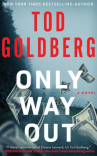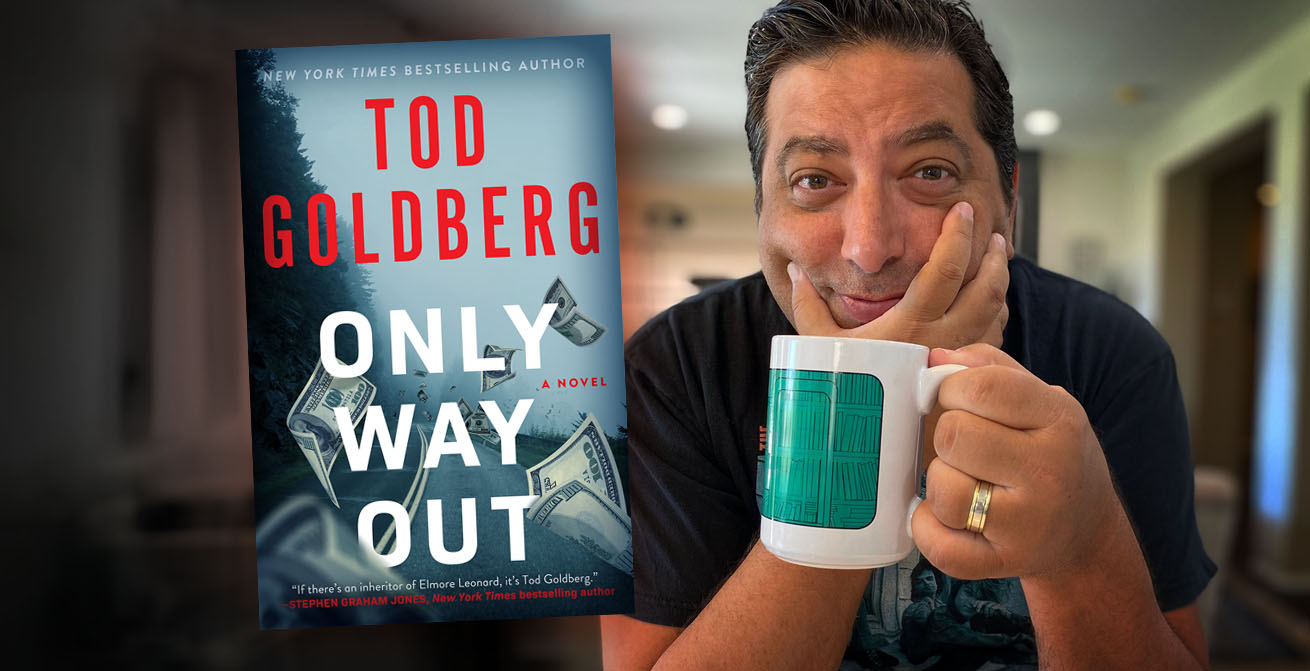
Tod Goldberg is the New York Times bestselling author of sixteen novels, including the Gangsterland quartet: Gangsterland, a finalist for the Hammett Prize; Gangster Nation; The Low Desert, a Southwest Book of the Year; and Gangsters Don't Die, an Amazon Best Book of 2023 and a Southwest Book of the Year. Other works include The House of Secrets, coauthored with Brad Meltzer; Living Dead Girl, a finalist for the Los Angeles Times Book Prize; and the Burn Notice series. His short fiction and essays have been anthologized in Best American Mystery and Suspense and Best American Essays and appear regularly in the Los Angeles Times, USA Today, and Alta. Tod is a professor of creative writing at the University of California, Riverside, where he founded and directs the low-residency MFA program in creative writing and writing for the performing arts. He lives in Indio, CA, with his wife, Wendy Duren. His latest novel is Only Way Out, and he recently talked to Daryl Maxwell about it for the LAPL Blog.
What was your inspiration for Only Way Out?
I guess it was two-pronged: I've always wanted to write a black comic noir that took place in a dying resort town—I find resort towns uniquely insidious—and I say that as a person who has lived most his life in a resort town. And a relative of mine told me a story about a law firm where he was a summer associate that had a floor of safe deposit boxes, which piqued my interest in very dark ways.
Are Robert, Jack, Penny, Mitch, or any of the other characters in the novel inspired by or based on specific individuals?
There are a lot of Easter eggs in this book about friends, family, and my own real life, but you'd have to know me pretty well to catch them all. The characters themselves are all creations of my own damaged mind, so I guess they're all based on versions of myself.
How did the novel evolve and change as you wrote and revised it? Are there any characters or scenes that were lost in the process that you wish had made it to the published version?
Well, I tend to write long and cut, so there are plenty of scenes that ended up in a cut file somewhere in my computer, but most of the time those scenes just amount to a lot of throat clearing on my part. I tend to write a bunch, looking for the moment I really want, so nothing really good was cut, just a lot of witty dialogue that I'll repurpose elsewhere. I always knew the basic plot of the book, so getting from A to Z was pretty straightforward in my mind, though the fun part is figuring out how to muddy the waters along the way. Anything I really wanted in the book is in the book.
Is Granite Shores, Oregon, inspired by or based on a real place?
The town of Granite Shores—the fictional setting for most of the book—is based on a couple of real places. Capitola, California where we had a beach house when I was a kid in Northern California; Loon Lake, Washington, where I spent my summers as until I was in my twenties; Seaside, Washington, where my grandparents had a condo for many years; and even Palm Springs, but the Palm Springs of my memory vs. the city I live in now. I took good and bad parts of all those places to create Granite Shores.
If you had to change your name, would you use the name of a family member or someone you knew? Make one up? Do you have an idea of what it would be?
When you're taking on a new identity, you want to use a fake name you can remember and/or is enough like your own name that if you forget and sign your name the wrong way, it still looks pretty close! These are things I learned a million years ago when writing Burn Notice. If I had to disappear under an unassumed name, I'd probably use some combo of dead pets and streets I've lived on. And that's how I'd become Sam El Conquistador.
Do you remember when/how you first learned of Parmenides' principle of sufficient reason?
About five minutes before I wrote about it.
In your Acknowledgements, you mention that, beyond the initial inspiration, you needed to "learn a few important things" to write Only Way Out. So, I'm guessing you had conversations with the people you mention and may have had to do some additional research. What were a few of the more interesting or surprising things that you learned while writing the novel?
Not to spoil too much of the book, but the one big thing I needed to learn about was how DNA degrades over time and what the effect would be on a frozen body. And I needed to understand how the DNA found in hair works, and if a DNA analysis would reveal whether or not the hair came off of a living or dead person. So there was that bit. This isn't a police procedural, so I don't need to go too in-depth on the science of things, but I wanted to make sure I got those details correct. And then, of course, I needed to find out what kinds of stuff people keep in safe deposit boxes.
Your biography says that you are a professor of creative writing at the University of California, Riverside. Does your work teaching writing inform or influence your work as a writer? If so, how?
Sure. I, of course, want to model behavior to my students—it's hard to give advice on how to write successful books if I'm not out there writing successful books—and also want to be honest about how we all fail, too, that rejection is a real part of this pursuit. So I try to be a realist with my students, share with them the struggles, the wins, and the losses, so they know what to expect. Plus, I feel the onus to write good books so the students don't look at my work and think, This guy has no idea what he's talking about.
You also founded and direct the low residency MFA program creative writing and writing for the performing arts at UCR. Can you tell us a bit about that?
It's one of the great joys of my life. I founded the program in 2008, and since then, we've done nothing but graduate successful writers—novelists, nonfiction writers, screenwriters, playwrights, and all points in between—and have done so using a simple abiding philosophy: We want to guide our students toward publication and production and into a successful life in the arts. It's a low-residency program, which means the students are only in person for ten days twice a year—December and June—when we gather for our residencies here in Palm Springs. The rest of the time is spent online, working one on one with your professor. Some of the graduates of the program include the amazing Southern California writers Natashia Deon, Francesca Lia Block, Maggie Downs, Brian Asman, Mickey Birnbaum, and Liska Jacobs, among countless others.
Only Way Out would make a marvelous film or television series! If/when it is adapted, who would your dream cast be?
Chris Pine as Mitch, Matthew McConaughey as Jack, Aubrey Plaza as Penny... and a really big budget for fudge.
What’s currently on your nightstand?
A mixture of fiction and nonfiction, old and new:
The CIA Bookclub by Charlie English—a strangely relevant book for our times…
Eerie Basin by Ivy Pochoda—a long short story by one of the best crime writers working!
The Confidence Game by Maria Konnikova—I love learning about how and why people get conned, and Maria's book is masterful.
Sun, Sin, and Suburbia by Geoff Schumacher—a re-read, for research purposes.
She's Under Here: A Memoir by Karen Palmer—an amazing work of nonfiction, about disappearing, and coming back.
What is the last piece of art (music, movies, TV, more traditional art forms) that you've experienced or that has impacted you?
The other night, I saw Paul McCartney in concert. I had amazing tickets—fifteen rows from the stage—because I have a friend who had the hookup. There Paul McCartney was, 83 years old, a piece of living history, singing songs that for me have always existed, like stars in the firmament. And he was so filled with joy, even in the sorrowful parts of the show, where he talked about his dead bandmates, that it was frankly inspiring to see. His face was still boyish, though he was older than my parents had lived to be, older than most of my grandparents had lived to be, and yet, of course, it was impossible not to see what was very clearly true—that his time on this planet was short. He held the audience in his hand. He made eye contact. He chatted. And then when he sang a song like "Hey Jude" and every single living soul in the room sang it back to him, you could feel the presence of something larger at work. I left that show vibrating.
What are you working on now?
I'm working on a couple of things that I'm not allowed to talk about... and then I'm also hard at work on my next book, The Salton Sea, which I hope to finish soon.