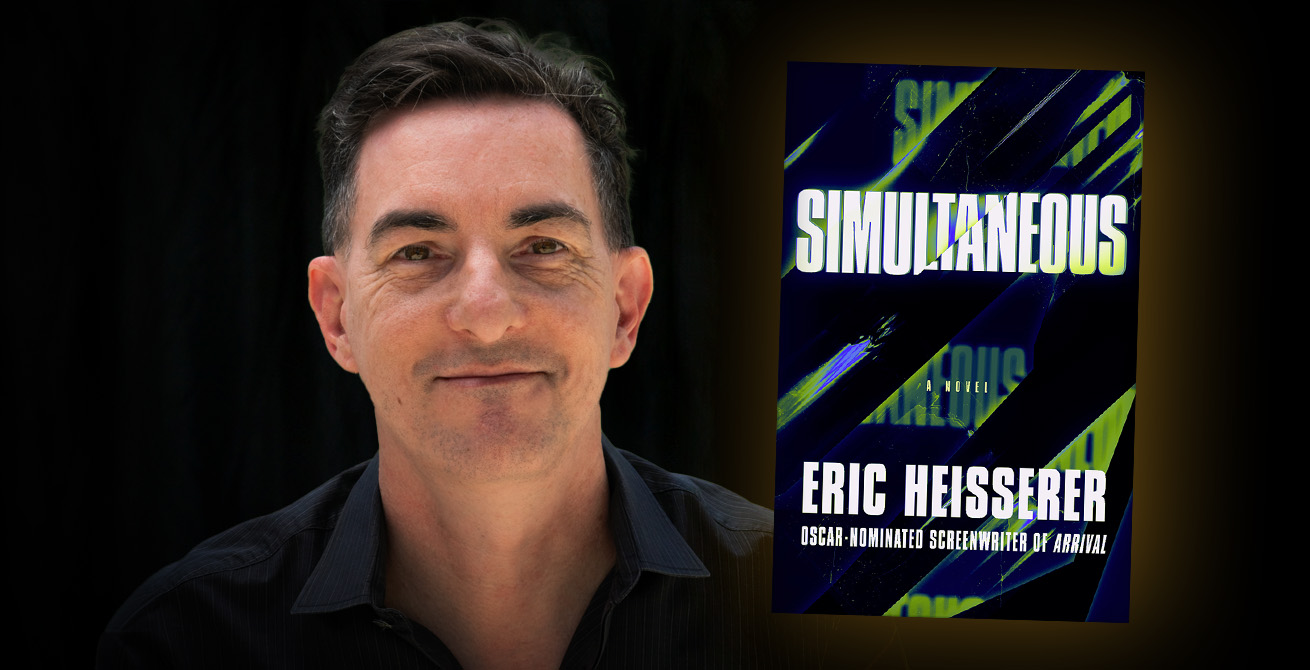
Eric Heisserer is the Academy Award–nominated screenwriter of Arrival and the creator of the Netflix series Shadow and Bone. He lives in Los Angeles. His debut novel is Simultaneous and he recently talked about it with Daryl Maxwell for the LAPL Blog.
What was your inspiration for Simultaneous?
I've been fascinated by reincarnation stories for years. It started with the movie Dead Again, and then I later became obsessed with a Dream Theater album about a murder mystery that involved reincarnation; Scenes from a Memory. Some part of my brain has always been tinkering with the concept, to see what other kinds of stories one could tell. Then I was recommended Claire North's novel The First Fifteen Lives of Harry August, and I reached a sort of critical mass of reincarnation stories that led me to the question about the nature of souls. Specifically, the idea that perhaps there is only a finite number of souls, which is what allows reincarnation to occur.
That was the germ of Simultaneous.
Are Grant, Sarah, Marigold, or any of the other characters in the novel inspired by or based on specific individuals?
No one is based on a specific individual, no. But I do tend to collect behavioral traits and quirks like a hoarder, and mix-and-match for my fictional characters to find someone who isn't a copy of a friend or family member but still authentic to me.
How did the novel evolve and change as you wrote and revised it? Are there any characters or scenes that were lost in the process that you wish had made it to the published version?
It's my first novel, so I learned a lot in this medium. Prose is so liberating when your entire career has been screenwriting—so much of what I've written in the last twenty years has been more akin to instruction manuals for a team to make a different product. I've had to work muscles closer to those developed by poets, where the language is meant to evoke much more than is written, or where you leave room for other creatives to extrapolate the action or dialogue into other images and behaviors. But here, the written word is the final product, and the author doesn't need to leave so much up to the reader's imagination if they so choose. I had the most fun but also the most challenges with that revelation.
As for scenes or characters lost in the process... I did write a number of pieces to chapters where I was in the POV of the villain(s). And while this helped me flesh out some of the mythology for the reader, it also felt like it took away some of the mystery for Grant, Sarah, and Marigold. Keeping it entirely to their POVs—with the rare inclusion of the detective, Brian, as an extension of Marigold—seemed to work better, dramatically speaking. So those other passages were cut loose.
Writing about, and getting "into the head," of serial killers can be challenging for writers. In Simultaneous, you had to get into the heads of a few. How did you approach this? Did you find it particularly challenging? Did you have to do any research about serial killers and how they are pursued by law enforcement?
The minds of serial killers, and killers in general, are always challenging for me. I'm drawn to stories that garner or evoke empathy. That's my dopamine craving as a reader or audience member. If I care about the characters, I'm hooked. So, dealing with villains is always a bit tricky for me.
What I found fascinating about this story is the research required into an offshoot of serial killers—the copycat killer. What made that subset of criminal motivated? They are both similar and different from serial killers, according to research. And while the reality of my villain is a bit different from the assumption law enforcement makes about the copycat, I still needed to figure out how and when federal authorities would engage in the case.
If you did do research, what was the most interesting or surprising thing that you learned during your research?
The legal system tends to double down on its conviction when it comes to copycat criminals. Perhaps it's a matter of pride, or the legal mess and the bureaucratic fallout from raising the possibility that the person currently incarcerated is innocent and the real killer is still loose… whatever the motive, the wheels of justice tend to move at a slower pace when it comes to copycat crimes. The exception is always the local detective who needs to clear the case. Because in their world, a victim is still dead, and the perpetrator is still at large.
You've written screenplays for both motion pictures and television. You've also written novels and comic books and worked as a Director for films and a showrunner for several series. Is there a format that you prefer over the others?
Having worked in all these different roles and different mediums, I find real satisfaction in each of them in their own ways. But the commonality, the direct line to my joy in their creation, is the relationships of the people with whom I make the thing. I've had some forgettable experiences in comics, and then I was paired with artists Raul Allen and Patricia Martin, who metaphorically brought an orchestra to my piano solo. Similarly, I've waged invisible wars on feature film projects where the other producers or the director had different agendas from making the movie I believed was inherent to the story, and then I met Denis Villeneuve.
So, for me, it's about the creative partners who take the journey with you. Thankfully, with Simultaneous, I had a patient, enthusiastic, and supportive editor by the name of Zachary Wagman.
Is there something you haven't done yet but are hoping to have the opportunity to try?
Quite often, I venture into a new genre or a new medium to "sharpen the saw" as a writer—to learn a tool or an aspect of storytelling I might not encounter if I were to stick to my old habits. I continue to find this helpful in my career, even as I'm getting long in the tooth.
With that in mind, I will likely make an attempt at a stage play. I don't know if I will show it to anyone when I'm done with it, but it could help me work some new muscles I hadn't considered before.
If/when Simultaneous is adapted to film or a series, would you want to adapt your own novel? Would you also want to take on directing? Who would you dream cast be?
These are all good questions, but I'm keeping them out of my mind for now, as of the date of this interview. I wrote the novel to be its own thing, and I want to spend a little more time thinking of it as a novel before I consider how it could move to another medium with or without me. I hope that doesn't sound too hokey.
Your biography says that you currently live in Los Angeles. Do you have any favorite places? A hidden gem that someone visiting should not miss, but would only learn about from a resident?
I am captivated by the Museum of Jurassic Technology. It's the kind of place you just have to go and visit—it's like telling a friend to watch a movie "cold" and experience it without any expectations.
Simultaneous ends on a bit of a cliff-hanger! Do you have plans to take readers on another investigation with Agent Lukather?
Ha! I hadn't meant for it to read as a cliffhanger, but more the kind of ending that speaks to a larger story that doesn't have to be followed. The ending of the movie Edge of Tomorrow does this well, I think. But yes, if I have the privilege of writing another novel, I'd truly love to continue the adventures of Grant and Sarah in a second book in this world.
What's currently on your nightstand?
Immortal Consequences, by I.V. Marie.
Can you name your top five favorite or most influential authors?
Oh, wow, that's tricky. Ray Bradbury, Michael Crichton, Ursula K Le Guin, Ed McBain, and Ted Chiang.
What was your favorite book when you were a child?
Watership Down and Have Spacesuit Will Travel were both books I reread often, likely when I was too young to understand all of them.
Was there a book you felt you needed to hide from your parents?
My mom hooked me on reading by reading to me before I could really read, so I never felt afraid or ashamed to share a book with her.
Is there a book you've faked reading?
As in, pretended to read but didn't? What would be the value in that?
Can you name a book you've bought for the cover?
The one on my nightstand now I picked up because the cover was arresting!
Is there a book that changed your life?
It seems like an obvious answer, but it's also true—Ted Chiang's collection Stories of Your Life and Others.
Can you name a book for which you are an evangelist (and you think everyone should read)?
Someone You Can Build a Nest In, by John Wiswell. Absolutely superlative. Has all the things I love in a story. Typically, anything that Charlie Jane Anders recommends is a good bet, though.
Is there a book you would most want to read again for the first time?
Hmm. I have such joy in rereading something my heart already loves, I don't mind knowing the endings, so perhaps I'm not wired to want to relive a first time.
What is the last piece of art (music, movies, TV, more traditional art forms) that you've experienced or that has impacted you?
The album Even in Arcadia, by Sleep Token.
What is your idea of THE perfect day (where you could go anywhere/meet with anyone)?
So many of my favorite days in my life were total surprises! I'm stumped.
What is the question that you're always hoping you'll be asked, but never have been?
I know this, but someday I hope to be asked it, and I don't want to give it away here.
What are you working on now?
I'm currently developing several original feature films, as well as a TV pilot script for a prequel series set in the world of Pacific Rim. Oh, and a graphic novel for a secret project. Oh! And a story consultant on a video game. Good lord, that sounds like a lot. Thankfully, they are all in different stages, so no two mouths are begging to be fed at the same time!