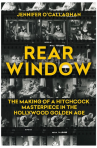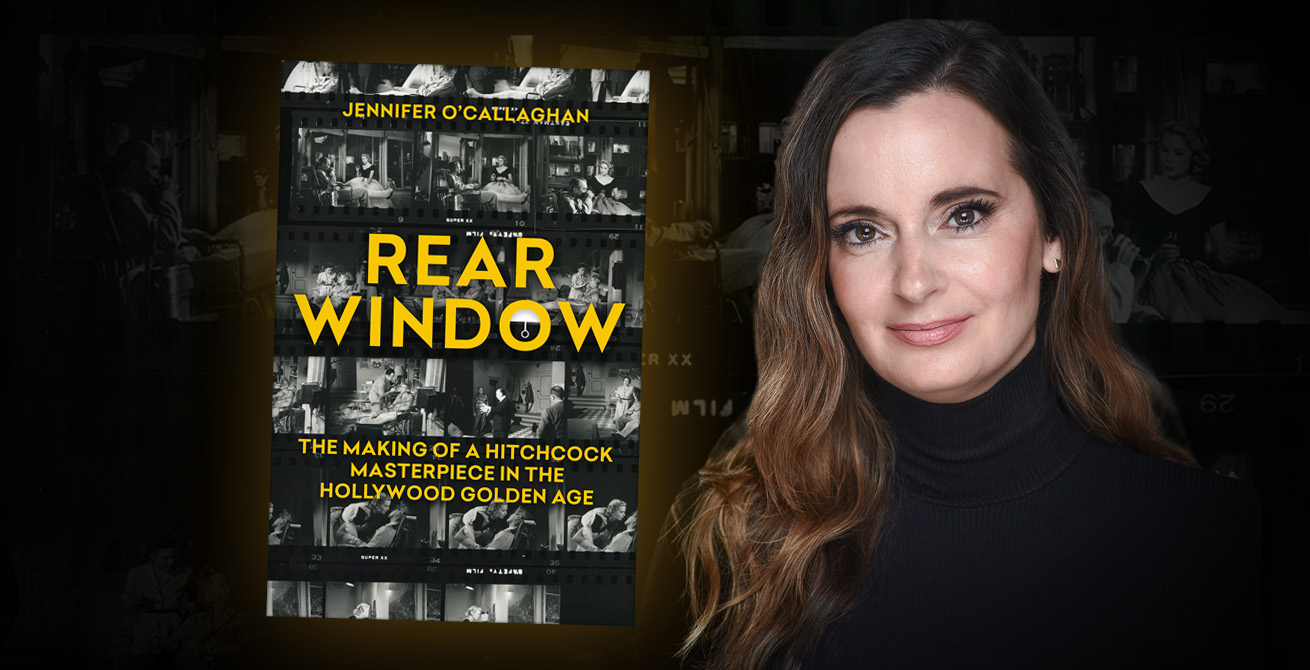
Jennifer O'Callaghan is a freelance writer and journalist. She has worked as a reporter for Metro News, The Sundance Channel, Shaw TV, and CKUA radio in news, entertainment, and lifestyle beats. She has also appeared as a red-carpet reporter for the web entertainment site MyBroadway.com , and as host on Paradetown USA on NYC-TV. She has interviewed celebrities including Will Ferrell, Meryl Streep, and Cameron Diaz, and appeared as a featured model on The Today Show and The View. She currently lives in Toronto and her latest book is Rear Window: The Making of a Hitchcock Masterpiece in the Hollywood Golden Age. She recently talked about it with Daryl Maxwell for the LAPL Blog.
What was your inspiration for Rear Window: The Making of a Hitchcock Masterpiece in the Hollywood Golden Age?
I've always been a fan of "making of" film books, and Rear Window has always been one of my favorite films. As a reader, when I couldn't find a "making of" book about Rear Window that told a narrative-driven story, I thought, "Well, I'm a writer. Maybe I can do it." The inspiration also came from recognizing that Rear Window represents far more than just a classic thriller—it's a lens through which to examine the Golden Age of Hollywood, the restrictive Hays Code era, and themes that feel remarkably relevant today. The film's themes of voyeurism, surveillance, and human isolation speak directly to our social media age, where we constantly observe others' lives through digital windows.
How long did it take for you to do the necessary research and then write Rear Window: The Making of a Hitchcock Masterpiece in the Hollywood Golden Age?
Overall, the project took a little over a year. I spoke to fifteen interview subjects and used resources like the Margaret Herrick Library and the BYU Library to go through the papers of Hitchcock, Jimmy Stewart, and Thelma Ritter. It was such a fascinating experience to slowly piece things together and truly understand what each key player with the film was going through in their own lives at that time in Hollywood history.
What were some of the more interesting or surprising things that you learned during your research?
It's common Hollywood folklore that Hitchcock used storyboarding for every single scene of all his films, but when I interviewed film historian Joseph McBride, he'd actually been on Hitchcock's last film set (Family Plot) as a journalist, and he witnessed Hitchcock actually improvising some of the more dialogue-heavy scenes. It was fascinating to realize that perhaps he wasn't always as strict about his protocols as we were all led to believe. Additionally, I learned that Grace Kelly did her own stunts on Rear Window. They had originally hired a stunt double for the scene when she climbs the fire escape ladder to Thorwald's apartment and climbs into the window to put herself in mortal danger. Kelly decided to do this stunt herself—in high heels and a dress!
You mention in the book that the sets for Rear Window were based on a real Greenwich Village complex that is still there. Did you visit the location while doing your research? If so, what was that like?
I lived in New York for a number of years at one point, and I spent much time in the West Village, as I'm an avid jazz music fan, and the music venues are around Christopher Street. So, I do remember walking past that building and being very curious about it. I wasn't surprised to later realize that Rear Window had been modeled after it. The building was also featured in the 1993 film Manhattan Murder Mystery with Diane Keaton and Alan Alda.
Do you remember the first time you watched Rear Window?
I remember the first time I saw it when I was much younger, and it really affected me. It was one of those films I kept thinking about for days after viewing it. I instinctively knew it was something special. It seemed to feature the best of Hitchcock—the mystery, the unbelievable suspense, the romance, and the glamorous Hitchcock blonde. I fell in love with the dialogue, too. Screenwriter John Michael Hayes had such a gift for sharp, witty, one-liners and bringing comedy relief when circumstances became heavy.
Is Rear Window your favorite of Alfred Hitchcock’s films? If so, why? If not, what is?
Rear Window is my favorite Hitchcock film because it beautifully balances suspense, romance, and social commentary while showcasing technical mastery. And Hitchcock made this masterpiece during a restrictive time with the Hays Code when films weren't allowed to show gore, things of a sexual nature, or much violence. Yet, he still managed to get through to millions of people worldwide. (The Lady Vanishes, starring Margaret Lockwood from 1938, is a close second).
Similar question for Jimmy Stewart. Is Rear Window your favorite of his films, or is it something else?
With Jimmy Stewart, I feel it’s a toss-up between Rear Window and It’s a Wonderful Life. That film is also embedded in our culture's emotional DNA as a nostalgic favorite that brings one back to memories of Christmases gone by. I suppose I love them equally for very different reasons.
We lost Alfred Hitchcock in 1980. If you could ask him something about Rear Window, or any of his films, what would it be?
I might ask about his decision to keep the film out of circulation for so many years during the sixties and seventies, or whether he truly understood how prophetic his exploration of surveillance culture would become.
Is there something you would want to tell him?
Like countless others, I would likely want to tell him how important his work has been to the cinematic landscape and how deeply his films have affected my life.
Same questions for Jimmy Stewart and Grace Kelly. Anything you would ask or tell them if you could?
With Jimmy Stewart, from an acting standpoint, I would ask: how did it feel to carry most of the film from a wheelchair, relying heavily on facial expressions and reactions rather than physical movement? With Grace Kelly, I'd want to ask her about her character, Lisa Fremont. Lisa was remarkably independent and career-driven for 1954. I'd want to know if Kelly saw her as progressive for the time, or simply as a woman with true agency?
Do you have a theory regarding why Alfred Hitchcock's films, in general, and Rear Window specifically, continue to be popular with viewers and filmmakers?
Hitchcock understood something fundamental about human nature that transcends any particular era. We're all voyeurs at heart. As he told Peter Bogdanovich, "Everyone does it, it's a known fact... People don't care who you are; they can't resist looking."
Rear Window remains relevant because it essentially predicted our current surveillance culture. In 1954, Hitchcock was already exploring themes that feel startlingly contemporary: the isolation of modern life, our compulsion to observe others from a distance, and how we form judgments based on incomplete information. L.B. Jeffries scrolling from apartment to apartment mirrors how we scroll through social media feeds today, making assumptions about people's lives from curated glimpses. What makes Hitchcock's work endure is that he was, as Francois Truffaut recognized, making films about cinema itself rather than just telling stories.
As a debut author, what have you learned during the process of getting your book published that you would like to share with other writers about this experience?
The most important lesson for me has been that passion for your subject matter is absolutely essential—it's what sustains you through the lengthy research process and multiple drafts. Writing about Rear Window didn't feel like work because I was genuinely fascinated by every detail I uncovered.
Research is everything in narrative non-fiction. I spent countless hours tracking down surviving cast, family members, and friends of people who are no longer with us, archival materials, and cross-referencing sources. The publishing industry moves slowly, so patience is important, too. From initial concept to finished manuscript to finding the right publisher often takes longer than expected. Having a strong platform and being able to articulate why your book matters in today's market is helpful too.
What's currently on your nightstand?
I’m currently reading The Path to Paradise by Sam Wasson and Intermezzo by Sally Rooney.
Can you name your top five favorite or most influential authors?
Mark Harris
Sam Wasson
David Thomson
Margaret Atwood
Sally Rooney
What was your favorite book when you were a child?
Island of the Blue Dolphins by Scott O’Dell. I still remember reading it in the fourth grade and falling in love with it.
Was there a book you felt you needed to hide from your parents?
I loved reading ghost and horror stories as a child, but my parents took them away because I started having nightmares from them. So I began to hide books like Scary Stories to Tell in the Dark by Alvin Schwartz under my mattress so they wouldn't know I was still reading them before I went to sleep at night.
Is there a book you've faked reading?
I think most people have done this at some point, but what's interesting is how often we end up going back to those books later and actually appreciating them. Sometimes we're just not ready for certain books yet. As a teen, I had trouble getting through The Catcher in the Rye but sometimes nodded and smiled when others talked about it. But now, I get its beauty.
Can you name a book you've bought for the cover?
Fifth Avenue, 5 A.M. by Sam Wasson. I bought it right when it was released and was completely drawn to the iconic cover of Audrey Hepburn standing in front of Tiffany's in her little black dress. However, it was so beautifully written that I completely devoured it in just a few days!
Is there a book that changed your life?
I'm always wary of claiming any single book 'changed my life.' That feels like too much pressure to put on one author. But there have definitely been books that shifted my perspective at crucial moments, usually when I was ready to hear what they had to say.
Can you name a book for which you are an evangelist (and you think everyone should read)?
Hitchcock/Truffaut—the book that came from Francois Truffaut's 50-hour interview with Hitchcock. It's not just essential reading for film lovers; it's a masterclass in how an artist thinks about their craft. Truffaut asks insightful questions, and Hitchcock's responses reveal so much about the psychology of storytelling and visual narrative. Anyone interested in how art is made should read it.
Is there a book you would most want to read again for the first time?
Pictures at a Revolution by Mark Harris. It's about the five films nominated for Best Picture in 1967, but it's really about the moment when old Hollywood died and new Hollywood was born. Harris weaves together the stories of Bonnie and Clyde, The Graduate, In the Heat of the Night, Guess Who's Coming to Dinner, and Doctor Dolittle to show how drastically American cinema—and American culture—was changing. I love how he interweaves these narratives. It's entertainment and a history lesson at once!
What is the last piece of art (music, movies, TV, more traditional art forms) that you've experienced or that has impacted you?
I recently watched Ingmar Bergman's Autumn Sonata on Criterion. Seeing Ingrid Bergman, whom I'd written about in the Hitchcock context, in this late-career performance was incredible. Her portrayal of a self-absorbed pianist confronting her daughter's decades of resentment was absolutely fearless. Bergman strips away the glamour and charm that made her a Hollywood icon to reveal this complex woman who's devoted everything to her art. It made me think about the tension between artistic focus and personal relationships - something that some artists struggle with. Watching it gave me new insight into Bergman as a performer and made me appreciate the collaborative magic she created with directors like Hitchcock even more.
What is your idea of THE perfect day (where you could go anywhere/meet with anyone)?
Honestly? A day with unlimited time in a really excellent library or archive, discovering some piece of Hollywood history that no one's written about yet, followed by watching classic films in a beautiful old movie theater. Then dinner somewhere with great Italian or Spanish food and conversation with friends, and ending the night writing some notes while everything is still vivid in my mind.
What is the question that you're always hoping you'll be asked, but never have been?
What's the most fun you had while researching this book?
What is your answer?
The most fun was interviewing family members and friends of these stars—Jimmy Stewart's daughter, Grace Kelly's cousin and nephew, and Grace's bridesmaid's daughter. They shared intimate stories that made these icons feel like real people.
Kelly secretly took in Josephine Baker's twenty-four children when Baker was struggling, but swore everyone to secrecy. Stewart was exactly the same decent person at home as on screen. These weren't polished Hollywood stories but family memories about what they were actually like off-camera.
Suddenly, I wasn't writing about movie stars, but about a woman who secretly helped struggling friends and a man who grew tomatoes and corn in his backyard. Those conversations connected me to that era in a way archive research never could.
What are you working on now?
I'm in the early stages of exploring another Golden Age Hollywood story that intersects with politics and social issues of the era. I'm drawn to stories where entertainment history and larger cultural moments collide, similar to what I did with Rear Window and the Hays Code era.