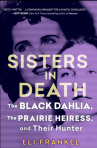
Eli Frankel has served as a television and documentary production company owner, Emmy-nominated executive producer, network executive, showrunner, editor, camera operator, writer, and director of multiple series for broadcast television, cable television, and streaming networks. As an avid true crime researcher and writer, he devoted more than five years to solving the mystery of who killed the Black Dahlia. The result of those years of research is Sisters in Death: The Black Dahlia, The Prairie Heiress, and The Hunter, and he recently talked about it with Daryl Maxwell for the LAPL Blog.
Do you remember how/when you first heard about the Black Dahlia murder?
I remember the exact moment. It was 1998, and I was editing TV shows for E! Entertainment Television, grabbing day shift, night shift, graveyard shift, take-it-as-they-come day player gigs on any show they threw at me. I'd edit anything, but the most exciting show to get pulled onto was "Mysteries & Scandals," hosted by AJ Benza. A remarkable show well ahead of its time, it exposed the most salacious and shocking stories from the Golden Age of Hollywood, many of which had never been told in a modern setting. Principal witnesses and participants in the stories were interviewed just before many of them would pass, leaving a rare historical record. For a 25-year-old film school grad obsessed with noir Los Angeles and desperate for work, the graveyard shift on the 3rd floor at 5500 Wilshire Boulevard was like my own private PhD program, albeit on a dark floor with no one else attending.
I was dubbing AVID outputs (making copies of edited sequences on tape) when I first saw the words "The Black Dahlia" written in pen on a VHS tape label. "What the hell is The Black Dahlia?" I thought. I popped the tape into a player to find out. Here was the story not of a celebrity or a famous director or studio chief, but of a short-term resident of Hollywood, a woman just like thousands of others newly arrived in postwar Los Angeles. And yet the story was haunting; I could not stop thinking about it. Against all company rules, I went to the E! post-production library and checked out the digital drives containing the raw interviews from the episode. I waited until the floor cleared out and then watched the unedited footage over the next week, soaking up every detail of the story.
In your Author's Note, you describe your initial interest in the Black Dahlia case as that of a "passive hobbyist." At what point did that interest change, and you became an active researcher?
In 2018, I acquired the 1,000 pages of District Attorney files related to the 1949/1950 Grand Jury investigation of the Black Dahlia murder and the LAPD's failure to close the case. Up until that point, I had read others' books, blogs, and articles on the case, believing any information that could be dug up had been and had already been exposed to the world. However, within the DA files was a trove of information that had never been reported, a web of details that, when put together, formed a different picture. I was determined to write it all down and try to put the puzzle pieces together—one day. Life was pretty busy, and spending a few hundred hours on a side-quest research mission was just not going to happen. And then the pandemic hit, sending my business and career reeling. Television and film production ground to a halt. No one knew when the business would be healthy again. For the first time in 20 years, I had time. The DA Files were waiting, and I jumped in.
How long did it take you to do the research and then write Sisters in Death?
I had already done several years of research before 2020, but over the next 3 years, I became much more serious about it, taking the research and interview skills I had honed in television and documentary producing and applying them to writing. I had to teach myself the skills, but I had a good foundation already. The biggest leap for me was cold calling strangers, a critical step in researching. Using online tools, I learned how to track down contact info for folks connected to the case and approach them for interviews. As I researched the case, the structure of the book began to evidence itself, so when it came time to start writing, I had a pretty good idea how I was going to move forward. The book took about 7 months to write, with another 4-5 months for rewrites, additions, and omissions.
Can you tell us some of the more interesting or unexpected things you discovered in your research?
There is so much I wouldn't even know where to begin. The entire journey was a series of unexpected twists and turns. What stands out is the rogue's gallery of characters populating the case. Postwar Los Angeles is a truly unique time in the city's history, and it attracted unusual and memorable characters. Elizabeth Short's time in Southern California brought her into contact with many unforgettable names, and researching the arc of their lives was nothing short of thrilling, especially the criminal elements. Those narratives didn't find their way into the book, but they helped explain the spirit of the age, the way people survived, their aspirations, and their expectations in a world that is so different from our own. It was like time travel for me, the ultimate trip.
Were you concerned, with all of the books, articles, documentaries, and television shows that had already been done about writing "another" book about the Black Dahlia Murder?
Absolutely. There's always a risk of wading into a well-worn subject of simply fading into the crowd. Go and spend the next five years writing and researching the JFK assassination, Watergate, or Jack the Ripper, and no matter how compelling the book it will always be seen as "yet another entry into the all-too-familiar subject of…" But the research I did led to what I believe are astounding and unknown facts about the case. Ultimately, a writer has to serve the truth, even if it means exposing themself to unjustified comparison.
Do you have a favorite of the existing books and/or documentaries?
Well, this is going to be a twisted answer which undermines itself but my favorite of the Black Dahlia books is John Gilmore's Severed, the first book on the subject, published way back in 1994. I'm a big fan of Gilmore's books. He was a true hard-bitten, street-level explorer of a Hollywood that no longer exists, with an eye for the real dirt. His writing style is tense and withholding, a perfect complement to the noir backdrops. I learned a lot from Gilmore. He knew many of the people he wrote about, which gave him insight no other writer could ever possess. Unfortunately, Severed is not historically accurate. It is simply a great story which takes place in late 40's L.A. The characters and events related throughout Severed never existed, but the world they inhabit is nonetheless fascinating and gives a lot of insight into the town and era.
Do you have a least favorite? (I realize that you may not want to address this one, and if that is the case, please don't. But I also realize it might be so bad that it could be fun to answer?
My least favorite would be any modern-day podcast that starts with the lie that Elizabeth Short was an aspiring actress desperate for fame who ironically only found it in death.
The Black Dahlia murder has become something almost everyone, especially Los Angeles residents, knows something about (like Jack the Ripper, the Zodiac Killer, or Jimmy Hoffa). What is it about these unsolved crimes that continues to fascinate us (even if they were committed over a century ago)?
What a great question. This is something I have spent a lot of time thinking about, and while I have ideas, I don't know that any of them truly answer the question. True crime is more than just salacious murder cases or some kind of fascination with gore. Every major case is, I believe, a lens into the darkest places of the human mind, a side of our own psyche we cannot peer into nor ever understand. However, we get dim reflections of it through certain murder cases. Jack the Ripperis an uncontrolled madman, an animal who kills at random and with no conscience. It is primal, a side of our human nature that existed long before logic, reason, and the construct of societal norms.
Zodiac is the polar opposite. He is the coldness of modern humanity—methodical, controlled, cautious, brilliant. He hunts us and finds us when we are alone and most vulnerable, and uses a gun to keep his distance, a mask to cover his identity. He uses cipher letters to mock our impotence against him. He is the id of our modern condition. The Manson Family represents the threat of psychological manipulation in the modern era, the fear that, underneath the surface, we are all capable of horrendous acts with just a modicum of reprogramming.
While people still investigate these crimes and provide their findings, collectively, we don't seem as interested in a solution as we are in having the ongoing questions... Why do you think we're unable or unwilling to accept definitive solutions to these crimes?
Two-fold: sometimes not knowing is more interesting than knowing. Enigmas, mysteries, and the unknown are endlessly fascinating because they allow our imagination to run wild, filling in the shadows with our ideas and theories. It allows us to create the answers we want to see, not the often mundane ones we eventually end up with. Definitive solutions, hard facts close the books, putting an end to 'anything-could-have-happened' speculation and the thrill of the hunt.
The other reason people often don't want to accept solutions is that it is very hard to prove a case beyond the shadow of a doubt decades later. Witnesses, evidence often go missing, resources are limited, and memories fade. Solving a case is very challengin,g and holes will always appear, even in definitive solutions. There will always be a reason to doubt a theory, even the 'case-closed' ones. Healthy skepticism in true crime is a good thing. But sometimes skepticism can also mean refusing to accept a preponderance of facts in blind pursuit of a more personally satisfying solution.
Are you concerned that this could happen with Sisters in Death and that diehard "investigators" of The Black Dahlia case will dismiss your findings?
Without a doubt The case is such an obsession for so many people that ideas become set in stone and any new evidence and theories simply do not fit into certain pre-existing narratives. At the same time, I welcome vigorous debate and look forward to discussing various aspects of the case. I want the skepticism, I want the questions, I want the holes to be exposed and discussed. Let's get to the truth.
Do you think there will ever be accepted solutions for Jack the Ripper, the Zodiac Killer, what happened to Jimmy Hoffa, or any of the other cases like them with huge followings?
Hard to say. It's always possible. I believe the Cleveland Torso Murders of the 1930s were definitively solved by James Jessen Badal in 2001 with In the Wake of the Butcher. Who would have seen that solution coming? Zodiac, I believe, has been definitively solved. It was Arthur Leigh Allen. Hoffa—we have a pretty good idea who did it and where the body was buried—I'll leave it at that. Jack the Ripper will never be solved. Aaron Kosminski and the DNA evidence from victim Catherine Eddowes' shawl was the last best effort using modern technology, but it seems to have fallen short. So, it's a mixed bag. But then again, do we really want Jack the Ripper solved? Doesn't the case live on in infamy because of the mystery? Then again, I sure would like to know who Jack the Ripper was, for our collective knowledge and certainly for the ongoing memory of the victims.
What's currently on your nightstand?
A half-eaten bag of chips, which I shouldn't be snacking on. Oh! You mean to read. Ironically, another book about the Cleveland Torso Murders—American Demon by Daniel Stashower—and Blood Slaves by Markus Redmond.
Can you name your top five favorite or most influential authors?
Jeff Guinn, Liv Constantine, Gregg Olsen, John Gilmore, Truman Capote.
What was your favorite book when you were a child?
My Father’s Dragon by Ruth Stiles Gannett. That book is my origin story. Not literally. But in every other way.
Was there a book you felt you needed to hide from your parents?
I was obsessed with Walt Disney growing up and over the years bought close to 60 or 70 books on his life and work. I don't think my parents were real thrilled with my choice of subject matter, so sometimes I had to make a purchase on the down low.
Is there a book you've faked reading?
Oh yeah. Did that quite a bit in college and almost got away with it. Recently, I attended a soiree filled with writers much smarter and more talented than I. The talk of the event was James Patterson's The Idaho Four, as the Brian Kohberger murder case was ongoing. Shamefully, I couldn't bring myself to admit I hadn't read what is widely considered a brilliant account of the case. And now the truth of my deception is known. I still haven't read it—but I'm going to very soon!
Can you name a book you've bought for the cover?
Devil in the White City, by Erik Larson. Best. Cover. Ever.
Is there a book that changed your life?
Demien by Hermann Hesse. And continues to. Ultimately, our journey is back to ourselves. The only question is whether we ever find our way there.
Can you name a book for which you are an evangelist (and you think everyone should read)?
The Gateless Gate: The Classic Book of Zen Koans. The key to understanding the nature of reality.
Is there a book you would most want to read again for the first time?
This is such an uninspired answer, but no. I actually really enjoy reading my favorite books again because there's so much more to discover, not to mention insight into how my perception of the book changed over time.
What is the last piece of art (music, movies, TV, more traditional art forms) that you've experienced or that has impacted you?
I watched The Day After recently, the infamous 1983 made-for-TV-movie which brought to life the reality of nuclear war. It still has as much impact 40 years later. An extraordinary film which changes your perception of geopolitics.
What is your idea of THE perfect day (where you could go anywhere/meet with anyone)?
Disneyland mid-week in the dead of January, when the crowds are at their lightest. With anyone. But ideally, with any Black Dahlia researcher who is prepared to spend the day debating. Disneyland and the Black Dahlia. That is one weird combination.
What is the question that you're always hoping you'll be asked, but never have been?
Why do you care so much about an 80-year-old murder case that has no connection to you, your past, or your life?
What is your answer?
I don't know.
What are you working on now?
A 1970's era thriller I am very passionate about.