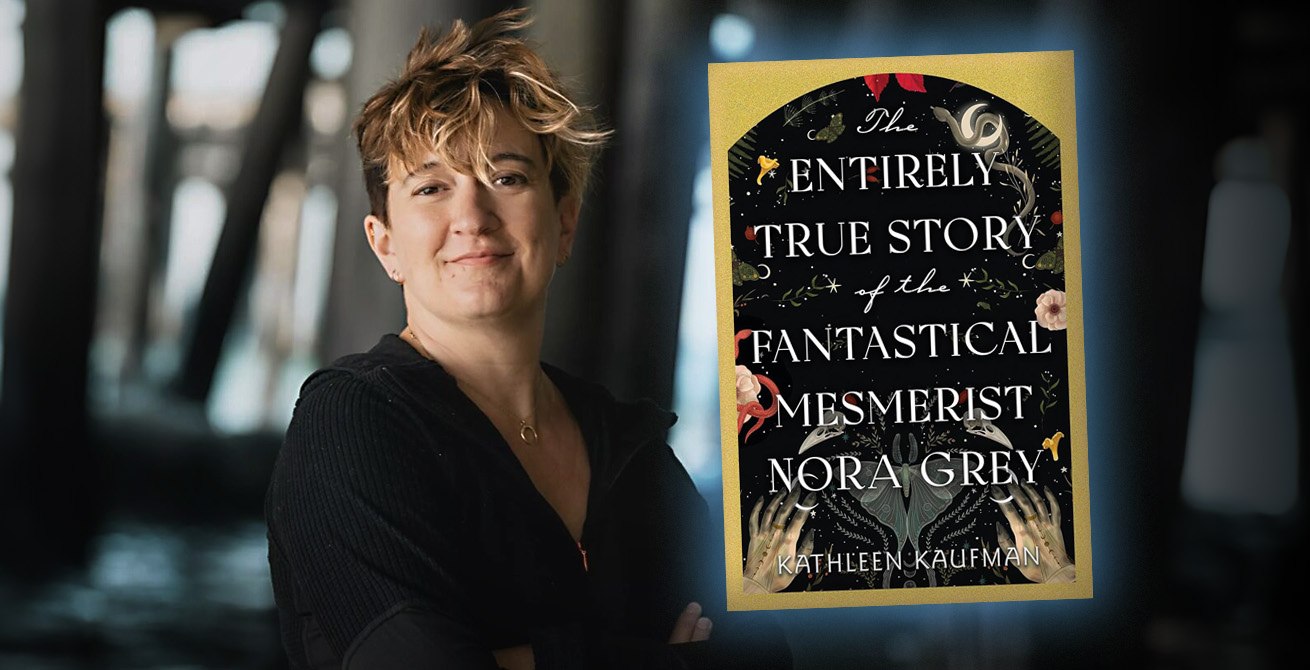
Kathleen Kaufman is an author of magical realism and feminist gothic horror, exploring "the other" from "the other's" point of view, how the horror of the past manifests in the present, and the inescapable intertwining of generational history. Her prose has been praised by Kirkus Reviews as "crisp, elegant" and "genuinely chilling" by Booklist. She is the author of the Diabhal trilogy, The Lairdbalor (soon to be a feature film directed by Nicholas Verso), Hag, and The Tree Museum. Originally from Colorado, Kathleen is a professor at Santa Monica College and lives in Los Angeles with her husband, son, kitten, and hound. Her latest novel is The Entirely True Story of the Fantastical Mesmerist Nora Grey, and she recently talked about it with Daryl Maxwell for the LAPL Blog.
What was your inspiration for The Entirely True Story of the Fantastical Mesmerist Nora Grey?
I somewhat recently became the caretaker of all the family records, which include hand-written family trees, letters, photographs, and drawn portraits that go all the way back to the 1800s. Among this treasure trove was the turn-of-the-century equivalent of a business card for my Great-Grandfather J.H. I grew up with stories about J.H.—a man so charming he could sell wool to a sheep. He was handsome, dashing, and an utter fraud at his chosen career of water diviner and psychic medium. This led to some very angry farmers and quite a few places in the Scottish lowlands where he was not welcome.
The stories vary in length and truthiness, but what we do know is that he left Scotland rather abruptly with my Great-Grandmother Effie. Once in the U.S., J.H. revived his career, this time touting himself as a 'mesmerist' and 'spiritual healer.' The same result, just different scenery, meant that J.H., once again, found himself 86'd from a number of towns. It was right about then that he was declared dead in a West Virginia coal mine accident.
Before you get too sad, my Great-Grandmother Effie was known to have a particular gentleman caller during her widowhood in Lyons, Colorado. The man was handsome, dashing, and so charming he could talk the honey from a bear.
I like to play with the what-ifs that life throws at us. In this case, what if J.H. had been the real deal? What if he had been a legit water diviner/medium/mesmerist/spiritual healer? I combined that with my love/obsession with the Victorian Spiritualist movement, and Nora Grey was born.
Are Nora, Lottie, Dorothy, or any of the other characters in the novel inspired by or based on specific individuals?
Nora is absolutely J.H. if he had legit talent. She's the best part of him, the genuine article, the gifted medium and psychic. She doesn't have his charm and pizzazz because she doesn't need it; she's the real deal and knows what she brings to the table.
Lottie was born as I was researching asylums of the time period. I joined MyHeritage, which is the British equivalent of Ancestry.com. A few rabbit holes later, I found a trove of original documents and first-hand accounts of the notorious Bethlem Royal Hospital, better known as Bedlam.
Lottie is based on the records of a woman named Clara Erwood, a Whitechapel girl who, like Lottie, married a Welsh man and then found herself widowed and pregnant in the 1840s. The records are spotty, but it does state that she was admitted by the London courts on the grounds of 'hysterical melancholy.' Her story was a combination of hand-scrawled court records and a haphazard account written by a female warden, who would later go on to file a complaint against Bedlam Hospital. There was no 'happily ever after' to Clara's story. It is indicated that her baby was stillborn. There was no record of what became of Clara at all.
Dorothy is a bit Madame Blavatsky, a bit Fox Sisters, and a bit Alma Felding. Madame Blavatsky was an outrageous 19th-century showwoman, founder of the Theosophical Society. Her seances were a spectacle and magic. Her persona was ice and fire. The Fox Sisters are described universally as beautiful, charming, and consummate professionals at their trade. There are accounts of their presence being so magnetic that their suitors would line up outside the show halls where they held their grand seances. Alma Felding was a London housewife in the 1920s who stunned the psychical societies with what became known as the first officially documented 'poltergeist' event.
I wanted Dorothy to be larger than life, beautiful with a presence that filled the room. There's a saying in theatre that you have to carry your own set of lights. Dorothy is her own light, a master show-woman who understands perfectly what the audience wants. She is mesmerizing, and her teeth are sharp.
Same question for Tavish (because, based on your Author's Note, I think there's a story or two)?
Ah, yes! See my lavish stories of Great-Grandpa J.H. above! Tavish is the roughest edges of Great-Grandpa J.H. If Nora represents the best of him, Tavish is the counter. Tavish is, at his core, a good person, a genuine person who loves his daughter and wants to care for her. He has absolutely no idea of how to be a father and how to live honestly.
So yes, Tavish is J.H. at his most devious. I grew up with so many stories about J.H. They were usually told when the family came together for holidays and the wine had been flowing a bit. My favorite is the one I share in my author's note for Nora Grey. The story goes that J.H. was riding his prize Clydesdale through the Scottish lowlands. And yes, according to legend (at least the legend that was born of late nights around the fire and perhaps an ale or two... ), he raised the most grand Clydesdale horses in all the land. His prize horse stood twenty hands tall (best not to completely believe that fact... ) and was a great black beauty of a creature with a mane of spotted snow and fog.
He was racing this creature, a regular kelpie if you believe the stories (and you best not), through a lightning storm set to cast the whole moor in flame. As he rode, a streak of lightning came down from Heaven above with the wrath of the old gods and the new (and perhaps a few angry farmers), and it struck the man entire as he rode through the storm.
When the horse rode into town (which town? Who knows?)—all that was left was his sapphire pinky ring that sat astride a charred saddle.
It bears noting that within the week, J.H. and my Great-Grandmother Effie were recorded as third-class passengers on a steamer heading to New England. It also bears noting that J.H. left behind a mob of angry farmers who had paid him to most definitely not find water on their land.
All of the stories surrounding J.H. live somewhere between the fantastical and edge of truth. It's no wonder that I became a writer. I grew up surrounded by these stories that wove the possible with the magical and were all the better for it.
How did the novel evolve and change as you wrote and revised it? Are there any characters, scenes, or stories that were lost in the process that you wish had made it to the published version?
I was beyond fortunate to have the eyes and expertise of my agent, Katelyn Dougherty, on even the earliest drafts of Nora Grey. Later, I had the team at Kensington go through multiple edits on content, history, language, style, and mechanics. I think the most difficult part of writing for any author is the editing. But the process I went through with this novel proves that if you are open to the process and willing to allow your creation to grow and change, it can turn into a beautiful monster.
A lot of the editing surrounded trimming it down. The original draft was well over 100,000 words, and it got significantly thinner as the edits went on. One darling that I had to kill but broke my heart was a bit that went along with Nora and Dorothy's seance at the Shin Mansion in Providence. As it stands, there is rather little background on the mansion or its occupants. In the original piece, and what will likely be its own novel one day, I had spun a truly creepy ghost story about the origins of the Shin Mansion haunting that were based on a real mansion in Providence bordering the infamous H.P. Lovecraft house.
Alack, it really was a deviation from the plot, as lovely as it was, and so, it was cut. I do think it will surface again one day.
How familiar were you with the Victorian Spiritualism Movement of the 19th century prior to writing The Entirely True Story of the Fantastical Mesmerist Nora Grey? Did you have to do a bit of research? If so, how long did it take you to do your research and then write the novel?
I was a bit familiar, but I realize now, it was very surface-level when I started my research. I read several books over the course of a couple of months: Kate Summerscale's The Haunting of Alma Fielding, Calling the Spirits: A History of Seances by Lisa Morton, Gary Lachman's Madame Blavatsky. I also listened to the second season of Aaron Mahnke's podcast Unobscured, which focuses on Spiritualism. That was really just the start. From that point on I found myself buried in texts about the Fox Sisters, Victoria Woodhull, Sir Arthur Conan Doyle, Cora Scott, Sojourner Truth, and so many more.
Then there was the research for Lottie, which found me digging through accounts of Bedlam Asylum, Bloomingdale Insane Asylum, Blackwell's Island.
All in all, I spent about three, maybe four, months of just research and marination time. I tend to do a lot of research as I go—I hit a wall, mark it, pause, fall into more research, resume writing. It was a wonderful journey all around.
As far as how long it took to write... about a year, but the initial plot and structural edits took another year after that, even before a team of experts got their hands on it.
What was the most interesting or surprising thing you learned during your research?
I was surprised at how progressive the Spiritualism Movement was and how it was really a conduit for the Abolitionists and Suffrage movement. I read a fascinating article about the presence of American Indian spirits that appeared through their white mediums. What was extraordinary about this was that the Native spirits did not speak pidgin English, as was the stereotype of the time. They were eloquent and expressed outrage and often echoed the racial politics of the reform movement. Were the spirits of Sagoyewatha and Tecumseh real? Maybe. But what is certain is that Spiritualism and the progressive movement were intertwined.
Another weird tidbit that I learned, and which had little to do with Nora Grey, was that there is a conspiracy theory surrounding the death of Harry Houdini. We all know that Houdini was a huge name in trying to debunk the Spiritualism movement. After all, who knew better than him how easy it was to fool an audience into believing an illusion? And we all know that he died from a ruptured appendix after being sucker-punched in the gut.
What I didn't know is that there is a conspiracy theory which states that his death was less accident and more political assassination on part of the Spiritualists in an attempt to silence his criticism and stop his efforts at unraveling the movement. No consensus on the veracity of this rumor; however, it is fascinating that Spiritualism was such a hard-core political and religious entity.
Have you ever attended, or participated in, a seance or tarot card reading? If so, can you tell us about it?
I was gifted my first tarot deck when I was around twelve years old. It was a beautiful Greek mythology themed deck that came with an interpretation and instructional book. I've been reading tarot cards for myself and anyone who asks since then. I actually collect decks and have way more than I can handle. Each deck is unique in its art and energy.
I fully believe that tarot cards are a tool to tap into your own unconscious mind. I do not believe they can foretell the future beyond what you see for yourself. Tarot is best used as a form of meditation or self-therapy. I use them when I am trying to puzzle out a complicated solution, or when I'm stressing about something. It helps to clear my mind and point out a path in the madness.
The only seances I have attended have been for entertainment purposes only, sadly. I would love to participate in an actual event with an actual medium. So if anyone out there wants to summon the dearly departed... call me.
Do you believe in ghosts? Have you ever had an encounter with something paranormal?
I do believe in ghosts. My mother is very sensitive and sees beyond the veil; thus, I grew up with her stories and her experiences. Lots of unexplainable things happened in our house growing up, and the next world was just something that we always talked about in very casual tones, without the barriers that other families had.
I could write a book about my mother's experiences—and did. 2018's Hag is based largely on my mother and so many of the stories she's told me about her life and adventures.
As far as my own experiences go, they are much more pedestrian and infrequent... so I will share one of my mother's experiences that I happened to witness.
I was seven, it was the night before the night before Christmas, and I was standing in a long line with my mother at a local sporting goods store. It was the sort of place where you could buy a soccer ball, a gallon of milk, and a lawn mower all in the same stop.
In typical small-town Colorado fashion, they also sold a range of hunting rifles, on display behind the counter.
As we're standing in line, there is a man in front of us who is obviously agitated and impatient, nothing extraordinary. All of a sudden, I see my mother go pale, and she turns to me and says:
"Did you hear that?"
I hadn't. She's obviously rattled as the line progresses. When the man in front of us gets to the top of the line, he indicates the hunting rifles, and a separate sales clerk takes him to the side for the transaction. We are checking out, about ready to go, when the interaction next to us breaks into a conflict. The man is arguing with the clerk, very animated and aggressive. A store security officer comes over and removes the man from the store. To my seven-year-old brain, this was peak drama, better than any soap opera, a live theatre performance right there in front of me.
When we got to the car, my mother is shaking. She tells me that while we were standing in line, a voice said clearly into her ear:
"He wants to buy a gun. He wants to blow someone away on Christmas Day. Don't worry, they won't let him, he's tried this before."
My mother has had things like this happen to her her whole life. It started when she was young, and even now at 84, she gets warnings and signs of the unseen around us.
I grew up with no choice but to believe in ghosts. I have empirical evidence that there is a world beyond what is dreamt of in our philosophy.
If The Entirely True Story of the Fantastical Mesmerist Nora Grey is adapted into a film or series, who would your dream cast be?
I would pass clean out if Mike Flanagan (The Haunting of Hill House, Midnight Mass) was at the helm. I love his poetic, gothic approach to his work.
As far as the cast goes...
Tavish: Matt Berry—I love his charm and Laslo-like wickedness. Dorothy: Kate Siegel—she's so gorgeous and steals every scene she's in. Nora: Rooney Mara—love her work, she has a quiet power that fills the screen. That being said, I have heard some really outstanding choices for dream cast from friends. Jessica Chastain as Dorothy would be just amazing. Recently I was told that a reader saw Tavish as Pedro Pascal. Pedro Pascal is absolutely fantastic in everything, and if he were Tavish, I would find a reason to visit set. Every. Single. Day.
What's currently on your nightstand?
I have a nightstand, but it's been long buried... It's been replaced by a towering stack of books consisting of TBR and completed. In the event of a nighttime earthquake, I will be buried in prose.
Right now—top of that stack:
A Better World by Sarah Langan—just finished. A delightfully disturbing dystopian that confirms why gated communities are super creepy. Nuclear War: A Scenario by Annie Jacobson. Fiction is scary, but not as scary as the truth. Jacobson interviews about a million experts to create this analysis of exactly what would go down, second by second, in the event of a nuclear bomb being launched at the US. It rattled the powers that be so much that they tried to stop distribution of the book. When I heard that, I immediately bought it. It's terrifying and a must-read.
Can you name your top five favorite or most influential authors?
Only five? Eek!
Margaret Atwood: I was introduced to The Handmaid’s Tale by my mother. She has always said that this novel was a total paradigm changer for her. We've seen that to be true for so many with the endurance of The Handmaid's Tale and The Testaments. My personal favorites from Atwood are the Maddaddam Trilogy, truly prescient and chilling dystopian fiction. I love that Atwood writes in so many genres, and refuses to be pigeon-holed.
Octavia Butler: The Parable of the Sower and Parable of the Talents should be required reading for humankind. I not only find Butler's work eerily prescient, but I also hugely admire her work ethic in regard to writing. The idea of persistence, dedication to your craft, and defying the odds really resonates with me. I teach a lot of her work including Parable of the Sower, Bloodchild, The Book of Martha, Dawn. She had a window into where humanity was headed unless we clean up our act quickly.
Tananarive Due: I fell in love with Ghost Summer and use it in both my high school and college literature courses. The Wishing Pool is absolutely brilliant. I am actually pretty hard to scare when it comes to books, and there were stories in that collection that left me with nightmares in the best possible way. Her newest, The Reformatory, is equal part mesmerizing and horrifying. She has a voice that feels so familiar. I've had the opportunity to see her read from Ghost Summer live, and she left the crowd stunned.
Emily St. John Mandel: Station Eleven is one of the most impactful and realistic apocalypse stories out there. It's another that I've taught for both high school and college, and it's incredible to see how my kids connected with it as well. Sea of Tranquility is a fantastic novel in the same universe, chilling and hopeful—it explores the idea of how we rebuild from the ashes. There are just so many by St. John Mandel that I love—The Glass Hotel, The Lola Quartet, Last Night in Montreal. She's another seer in writer form.
Shirley Jackson: I read The Haunting of Hill House at a young age, and therefore all other haunted house stories were ruined for me. That opening passage with the larks and the katydids sets a tone that has never been effectively replicated in horror fiction. We Have Always Lived in the Castle lives rent-free in my brain with its mix of madness and circumstance. Jackson is my "Goddess of Making It Happen." She wrote amidst the chaos of kids, life, noise, chaos and made it happen. Not only that, but she wrote across genres, never allowing herself to be labeled. Like Atwood, she just wrote and let the readers figure out later how we could categorize it.
There are so many others I could go on and on about but what these five have in common is that they are careful observers of humankind and have an eerie ability to follow the course we are on to the future. The prose is, of course, lyrical, beautifully mastered, cutting—and the message is a mix of hope and terror—my favorite state of being.
What was your favorite book when you were a child?
The Neverending Story by Michael Ende. I read that cover to cover about 1,000 times. It defined magical realism and fantasy for me as a child. It is a deeply philosophical story and as an anxious kid growing up in a house that was uncertain and populated with unreliable players—it was a guiding light. I wanted nothing more than to disappear into a book, and The NeverEnding Story was just that escape. I understood all the monsters that ruled Fantastica, whereas in real life, the monsters were far more ambiguous and confusing.
Was there a book you felt you needed to hide from your parents?
I grew up with my mother, who always encouraged my reading. That being said, I went through a phase somewhere around fourth grade where I was utterly convinced that we were going to be obliterated in a nuclear war at any moment. My mother, with good cause, tried to curb my consumption of the apocalyptic literature and films that I was ravenously consuming. This led to me reading Nevil Shute's On The Beach at way too young an age, hiding in the closet with a flashlight.
Is there a book you've faked reading?
While not proud of this—I will fully admit that I faked my way through James Joyce's Finnegan's Wake when it was assigned for a college course in my twenties. I tried, I really did, and I Just. Couldn't. Do. It. This was before the internet made it so easy to cheat on such things, so even faking reading a book took a lot more effort.
Can you name a book you've bought for the cover?
Very recently, I bought Leigh Bardugo’s The Familiar based solely on the cover. I had no idea what it was about- but between the title and that ghostly hand with the scorpion crawling on the sleeve—yes, and yes. The pages on the hard cover are gilded, and there was such an entirely satisfying physical sensation every time I turned a page.
The book itself is fantastic. Set during the Spanish Golden Age, it is such a magical mixture of historical fiction, magical realism, horror, and romance. It is a beautiful story wrapped in a beautiful cover.
Is there a book that changed your life?
I read Marion Zimmer Bradley's The Mists of Avalon as a teenager. I grew up in a congregational non-denominational church in a small town. The church took the flavor of whoever was the pastor at the time; hence, we had a rabbi, an ex-Catholic priest, an evangelist. At the time I was sixteen, we were Lutheran flavored, and I was going through confirmation.
The problem was that I was pretty sure I didn't believe in God, especially one with a capital G. The Mists of Avalon showed me a whole other pantheon and belief structure. It made me feel seen and confirmed my natural lean toward a more agnostic pagan outlook on the world.
Can you name a book for which you are an evangelist (and you think everyone should read)?
Just one? Agh!
Everyone should read Margaret Atwood’s The Handmaid’s Tale. I know, you've all seen the Hulu series, and I am a huge fan, but the book packs such a quietly powerful punch that you really need to give yourself the time and space to roll around in Atwood's cautionary tale. I think speculative/sci-fi writers are part seer, and Atwood's vision for this dystopian world back in 1985 is not just prescient, it's straight-up chilling. My mother always told me that this book changed her life. It was the first time she saw the reality of being a woman in the world reflected in print.
My second pick is Octavia Butler’s The Parable of the Sower—for the same reasons. Butler had a vision of the world back in 1993 that she said was in line with Robert Heinlein's Speculative Fiction definition, which was a 'if this continues' story. Parable begins in the summer of 2024, and the parallels between her vision and our current reality will make your hair stand on end. It's a beautifully written book that is a cautionary tale and also the story of Lauren's break from what she was taught to what she really believes.
Is there a book you would most want to read again for the first time?
I would love to read Suzanne Collin's The Hunger Games for the first time again. I love YA dystopian fiction and have read and consumed the entire Hunger Games universe. I love it all. I first read The Hunger Games when my son was small. I read it on the Kindle app on my phone while watching him play with trains and toys. I was distracted and exhausted, as all parents of littles are. Even in that half-conscious state, it knocked my socks off, and I would love to read it again for the first time, but actually be plugged in this go around.
What is the last piece of art (music, movies, TV, more traditional art forms) that you've experienced or that has impacted you?
I love theatre in all forms—stage plays, musical theatre, opera, symphony, ballet—all of it. We just saw the opera Rigoletto at the Dorothy Chandler Pavilion, and it was marvelous. It is, inherently, an opera about men behaving badly on all fronts. I love the opera so much—the formality of it, the stagecraft, the art. I love that it is not intended to reflect real life in any way; it lifts you out of the world for a bit and places you in an oil painting. I also love how inclusive the opera has become—while lots of work to be done, the casts are far more diverse than they were when I first saw performances as a child, and you see that reflected in the audience too. It's an example of a classical artform that is evolving (albeit slowly) and adapting to meet the modern world while still maintaining the magic that makes it so unique.
As of the writing of this response, my husband and I are set to see Hamlet at the Center Theatre, and I am downright giddy. Seeing Shakespeare live on stage is electrifying - the power of the language and ability of those words to convey an emotion that's as relevant now as it was in 1600.
And I have to give a shout out to the Nocturne Theatre in Glendale, where we recently saw Little Shop of Horrors in their intimate theatre-in-the-round. They are next level when it comes to musical theatre—the talent from the performers, costumes, sets, lights, sound is gobsmackingly amazing. It always inspires me to go home and make art—be bold.
What is your idea of THE perfect day (where you could go anywhere/meet with anyone)?
Ooh. I have been marinating on this question. I prize quietness so highly that my perfect day would really be quite pedestrian to most. First, the weather: perfect sunny SoCal summer—not too hot, not a cloud in the sky.
Morning: I would start my perfect day with a long paddleboard with my husband. We've been paddleboarding for a few years now, and it's just absolute Zen peace. We would go out past the marina into the open water off Venice Beach and just let the waves knock us around a bit. Ideally, we would see the sea lions on our way out and then watch the dolphins off the coast.
Lunch: Our favorite beach taco stand—best veggie tacos EVER.
Afternoon: Home—writing or reading time with a lot of iced tea. I like to write on our back patio where I can hear the Pasadena Parrots screech overhead and the crows fussing at each other. Our cat, Honeybee, chasing figeater beetles, Angus, my soul-dog at my side, occasionally woofing at a passing Labrador.
Evening: Dinner with my husband and son, maybe a movie or a favorite show with my husband and Angus. My son is a drummer, and listening to him jam in his room is a balm. I might play a little Baldur's Gate 3 or Civilization VII—which I have yet to win, but still have hope… That is my perfect day—beach, tacos, books, and the people and creatures I love most.
What is the question that you're always hoping you'll be asked, but never have been?
I am a member of the Horror Writers Association, and while my books meddle in Historical Fiction, Magical Realism, even Science Fiction—there is absolutely horror in there too. When you hang out with spooky people, everyone assumes that nothing scares you.
So my question that I've never been asked but would love to answer:
What scares you?
What is your answer?
Back in 2000, my husband and I were on our honeymoon in New Orleans. We took an absolutely fantastic haunted history walking tour. Our tour guide was a salty retired professor from the university, and he provided all the juicy stories mixed with a healthy dose of skepticism. New Orleans is all about the vampires, and at one point, after he had just told a particularly gruesome supposedly true story of vampire mayhem, someone asked him:
Do you believe in vampires? He replied that no, he didn't believe in undead creatures that craved blood and had unearthly powers of mesmerism, shape-shifting, and immortality. But he did believe that there were people who believed they were vampires. What scares me? People. I am pretty sure that vampires, werewolves, and zombies don't exist. However, in the immortal words of the salty tour guide: I am absolutely sure there are people who believe they are any number of or combination of these monsters.
Our capacity to cause harm to each other terrifies me. War, bombs, people struggling to exist in the face of starvation, loss, illness, injury. Our disregard for the planet, the environment, the animals and insects that are trying to coexist while we conquer the land with waste and pollution—the fact that we've invested an entire history into building weapons whose sole purpose is to make the Earth uninhabitable.
And that's not even scratching the surface of the more personal horrors—murder, rape, assault that happen every day. So yes, my answer to what scares me is People. But having said that, I believe firmly in duality. While we all might be capable of incredible horror, we are also capable of equally limitless love. I hold to the hope that the better angels of our collective nature will overpower the darkness.
What are you working on now?
Right now I am working on edits for my upcoming Summer 2026 release—Past The Graves, which takes place on present-day Bell Island and explores the lineage of Lady Loreana Bell and the magic that exists in this space. I'm immensely excited for this release. It is my love song to the summer I spent in Vestmannaeyjar, Iceland. I saw and experienced so many magical things during this time, and it was fun to create Bell Island and walk through Bell Manor as I wrote this story.
I am also playing with a draft zero about Dorothy Kellings and the years after Nora Grey. It's a sketch of an idea at this point, but Dorothy is hella fun to hang out with, so I visit her in this draft at every opportunity.