The Legacy of D.H. Lawrence: Often Censored, but Never Forgotten


Sept. 11, 1885 is the birthdate of D.H. Lawrence, who rose from a working-class family in an industrialized England to become one of the most important and controversial authors of the early 20th century.
David Herbert Lawrence, whose father was a coal miner in the industrial village of Eastwood, Nottinghamshire, gained an interest in literature through his mother, who studied to become a teacher. The marital conflicts that Lawrence witnessed in his own family would be an influence on his life and his writings. Lawrence would eventually become a veritable Renaissance man in literature, including being an accomplished playwright, poet, essayist, travel writer, critic, and painter. Lawrence would become a leading force in the literary movement known as modernism.
At the heart of Lawrence's writings are the complex sexual dynamics between men and women, the debilitating forces of modernity, including industrialization, his own love of nature, the mysteries of sexual attraction, and the emotional energies involved in friendship between males. Lawrence's work would draw the ire of criticism in post-Victorian society, leading him to be labelled as obscene and pornographic; his works became the subject of obscenity trials and sometimes bore the mislabeling of eroticism.
Lawrence worked as a teacher until he could support himself as a writer. Although he suffered from debilitating tuberculosis, he traveled extensively in his lifetime and left detailed accounts of his travels. He purchased property in Taos, New Mexico, and dreamed of developing a new Utopia for artists and free thinkers. The property is known today as the D.H. Lawrence Ranch.
It was not until after his death that Lawrence was celebrated as a genuine literary figure; his work was championed by the renowned critic and author E.M. Forster, who called Lawrence "the greatest imaginative novelist of our generation."
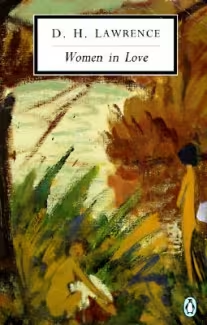
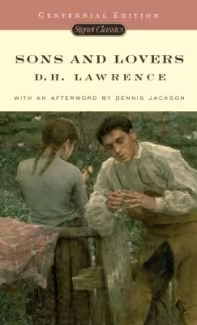
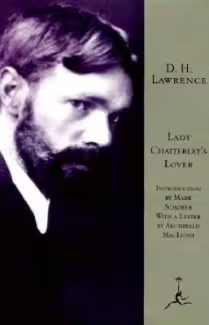
Whether you are familiar with this renowned author or you want to explore his works for the first time, here are this blogger's picks for the best of D.H. Lawrence in the Library Catalog.