Interview With an Author: Gareth Brown

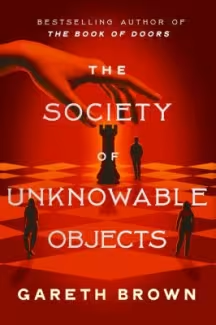
Gareth Brown is the author of the international bestseller The Book of Doors. He wanted to be a writer from a very young age, and he completed his first novel as a teenager. For the last twenty years, he has worked in the UK Civil Service and the National Health Service while writing in his spare time. When not working or writing, Gareth loves travelling, especially the whirlwind first few hours in a new city and long road trips through beautiful landscapes. He enjoys barbecues, patisseries, playing pool, and falling asleep in front of the television like an old man. Gareth lives with his wife and two impudent and highly excitable Skye terriers near Edinburgh in Scotland. His latest novel is The Society of Unknowable Objects and he recently talked about it with Daryl Maxwell for the LAPL Blog.
What was your inspiration for The Society of Unknowable Objects?
I think two things really inspired The Society—firstly, it was the idea of secret societies. I've always loved the mystery and intrigue that comes with secret societies, the rituals and routines, the meetings, all of that! I wanted to do something about a society of people who live everyday lives, but who share a hidden mission.
The second thing was Hong Kong. In the same way that New York City really inspired me to write my previous novel, Hong Kong was a place I'd been to recently, and for some reason, I just started thinking about it a lot when I was developing this novel. I wanted to travel there again. I wasn't able to go back myself, so I sent Magda, the main character in this novel, in my stead!
Are Magda, Frank, Henry, Will, James, or any of the other characters in the novel inspired by or based on specific individuals?
I don't think so... certainly there is no single person who inspired a single character. Will is probably the most like me in the sense that he's an introvert, scared of change, and comfortable in his routine! Frank probably shares my love for soft drinks and biscuits... but other than that, no, I think the characters were all their own people.
How did the novel evolve and change as you wrote and revised it? Are there any characters or scenes that were lost in the process that you wish had made it to the published version?
In the process of editing, this novel moved from being more of a multiple-point-of-view piece to a novel primarily from Magda's point of view. This was a note from my editors—and I think it was absolutely right, the novel really should be about Magda's journey. But as a result of that change, there were a few scenes that I lost because they couldn't be told from Magda's perspective. There was an introductory scene with Henrietta that I loved, and there were more scenes from the perspective of Lukas, explaining some of his mysterious backstory. It would have been nice to include those, but nothing is ever lost. Maybe these scenes will reappear in something else in the future, in some form.
In your Acknowledgements, you state that while The Society of Unknowable Objects was a much more straightforward novel than your debut novel, The Book of Doors, it also "took three times as long to write, and felt ten times more difficult." Can you tell us a bit more about why you felt this while writing The Society of Unknowable Objects?
Partly this was because I started too soon, I think. I knew I had to write a second book, so I just wanted to make progress. I probably should have taken a few months to let the story gestate before starting. I ended up working out the story while writing, which meant I was writing and rewriting to see what would work. A big challenge was also trying to work out who the villain was and what their motivation was. I was determined not to just repeat what I had done in the Book of Doors. I wanted something different, something interesting, and it took me a long while (and a lot of writing) to see what it was.
Bell Street Books sounds lovely! While there aren't as many as there used to be, London has so many marvelous bookshops. Did you base Bell Street Books on a real bookshop? Do you have a few favorite bookshops in London? Somewhere else?
It's not based on a real bookshop—it's entirely what I imagine a perfect second-hand/antiquarian bookshop would be like. I love any bookshop, but Daunt's in Marylebone in London is lovely, just for atmosphere. It's always busy though, which is annoying! I love the Waterstones on Gower Street in London—it's a lovely, rambling old building with nooks and crannies. Edinburgh, where I live, has lots of great bookshops, and some lovely independent ones. There's a fabulous one called Topping and Company, which is in an elegant Georgian building, with high ceilings and rolling ladders on the bookshelves and beautiful views over the surrounding streets. I love it.
In our last interview, you said that you started The Book of Doors in New York because it is one of your favorite places and it allowed you to vicariously travel there. Why/how did you decide to set part of The Society of Unknowable Objects in Alabama? Is it also somewhere you've visited and enjoyed?
No, I haven't been to Alabama—although I have been to both Mississippi and Georgia, funnily enough. When I was working out the plot, I wanted somewhere rural and remote, and somewhere that had that slightly rundown small-town USA feel. I remember watching some random videos on YouTube, and I came across a guy who was visiting abandoned houses in rural Alabama, and that just grabbed me. It was exactly the right atmosphere—creepy and unsettling even in the daylight.
If you could have one of the "unknowable objects" that are in the novel, which one would it be?
This is a spoiler, so if anyone reading this hasn't read the book yet, look away! I think having James' pill bottle to guarantee a long and happy life would be fabulous. I am lucky that I've never been seriously unwell, and I think it is easy to take good health for granted. Our life is probably the most valuable thing we have, so being guaranteed to have it for a long time, that would be lovely. I also would love to be able to fl,y though... and to walk through walls... Y'see, this is the difficulty: when you know about unknowable objects, it is hard not to covet them all.
If you could create your own "unknowable object," would you do it? If so, what would it be/do? If not, why not?
I think I would... because I trust myself not to misuse it. I suppose the danger is if it fell into the wrong hands, so I'd have to think very carefully about what I wanted it to do. All of the objects described in the novel are essentially me thinking about what I'd love to be able to do, so in terms of what it would do/be, I refer you to my previous answer!
What's currently on your nightstand?
I have just finished reading an advance copy of the second book from Sunyi Dean—The Girl With a Thousand Faces. It was fabulous—highly recommended when it is released next year. Next on my list to read is Artificial Wisdom by Thomas R. Weave, another advance copy I received from my publisher, or The Kingdoms by Natasha Pulley, a novel I've been wanting to read for several years now. I'm not sure which of the two I'll pick.
What is the last piece of art (music, movies, TV, more traditional art forms) that you've experienced or that has impacted you?
I've had a really good year when it comes to television. We recently finished watching Department Q on Netflix, which is set in Edinburgh. That was excellent. More recently, we watched Paradise, which does some really interesting things with well-worn thriller/intrigue tropes. The penultimate episode of that series is one of the most gripping things I've watched in a few years. In more traditional art forms, my wife and I went to see Oliver the musical, in the West End, earlier this year when we were in London. That was fabulous.
What are you working on now?
I am very lucky that we've just agreed a new deal with my publishers in the UK and the US, so I am hard at work on my next novel. I can't tell you anything about it though—it's top secret!