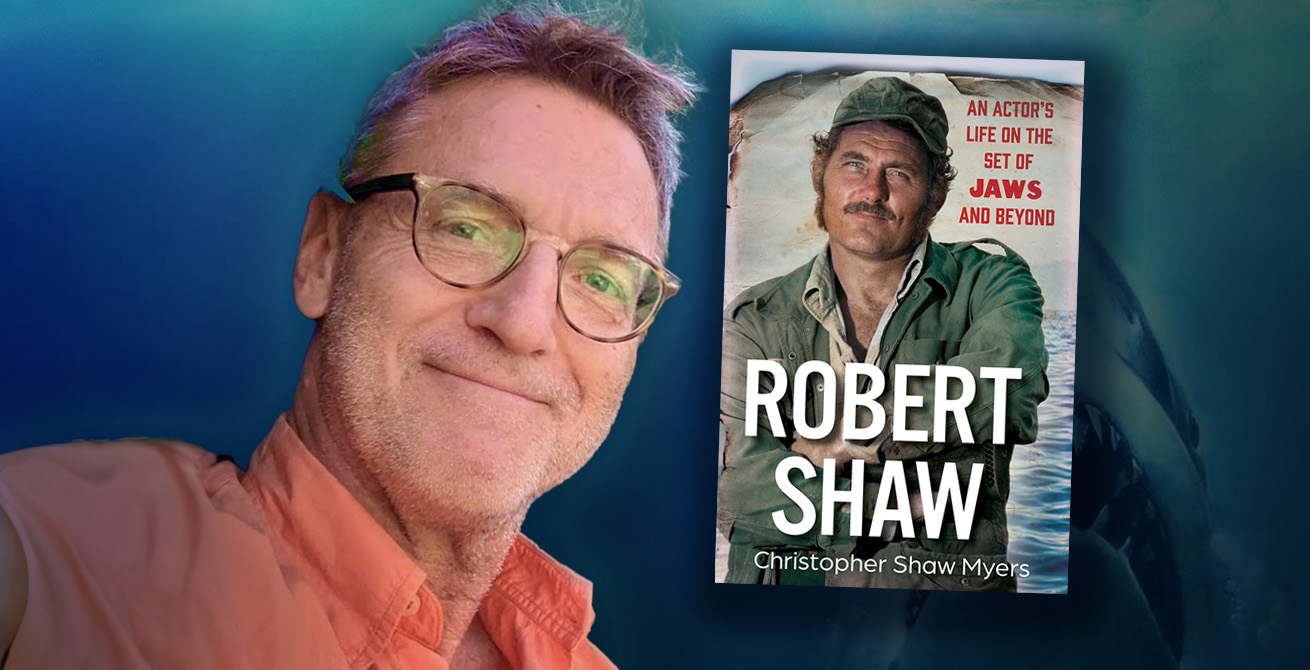
Christopher Shaw Myers grew up listening to the stories told by his colorful uncle, Robert Shaw, and other family members. Born and raised in Pennsylvania, he attended Trinity College, where he double majored in English Literature and Mathematics, and Columbia University, where he received a master’s in business administration. After a 30-year career in the hi-tech field, he delved deeper into his family’s history to explore the magic that Robert and his siblings cultivated in their lives. His book is Robert Shaw: An Actor’s Life on the Set of Jaws and Beyond and he recently talked about it with Daryl Maxwell for the LAPL Blog.
What inspired you to write about your uncle in Robert Shaw: An Actor’s Life on the Set of Jaws and Beyond?
When I was growing up, Robert Shaw was not known as Quint. He was just my uncle. He was larger than life, he took over a room whenever he entered, but he was still just my uncle—albeit, a bit crazy at times, laugh-out-loud funny and a great storyteller.
I began this book as a biography of my mother, Joanna Shaw, who was Robert’s younger sister and best friend in life. She also led an interesting life: she attended Cambridge University at a time when very few women went to any university; she fought Apartheid in South Africa and conferred with Nelson Mandela (before he went to prison); she worked full-time while raising seven children; and then, when she discovered they were paying the men more than the women, she sued and won her case.
And, oh-by-the-way, Joanna grew up with Robert Shaw and knew him better than anyone in the world. Not only did they remain best friends throughout their lives, but she was often backstage with him after a Broadway play, she visited Robert on multiple movie sets, and she was on the set of Jaws for a week and witnessed what was happening when the cameras were not rolling.
I spent hundreds of hours interviewing my mother, and in the process, I learned what Robert Shaw was really like: as a boy, as a teenager, and as a young man. The more I learned about Robert, the more I realized this would be of interest to everyone.
In your Author’s Note, you talk a bit about how you wanted to capture the special relationship that existed between Robert Shaw, your uncle, Joanna Shaw, your mother, and Doreen Avery Shaw, your grandmother, in this book. To do so, you relied on memories, your own and others, along with family documents your mother had, and outside resources. How long did it take you to explore and research these different sources and then write Robert Shaw?
When I was five years old, my mother began taking me with her to New York City whenever Robert was in town. He always seemed to be there, for a play, a movie premiere, or a meeting with executives. I sat and listened to Robert and my mother howl with laughter as they recalled their youth, especially their teenage antics during World War II.
Robert and Joanna Shaw had what most people would consider a tough childhood—their father committed suicide before they were teenagers, they went from riches to rags, their mother was critical of everything they did, and World War II had just begun—everyone was afraid Germany would invade. And yet Robert and Joanna did not talk about those things: they chose to remember all the fun they had.
So yes, this is a biography of Robert Shaw, but it is also about his family, especially his mother and sister, because they are also interesting, and equally important, their stories put Robert’s story into context.
What was the most interesting or surprising thing that you learned during your research?
Robert was the type of person that people either loved or hated. There was rarely any in between. People either loved his humor, his intelligence, and his fabulous storytelling ability, or they hated his competitiveness and arrogance. The ones who loved him were comfortable enough in their own skin to dish it right back at him, and they always performed better as a result. Richard Dreyfuss and Sean Connery come to mind. In Jaws, Robert constantly needled Richard Dreyfuss when they got into costume, and the young actor turned in one of the great performances of his career. In From Russia With Love, Robert did the same thing to Sean Connery, and the James Bond franchise was born.
What was the most interesting or surprising thing that you learned about Robert Shaw and/or his work/career during your research?
I was surprised to learn how generous Robert Shaw was with his money. I knew he had paid for my mother to get her PhD, after she told him she needed it to advance in her career. But I did not know that this was a lifelong habit, that Robert gave away money to friends and family whenever they needed it. And more interesting, he did this not only when he had money to give away, but when he did not. Even as a struggling young actor, barely scraping by, he told everyone about a new part if he heard about it first, and invited them to compete with him to win the part. Most young actors would keep that information to themselves, to have a better chance at winning the part, but not Robert Shaw.
Was there something interesting or unexpected you discovered about someone else?
If an outsider were to ask, "Who had the biggest personality in the Shaw family?" the answer would most likely be Robert Shaw. And it is true that he had an enormous personality. But what surprised me was that Robert’s mother—my grandmother, whom I called Ouma (Dutch Afrikaans for grandmother), but I call her Mrs. Shaw in the book because that is what she preferred—actually had the biggest personality in the Shaw family.
When I was a boy, Ouma terrified me: she could praise or insult you, often in the same breath. As an adult, I came to realize her criticism was largely tongue-in-cheek, and I began dishing it back at her, which she loved. Then, when I began speaking to my mother about her, I came to admire her toughness. Ouma's husband killed himself, leaving her with no money and five children, just as World War II began, but she not only got them through it, she put each of her children firmly on the path to success.
Robert is the best known of those children, but all five went on to success in their fields: the second child attended Oxford, the third attended Cambridge, the fourth went to a prestigious medical school, and the fifth became known throughout England for her work in autism. Those five children could have become bitter after their father’s death, their lives could have spiraled downwards, but just the opposite occurred, and that is a testament to Mrs. Shaw.
Are there any stories, or events that were lost in the process of writing the book that you wish had made it to the published version?
That will be in my sequel.
Robert Shaw performed as an actor on television, the stage, and in motion pictures. He also wrote novels and plays. Do you have a favorite of his published works? His television, stage, or movie performances?
My favorite of Robert’s published works is his first novel, The Hiding Place. It was turned into three separate movies, two on television and one in the movie theaters. It is a fascinating study in what we now call the ‘Stockholm Syndrome’—two pilots are captured during the war by a lonely old man, who keeps them in a cage in his cellar until long after the war ended… because he is lonely.
My favorite of Robert’s movies (aside from Jaws) is A Man for All Seasons. Robert only has twenty minutes of screen time, but he received an Academy Award nomination because those twenty minutes are as intense as any scene in movie history.
What is your strongest or fondest memory of him as your uncle (and not a world-famous performer/writer)?
I mentioned earlier that he was my "just crazy" uncle when I was growing up. One of my earliest memories was after he did the James Bond film, From Russia With Love, and suddenly the adults in our neighborhood all wanted to meet him. So the next time Robert was coming for a visit, my mother organized a small party and invited our neighbors. She didn’t tell Robert there would be about thirty people waiting to meet him at our house, so he was quite surprised when he walked in. Then, recovering his composure, he announced in a loud voice: "You’ll have to forgive me if I fart, it’s a condition I have and my doctor has told me not to hold it in."
There was a look of horror on the face of nearly every adult in the room, but my brothers and I, who were all under ten years old and watching from the stairs, burst out laughing.
Robert Shaw passed in 1978. When was the last time you saw him or spent time with him before he died?
I began college in 1975, so I was not home when he visited after that. My last memory of seeing him was just after Jaws came out: Robert was in town to promote the movie, and afterwards he took us out to lunch and told some very funny stories about all the mishaps that occurred while the movie was being made.
My last indirect memory of him was when my mother called me and told me he had died. It was the only time I ever heard her cry.
If you had the chance to ask or tell him something now, after completing your research and writing the book, what would it be?
Having now written a book of my own, and discovering how hard it is to write, I would love to talk to him about where he got his inspiration for his novels and plays, and how he had the discipline to write so many of them (he wrote five novels and three plays) while working full-time as an actor (not to mention being a father of ten children).
Jaws is celebrating its 50th anniversary in 2025. What do you think it is about Jaws that has made, and kept it, a cultural phenomenon for half a century?
There have been so many articles written about Jaws that it would be hard to add something new to the mix. Overall, I would have to point to Steven Spielberg as the unifying reason for its success—everything that has been written ultimately points back to him, because he was the boss, and as Robert pointed out, Spielberg was a "genius."
Having said that, I will highlight two reasons that you do not hear as often, but which I think are the most important reasons for the success of Jaws. The first is the strength of the script. Quint, Hooper, and Brody represent the three elements of Plato’s Republic: Quint is the warrior, Hooper the intellectual, and Brody the statesman. As Plato noted, when those three elements are in harmony, an individual or a society is in harmony; but when they are not in harmony, tragedy follows. Of course, in Jaws they were very much out of harmony—the statesman (Brody) should have been making the decisions (e.g. to radio for help, to get a bigger boat, etc.), but the warrior (Quint) kept overriding him (by smashing the radio, etc.). And as Plato might have predicted, the ending of Jaws did not go well for the warrior!
The second reason is the USS Indianapolis speech. That is one of the great monologues in movie history, and I would argue that it rises to the level of a Shakespearean soliloquy. Just as Hamlet unburdened his soul with "To be or not to be…" Quint unburdened his soul with "Eleven hundred men went into the water…" In both cases, the lead character appeared to be insane, even suicidal, until they spoke directly to the audience and explained what lay behind their apparent insanity. The camera was on Robert for three minutes during that speech, an extraordinary amount of time in any movie or play, and it helped elevate Jaws to a film classic.
As a debut author, what have you learned during the process of getting your book published that you would like to share with other writers about this experience?
Don’t give up! There were so many times when I could have folded up my laptop and stopped the process, but I never did. It takes perseverance, in addition to a belief that you have something special.
What’s currently on your nightstand?
I am now researching my next novel, which will be a YA trilogy—so my bookstand has several great YA novels, including The Giver, The Lion The Witch And The Wardrobe, and Wind in the Willows. One of the great things about rereading YA literature is that the best of them are just as interesting for adults as they are for teenagers: the characters are so well drawn and the situations so funny that I find myself enjoying them all over again.
Can you name your top five favorite or most influential authors?
Charles Dickens, Joseph Heller, Jane Austen, Arthur C. Clarke, Mark Twain.
What was your favorite book when you were a child?
As a teenager, it was Dune, by Frank Herbert.
Was there a book you felt you needed to hide from your parents?
No. I was a good kid.
Is there a book you've faked reading?
You couldn’t really fake reading in my day—there were no internet synopses, etc. I was an avid reader as a kid, and I still am.
Can you name a book you've bought for the cover?
No.
Is there a book that changed your life?
Catch-22, by Joseph Heller. Until then, I did not realize one could look at the world and see something completely different from everyone else.
Can you name a book for which you are an evangelist (and you think everyone should read)?
Catch-22.
Is there a book you would most want to read again for the first time?
I have reread Dune several times as an adult and still enjoy it. And now, with the latest screen version of the story—which I think is very good, and true to the novel—I am reexperiencing it once again.
What is the last piece of art (music, movies, TV, more traditional art forms) that you've experienced or that has impacted you?
I was in the Stonington Lighthouse museum recently, along the CT shoreline, and learned what it was like to be a lighthouse keeper. Europeans often joke that the United States is a very young country—their relics to the past are sometimes thousands of years old—but I nevertheless enjoy learning about the people who lived two hundred years ago.
What is your idea of THE perfect day (where you could go anywhere/meet with anyone)?
I would be in Cinque Terre, Italy, with my wife. We would have a leisurely coffee and breakfast in a small café along a narrow, cobblestone street; we would read a book by the ocean, occasionally going in for a swim; then we would have dinner with some local people and go home, laughing at all the fun we had.
What is the question that you’re always hoping you’ll be asked, but never have been?
What is the meaning of life?
What is your answer?
42
What are you working on now?
Yes, I am writing a Young Adult (YA) trilogy about three handicapped boys—each living in a different country (United States, India, Argentina)—who want to follow in their father’s footsteps and become a professional athlete (in baseball, cricket, and soccer). Each boy has a different handicap, and each must overcome both the handicap and the stigma that comes with it in order to succeed. PS: Each does so with the help of a mysterious fortune teller.