
A City Engaged: Los Angeles in the Civil Rights Era


Los Angeles has always been a city of rich cultural diversity, often serving as a beacon of prosperity for migrants and immigrants around the globe. However, the existence of an ethnically diverse population has not always translated into racial equality, nor rendered the City of Angels immune from policies of discrimination. Segregated public spaces such as beaches and community pools lurk in our city’s history, along with the now notorious racial covenants written into real estate deeds, prohibiting people of color from owning property in certain neighborhoods. However, this checkered past also prompted local citizens to actively engage in the Civil Rights movement that was sweeping across the country in the 1960s, which brought Los Angeles into the national conversation.
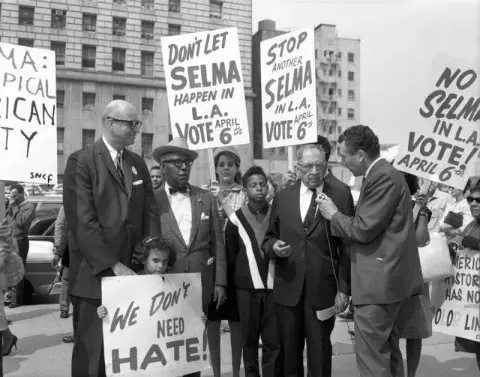
Local activists protested in favor of fair housing and equal education, and against police brutality, among many other issues. The local chapter of the Congress of Racial Equality (CORE) was especially active and led the charge for many of these activities. Leaders on the national level such as Martin Luther King Jr., Malcolm X, Shirley Chisholm, and Jesse Jackson made public appearances in Los Angeles to spread awareness of civil rights struggles, as did prominent figures of arts and entertainment like singer Odetta and boxer Muhammad Ali. Los Angeles may not be the first city that comes to mind in association with the Civil Rights Movement, but it was by no means inactive.
Local newspapers, such as the Los Angeles Herald Examiner and the Valley Times were on hand to document the numerous leaders and activities on the forefront of Civil Rights across the city. Through the adept lens of the papers’ photographers, speeches, protests, and rallies that occurred a half century ago come alive and still resonate as the city and country continue to revisit many of these same struggles. In addition to newspaper representatives, individual photographers such Rolland Curtis, who served on staff for Councilmembers Tom Bradley and Bill Mills, also contributed to the historical record with their own images of this pivotal time.
As custodian of the Herald Examiner, Valley Times, and Rolland Curtis image archives, among others, the Los Angeles Public Library plays a vital role in preserving the photographic record of Los Angeles history at large, including its role in the Civil Rights era. As a public institution, the library also bears the important responsibility of making this history accessible, which is demonstrated in the selection of images currently displayed in the Getty Gallery at Central Library. Through these collections, we are able to ensure Los Angeles’ place in history is available for all the world to see.
A City Engaged: Los Angeles During the Civil Rights Era, a companion exhibit to For All the World to See is on display in the Getty Gallery through May 25, 2018.
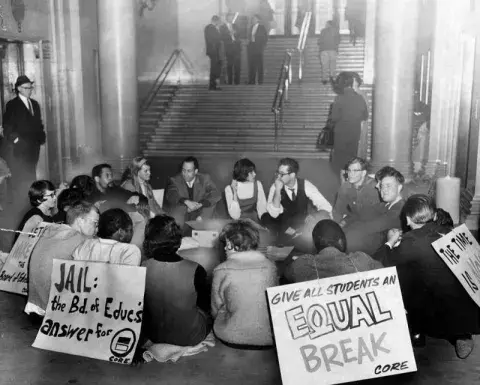
CORE members sit on the floor in the Hall of Justice rotunda on January 30, 1964, in a sympathy demonstration for a jailed member. Herald Examiner Collection/Los Angeles Public Library
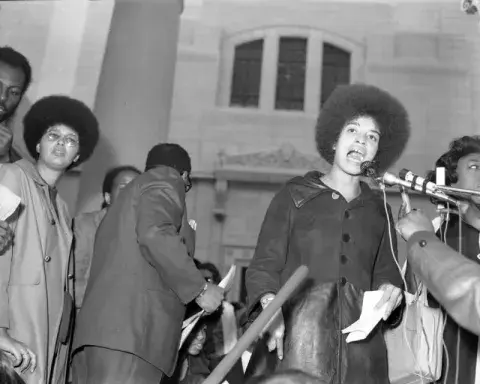
Angela Davis speaks from the Spring Street steps of City Hall during the community rally on December 11, 1969. Between 3,000 and 5,000 people came out to protest the deteriorating relations between the Los Angeles Police Department and the Black Community. Protesters claimed that officers applied excessive force during their raid on the Southern California Headquarters of the Black Panther Party for Self-Defense, 4115 S. Central Avenue, three days before. Rolland J. Curtis Collection/Los Angeles Public Library
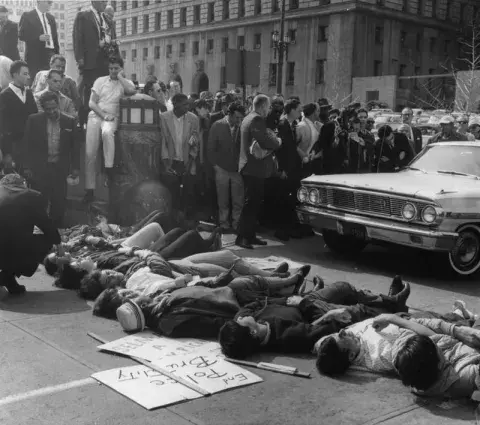
Civil rights pickets block the Los Angeles Federal Building driveway in 1965, preventing this car and mail truck from moving either in or out. Marshals arrested 98 demonstrators on a variety of charges. Phil Hanna, Valley Times Collection/Los Angeles Public Library
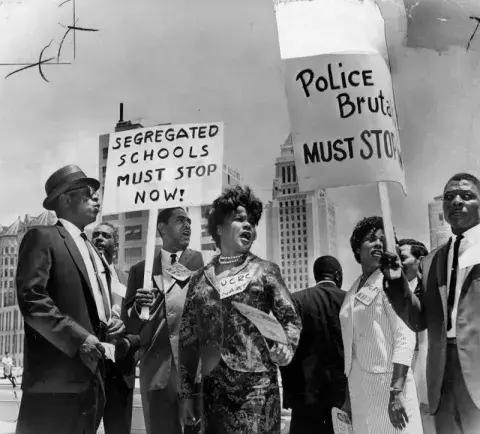
Integrationists carrying signs, pause near City Hall on their way to the Board of Education in 1963. Los Angeles Herald Examiner Collection/Los Angeles Public Library
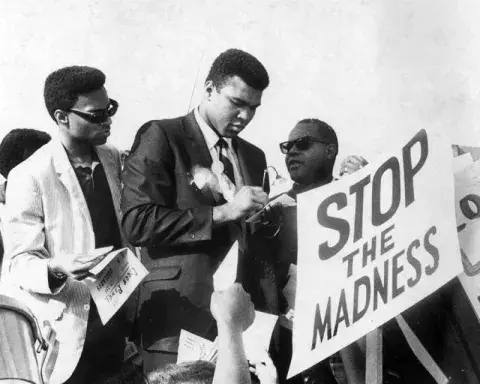
Muhammad Ali signs draft cards during a protest at Cheviot Hills Park in 1967. Los Angeles Herald Examiner Collection/Los Angeles Public Library
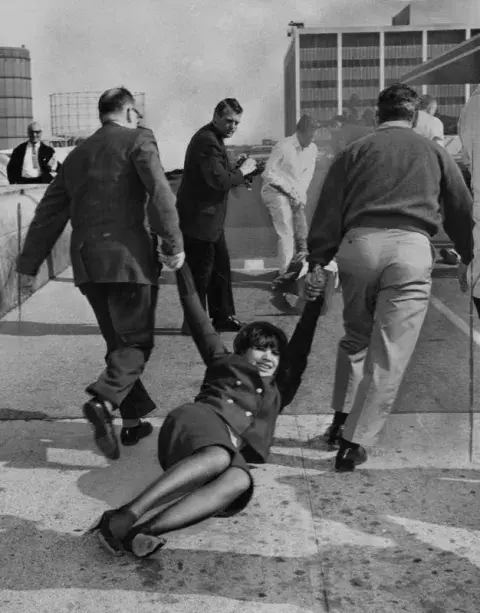
A civil rights demonstrator is unceremoniously dragged across the driveway of the parking lot on the Spring Street side of the Federal Building in 1965. Terry Sullivan, Los Angeles Herald Examiner Collection/Los Angeles Public Library


