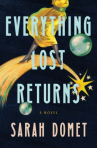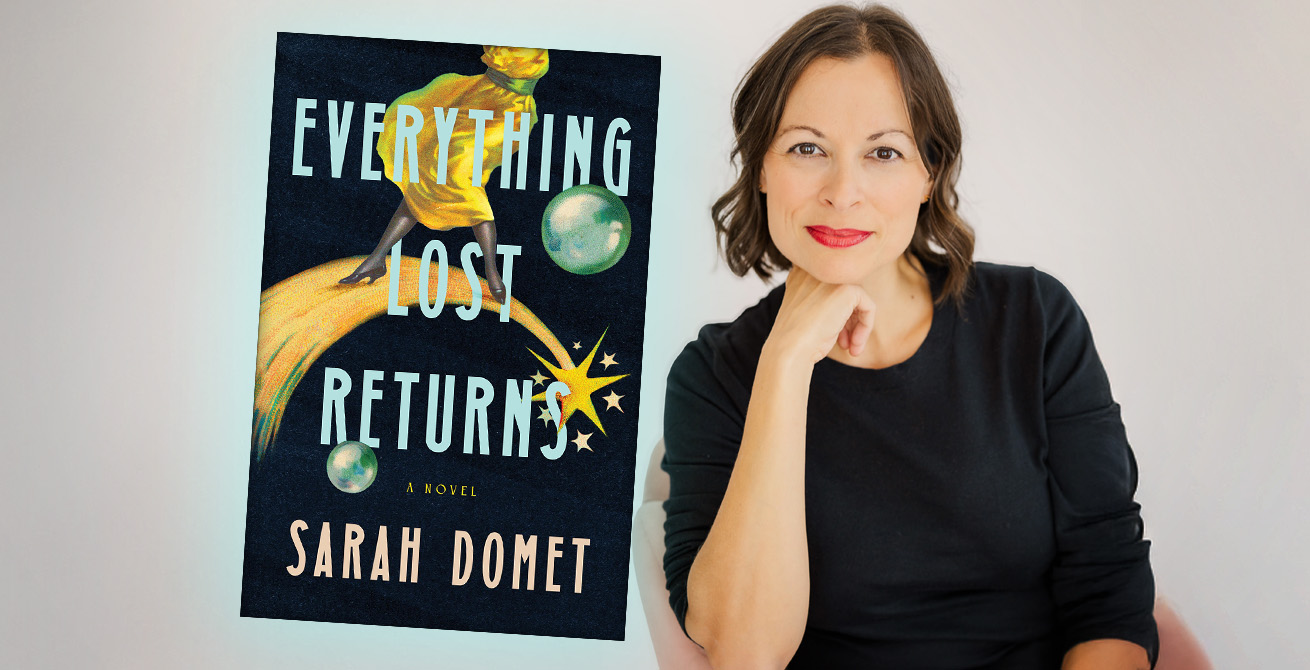
Sarah Domet is the author of the novel The Guineveres and the craft book 90 Days to Your Novel. She is a professor and the coordinator of the MFA program in creative writing at the University of North Carolina Wilmington. Her latest novel is Everything Lost Returns, and she recently talked about it with Daryl Maxwell for the LAPL Blog.
What was your inspiration for Everything Lost Returns?
So many experiences and interests came together as inspiration for this book—my life-long obsession with Halley's Comet, my burgeoning curiosity about feminist spiritualists, my hometown's soapmaking history, my teenage compulsion to watch soap operas. Over the years, I've thought a lot about how the sacrifices of my grandmothers—one who immigrated from Lebanon and worked for years cutting fabrics in a uniform factory; the other who dropped out of school in 8th grade and worked for years in a spice factory—ultimately led to the privilege of my own life as a writer. At its core, Everything Lost Returns investigates the idea of woman's work, in all forms, and how one can assume power within structures not built to serve them.
Are Opal, Nona, Bertie, or any of the other characters in the novel, inspired by or based on specific individuals?
Opal was originally inspired by Victoria Woodhull, perhaps best known as the first woman to run for president in 1872, with Frederick Douglass as her running mate. I had set out to write a novel loosely based on Woodhull's spectacular life. She was the first female stockbroker, the first woman to publish a newspaper—a total tabloid sensation in her day. Like some other feminists of the era, she was also a spiritualist who claimed she could commune with the dead. In a biography I read about Woodhull, I learned she used her spiritualist platform as a mode through which she could speak her own opinions and beliefs. Soon, I became less interested in the historical figure who inspired Opal and more interested in the kind of woman (and situation) that would require one to use ghosts to communicate what they could not say themselves.
How did the novel evolve and change as you wrote and revised it? Are there any characters or scenes that were lost in the process that you wish had made it to the published version?
Oh, wow—the novel changed so many times as it found its footing. At various times, it was about investigative journalism, doomsday cults, kidnappings, scam artists, or chat rooms that allowed one to communicate with souls stuck in the coma of Halley's Comet. I had to try on all these plot options, like outfits, to finally arrive at the organic story that arose from all of it. I don't ever think of the process as being lost or wasted—in fact, the process of arriving at the real story is, for me, the fun part. I tend to write first drafts as wild and weird as I want, and then step back and ask: What do I have here, really? What am I trying to say, and what storyline will take me there?
Who or what was your inspiration for the "earthshine girls"? Are they based on an existing corporate advertising mascot/character?
They aren't based on any mascot, in particular, but on an aggregate of characters: Morton Salt girl, Miss Swiss, Clabber Girl, etc. As a kid, I used to stare at the now retired Land-O'Lakes mascot—"Mia"—and marvel that she was an image holding the box with her image, holding a box with her image. I didn't know then it was called the Droste effect; I just knew she went on for eternity. My little mind was blown. I'm interested in the idea of girls/women who get trapped inside the problematic roles these mascots project—and the roles they're asked to play in their everyday lives.
Do you have a favorite character associated with a product or service?
When I was a kid, I loved Spuds MacKenzie, the original party animal and brief mascot for Bud Light. (My sister somehow owned a Spuds t-shirt, and I was red with envy.) Spuds was portrayed as a male, but was played by a female dog, and this fact feels important.
Have you ever been a fan of "soap operas"? If so, do you have a favorite?
Yes, indeed! I was a huge Days of Our Lives fan when I was younger. I loved the storyline where the character Carley (Dr. Carly Manning) was buried alive by her nemesis, Vivian. Because of the way time moves in soap operas, her fate was revealed over a series of months. I'd race home from school, forsaking all else, to watch Carley struggle to free herself from that coffin inside a mausoleum.
Your biography says that you teach creative writing at the University of North Carolina Wilmington. Does your work teaching writing inform or influence your work as a writer? If so, how?
Absolutely. I love my job. Right now, I'm teaching a year-long Long Form Narrative workshop, and it's truly been a genuine joy. I love thinking about the nuts and bolts of craft, and how a story comes together. But in this class, we also talk about those bigger questions that haunt us as writers: Why am I writing this work? What am I trying to say? What larger conversations am I taking part in through this book? How is this book a reflection of my own vulnerabilities or values? How am I taking risks on the page? Whenever I ask these questions of students, I'm forced to ask them of myself. Teaching is a kind of built-in lie detector for my own work and processes. And it also keeps me honest—and motivated to write.
Your biography also states that you attended the University of Cincinnati, and you set Everything Lost Returns in/around Cincinnati. Do you have any favorite places? A hidden gem that someone visiting should not miss, but would only learn about from a resident?
The Mercantile Library is one of my favorite places in the world. It's a setting in the book, too, late in the novel, in a climactic moment for both my timelines. As a Ph.D. student at the University of Cincinnati, I studied for my comprehensive exams and wrote a good part of my dissertation at one of their old wooden tables. When my first novel, The Guienveres, came out, I gave a reading in the same space where people like Harriet Beecher Stowe and Herman Melville once spoke. It's been a meaningful place for me personally and creatively, and whenever I walk into the space, I feel an odd sense of connection and calm. Perhaps I was a librarian there in a former lifetime.
I remember exactly where I was and how I learned about the Challenger disaster. Do you remember where you were when you learned about it?
Yes, for sure. I was in grade school, and they wheeled in a television on a cart to our classroom. We gathered on the floor to watch the launch. It was around the time of Halley's Comet—so we'd already been doing a lot of thinking about what life was like long ago, in 1910, and what life would be like in the future, 2061. This may have been the first time I confronted the idea of mortality, even in an abstract way. Would I be around during the next appearance of the comet? The Challenger launch seemed to have nothing to do with mortality, of course. It was thrilling to know a civilian was going into space—we'd been learning about that in school, too—all about Christa McAuliffe, the winner of the "Teacher in Space Program." If a teacher could go into space, we, too, could do anything to which we set our minds. We watched the launch and counted aloud, along with the TV voice. We cheered at initial launch. And then the explosion. I don't think I fully grasped what was happening in the moment. I do remember the reactions of my teachers, visibly shaken. And I remember the haunting silence.
If/when Everything Lost Returns is adapted to film or a series, who would your dream cast be?
I'm not sure, but I'd hope they'd let me be an extra, working on the floor of the Earthshine Soap factory.
What's currently on your nightstand?
The Correspondent by Virginia Evans.
Hemlock by Melissa Faliveno.
How to Be Both by Ali Smith.
Can you name your top five favorite or most influential authors?
Virginia Woolf
Lorrie Moore
Muriel Spark
Italo Calvino
Aimee Bender
What was your favorite book when you were a child?
The Wind in the Willows by Kenneth Grahame.
Was there a book you felt you needed to hide from your parents?
Fer Shurr! How to Be a Valley Girl—Totally! by Mary Corey and Victoria Westermark.
Is there a book you've faked reading?
House of Leaves by Mark Z. Danielewski.
Can you name a book you've bought for the cover?
Is there a book that changed your life?
So many! Some books come into your life with perfect timing. A recent such one was Miranda July's All Fours.
Can you name a book for which you are an evangelist (and you think everyone should read)?
The Prime of Miss Jean Brody by Muriel Spark.
Is there a book you would most want to read again for the first time?
The Edible Woman by Margaret Atwood.
What is the last piece of art (music, movies, TV, more traditional art forms) that you've experienced or that has impacted you?
Since August, I've been taking a hip hop class—my first dance class since age seven. I'm the oldest and least talented dancer in the room, which could be embarrassing if I really thought too hard about it. This genre of dance, with its roots in resistance, improvisation, and self-expression, has reminded me of my own agency and that it begins in the body. It has loosened something in me and opened up new portals toward my own creative practices.
What is your idea of THE perfect day (where you could go anywhere/meet with anyone)?
Coffee and a book in the morning, a hike somewhere beautiful in the afternoon, and dinner with friends and beloveds in the evening. Maybe a living room dance party or karaoke session to follow. I guess to make it more exciting, this could all take place in the French Riviera.
What are you working on now?
My third novel! It's about a speechwriter for a cult leader, and that's all I'll say because I don't want to jinx it.