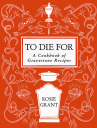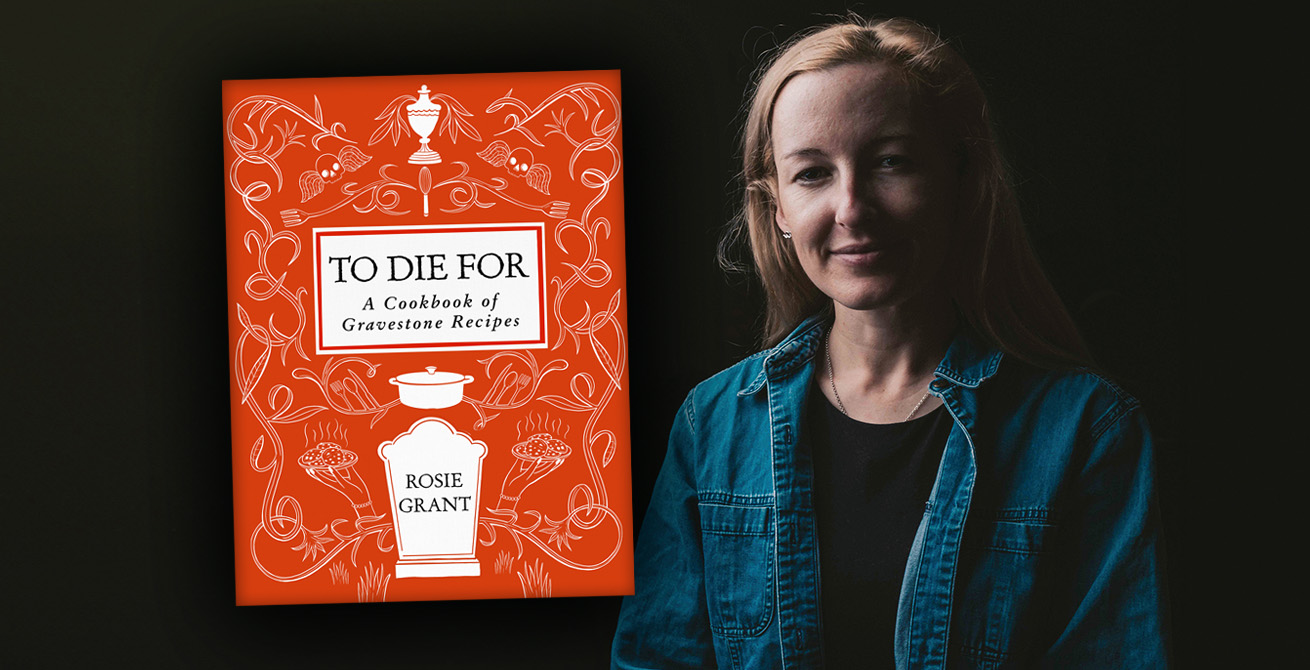
Rosie Grant is the creator behind @GhostlyArchive on TikTok and Instagram, where she researches and re-creates recipes found on gravestones. She works at the Center for the Study of Women at UCLA and is currently working on a food studies certificate at the UCLA Extension School. She received her Master's in Library Science (MLIS) from the University of Maryland in 2022, with a concentration in digital archives, where she combined her love of food writing, cemeteries, and archival work. The gravestone recipe project first began during her digital archives internship at Congressional Cemetery in Washington, DC, and resulted in her first book: To Die For. She recently talked about it with Daryl Maxwell for the LAPL Blog.
To Die For had its origins in an internship at Congressional Cemetery, a paper for your graduate work in Library & Information Science, followed by social media accounts regarding family recipes preserved on loved ones' tombstones. How/when did you realize you had the makings of a book? How did you pursue that?
It started organically. I first learned about a recipe grave belonging to a woman named Naomi, buried in Brooklyn, NY, who has her wonderful spritz cookie recipe on her grave. I then learned about a woman with a fudge recipe in Utah and another woman with a cookie recipe in Iowa. I tried their recipes first, thinking they were the only three. Then I slowly started learning about more people. I tried everyone's recipes as I learned about them and eventually started traveling to visit their memorials. I kept thinking I'd learned about everyone who decided to have a gravestone recipe, then I'd learn about a new one.
How did the book evolve and change as you worked on and revised it? Is the end result markedly different than what you originally envisioned?
It changed a lot from when I first made Naomi's recipe. I worked with all of the families and traveled to visit all the North American memorials and recipes featured in the book. I never imagined it would grow into what it has today. It started as something I was just curious about and turned into learning about the importance of family recipes and how we use food to remember those we've lost.
When I'd learned of about 20 people with gravestone recipes and had started meeting the families to learn more, the idea of an unusual cookbook started to come about. It was more than just recipes but also stories about how the people behind the recipes were community members, beloved parents and grandparents, adventurers, and individuals who showed love through food.
Do you have a favorite (or two or three) of the recipes included in To Die For?
They're all my favorites—every recipe and person is so unique. But the ones I make the most often are recipes I'm nostalgic about. Helen's Texas sheet cake is really moist and fun to make. Annabell's snickerdoodle cookies remind me of the cookies my mom used to make when I was a kid. And Naomi's spritz cookies, I make a lot since they're delicious and so fun to make with a cookie press.
I first learned of To Die For from a segment on CBS Sunday Morning. How did that occur? Did you reach out to them? Did they reach out to you? What was that experience like?
The publisher HarperCollins organized that—I had the most wonderful publicist named Tess Day, who reached out to a lot of people to share stories from the book. CBS Sunday was so wonderful to work with—they were really interested in getting the families involved and visiting some of the gravestone recipes, and it was wonderful seeing the stories told about each person. Their team does so many cool stories, so it was an honor to get to work with them! They did the legwork of traveling to different gravestone recipes around the country, which was so impressive to see for the journalistic work.
You mention that your parents are ghost-tour guides in the Alexandria, Virginia area and that you grew up comfortable with walking around/through cemeteries. Now you visit cemeteries regularly all over the country. Do you have any favorite cemeteries in Virginia? What are some of your favorites from your research on tombstone recipes?
Yes, my parents are ghost tour guides, and we love our local cemeteries. I grew up in Northern Virginia, close to Arlington National Cemetery, which is a really impressive cemetery in general and one my parents love to give tours of. In the area, my favorite cemeteries are actually in DC and Maryland, though no gravestone recipes are located near there (the closest is Naomi's in Brooklyn). Unusual gravestones in the DC/Maryland/Virginia area that I like to visit are the Adams Memorial in Rock Creek Cemetery, belonging to the grave of Marian Hooper Adams. She was a photographer married to historian Henry Adams, and when she passed away, her husband commissioned a statue titled "Grief" that I find very moving to visit. Also in Rock Creek Cemetery is another grave I love dearly—the graves of Evelyn Davis. She has 3 gravestones, one listing her ex-husbands, one with her resume, and one that says "Queen of the Corporate Jungle."
Is there a cemetery that you are hoping to visit but haven't yet had the opportunity?
Oh yes, I have a long list of cemeteries I'd love to visit. A few on the list:
- In Point Hope, Alaska, there is an Inupiat whaling community whose cemetery is marked by whale bone gravestones.
- In Joseph Grimaldi Park in London, there are two gravestones that make up a musical instrument and people are invited to "dance on the graves" of Grimaldi and Dibdins' graves. As they dance, the tune 'Hot Codlins' plays.
- Outside of Chicago, there is a famous Showmen's Rest cemetery (Showmen's Rests are cemeteries dedicated to people in the circus—there are Showmen's Rests all over the US, but the one in Forest Park, Illinois, is one of the largest. There are some beautiful memorials designed for performers.
What was the most interesting or surprising thing that you learned during your research into gravestone recipes?
That there are so many options and ways people get creative with how they want to be remembered. If something is important to you, you can put it on your gravestone, as well as other choices people make when it comes to celebrating your legacy. For some, it's having their recipes made during the holidays years after they passed away; for others, it's having a song they like continued to be played, which reminds everyone of them. I think something I've learned that's been very important to the project is that you can have these conversations now with loved ones about how you want to be remembered; it might feel uncomfortable at first, but it's actually a really healthy discussion that can be very life-affirming.
To Die For includes 40 recipes, and you mention there are more for which you have yet to connect with the connected family or prepare the recipe. What are your plans for your research and social media accounts? Could there be another book of gravestone recipes in your future?
I plan to continue sharing what I learn on @Ghostlyarchive. I have a lot I still want to learn, and yes, there are more gravestone recipes to research. The book featured the 40 I was able to connect and interview the families with, but there are more I know about and need to connect with loved ones for permission and learning stories. In the meantime, I love visiting local cemeteries as I travel and sharing what I learn as I go.
You also mention that you've fallen in love with community cookbooks and the notations that are often included with the recipes they include. What are some of your favorites (organization, location, year)? Favorite notation?
Community cookbooks are the best! I started collecting them while traveling to visit gravestone recipes—you get a great sense of place and community through them. My favorites are community cookbooks from cemeteries, which generally were made to help support cemetery upkeep but also give tips on end-of-life planning, histories of the cemetery, and recipes of people connected to the cemetery. The three I have are:
- Recipes for the Soul: A Book of Funeral Food, Tips and Stories—by the New Braunfels, Texas Cemetery Committee
- Food To Die For: A Book of Funeral Food, Tips and Tales From The Old City Cemetery Lynchburg, Virginia by Jessica Ward
- A Spread for the Dead: Celebrating a Life Well Lived with Food Well Loved, compiled by Mulberry Street Cemetery in LaGrange, Georgia
Now that you have cooked at least 40 gravestone recipes and are currently pursuing a food studies certificate at UCLA, do you think you will ask for a recipe to be placed on your gravestone? If so, any idea yet what that recipe might be?
Yes! I actually end To Die For with my own recipe—a simple clam linguine that I had as a kid. It includes white wine, butter, and parsley, and is so soothing to cook and make with others.
What's currently on your nightstand?
Currently its my brother's book, On the Fringe by Patrick Grant; It by Stephen King; House of Leaves by Mark Z. Danielewski; Archiving Activism in the Digital Age, edited by Daniele Salerno and Ann Rigney
Can you name your top five favorite or most influential authors?
Anthony Bourdain
Samin Nosrat
David Sedaris
Mary Roach
Michelle Zauner
What was your favorite book when you were a child?
Was there a book you felt you needed to hide from your parents?
I actually can't think of any—they were very open about letting us read what we wanted. But a book I once hid the cover of while reading in public was A Little Life by Hanya Yanagihara; it seems to be a very triggering book for people.
Is there a book you've faked reading?
I’ve been at parties pretending I’d finished House of Leaves by Mark Z. Danielewski as well as It by Stephen King. They're both so good, but are taking me ages to read.
Can you name a book you've bought for the cover?
Most recently, I picked up The Restaurant of Lost Recipes by Hisashi Kashiwai. The cover is so cute, and I loved the title (and concept) of this book!
Is there a book that changed your life?
A tie between Salt Fat Acid Heat by Samin Nosrat and When You Are Engulfed in Flames by David Sedaris.
Can you name a book for which you are an evangelist (and you think everyone should read)?
When You Are Engulfed in Flames by David Sedaris changed how I thought about traveling, writing, and how I tell stories about my family.
Is there a book you would most want to read again for the first time?
The Hobbit-reading that book for the first time as a kid made me want to go on adventures.
What is the last piece of art (music, movies, TV, more traditional art forms) that you've experienced or that has impacted you?
I recently rewatched a few Hayao Miyazaki films, including Spirited Away and Howl's Moving Castle. His movies hit a nostalgic chord for me that I can never perfectly describe, but are so raw and beautiful.
What is your idea of THE perfect day (where you could go anywhere/meet with anyone)?
These days, I love a calm, meandering day. At best, it would be starting the morning with breakfast at my local diner (I live around the corner from Clark Street Diner on Franklin Ave), then visiting a new cemetery, ideally with any friend who also doesn't mind a day trip to a cemetery. In the Los Angeles area, I still have a lot of cemeteries to visit to learn more about local individuals and history. Since it's the perfect day, getting sushi for dinner from Sugar Fish and an early evening in bed reading.
What is the question that you're always hoping you'll be asked, but never have been?
I've always had an answer to the question (and yet to be asked) Who would I invite (living or dead) to my perfect meal and where would it be?
Which is, a picnic in a cemetery with Anthony Bourdain, Samin Nosrat, Robin Wall Kimmerer and David Sedaris. Could you even imagine?
What are you working on now?
Book 2 of gravestone recipes!