
Who’s the Boss? Part 1 of the Central Library Director Series

Los Angeles Public Library is celebrating 100 years of the Central Library, making this the perfect time to spotlight the exceptional librarians who have overseen this remarkable building and everything within: its collections, programs, services, and staff. Over the next several weeks, we’ll highlight the individuals who have served as Director of Central Library.
From Central Library’s opening in 1926, it took thirty-five years before the current position, formally called Division Librarian, was established in 1961. So who ran the show in those early decades before an official director existed? Today, we’re looking at three Midwestern women who became Angelenos and shaped the Central Library’s formative years.
Helen Theresa Kennedy
Helen T. Kennedy was already a seasoned member of the Los Angeles Public Library staff when Central Library opened in 1926. Originally from Iowa, she studied at Illinois Woman’s College and earned her library degree from the University of Illinois in 1903. Her early career took her from the Illinois School for the Deaf to the Kewanee Public Library, then the Wisconsin Free Library Commission, where she helped establish and improve libraries statewide. In 1911, after a brief stint with the Oregon Library Commission, she was hired by Los Angeles Public Library to head up the library training class, which had started in 1891 under City Librarian Tessa Kelso. At this time, the training class was undergoing a period of increased development and professionalism as it transitioned to a full-fledged library school.
By 1913, Kennedy was made Principal Librarian, overseeing the branch system, receiving the title of Second Assistant City Librarian in charge of Branches in 1922. As head of the Branches Department, Kennedy administered the building and equipping of twenty new library branches. Her goal was to place a library throughout every neighborhood of the rapidly expanding city, stating that “no citizen need walk more than a mile to a library.” She was also heavily involved with the California Library Association, serving in the program committee for many years and as Vice President in 1924.
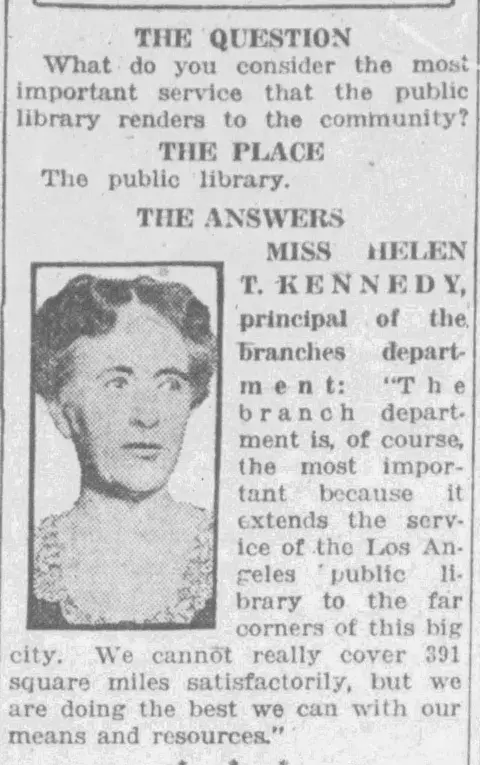
Kennedy was so associated with the branches that she was referred to by some as “mother of the branch libraries of Los Angeles.” Nonetheless, when Central Library opened, her attention was redirected to its operation. She orchestrated the move of nearly one million books from the rented Metropolitan Building to the new facility. Under Kennedy’s purview were Principal Librarians supervising multiple subject departments, fifteen reading rooms, and various technical departments, such as Catalog and Registration & Loan. Kennedy also had the somewhat unrelated but arduous task of vacation scheduling throughout the library system.
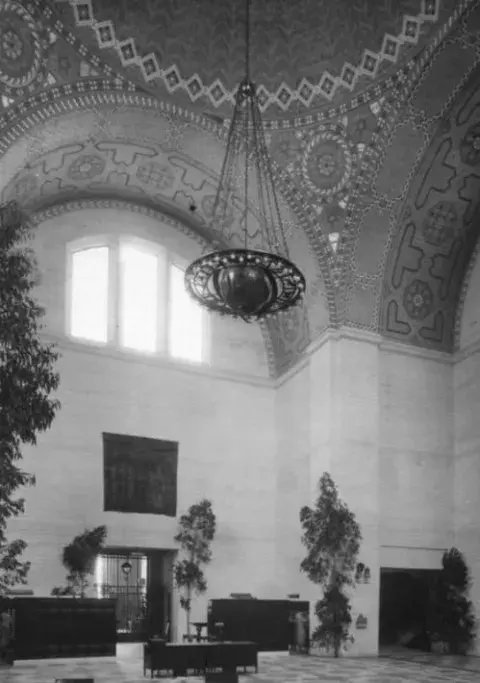
During Kennedy’s tenure, the Central Library subject departments acquired an increasingly specialized reference collection, while also seeing an increase in circulation from 1.5 million to nearly 2.5 million. More noteworthy than the gain in circulation, though, was the number of people who came to read and study. The new building had a seating capacity of 755, nearly double that of the old facility. Kennedy helped establish Central Library as a cultural destination for many. The Lecture and Exhibit Room, measuring thirty-five by ninety feet, had 250 movable seats and a separate exterior entrance for evening meetings.
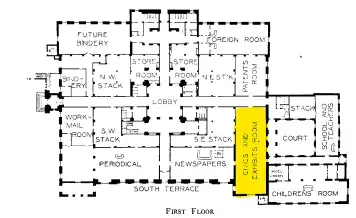
This space held numerous cultural programs, such as talks given in multiple languages, art exhibitions, and even the occasional concert. Especially popular were the annual lecture series by well-known book reviewer and librarian Helen E. Haines. Attendance for these programs was estimated at one-half million in Central’s first five years. Kennedy was especially involved in creating stunning displays in the first-floor lobby, which were viewed daily by thousands of visitors. She also attended to publicity efforts, such as sending mailers that summarized library reports and featured easy-to-read graphics to groups like the Chamber of Commerce and the Parent Teacher Association. In 1928, she introduced a series of radio talks, which were broadcast by KHJ every Wednesday at 2:30 p.m. A rotation of librarians would have thirty minutes to give book reviews and other library updates.
Ill health forced Kennedy to retire in 1930, and she passed away on July 8, 1935. Her mother was present to accept the library board’s laudatory resolutions in her honor. Kennedy’s obituary does not mention her role of overseeing Central Library, but instead praised her energy and enthusiasm in building up the branch system, stating: "Twenty branch buildings, the construction of which she planned and supervised, are her monuments."
Althea Hester Warren
When Kennedy retired in 1930, her position of Second Assistant Librarian in charge of Central Library went unfilled, although some staff members were noted to have taken over various tasks: Katherine Dunn followed by Harriet Febiger Marrack took over the lecture programs and exhibit schedules, Betsy Foye was tasked with personnel vacation scheduling, and Faith Holmes Hyers was the full-time library publicist. In administration were City Librarian Everett Robbins Perry and Assistant City Librarian Althea H. Warren, who had up to this point been in charge of the Branches Department. When Perry died in October 1933 after a brief illness, the library board unanimously voted for Warren to succeed him as City Librarian. Due to lack of funding, no other administrators could be hired. Warren then found herself solely responsible for the operations of the entire system, branches, and Central alike, for many years.
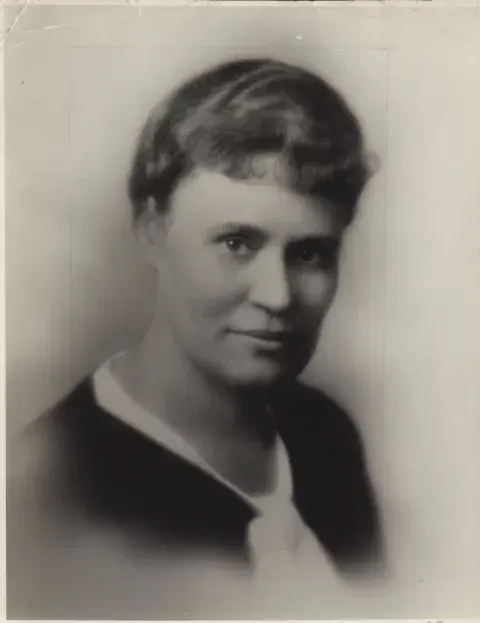
Originally from Waukegan, Illinois, Warren attended the University of Chicago, receiving a Bachelor of Philosophy in 1908. After a gap year in Europe, she received her professional training at the University of Wisconsin Library School. She was hired by the Chicago Public Library, where she worked in a poor neighborhood and earned a generous $60 per month. She then transferred to a librarian position with Sears-Roebuck & Company, which was affiliated with the Chicago Public Library. Warren made her way out west and was City Librarian at San Diego Public Library for ten years, where she modernized the system. She served as California Library Association president in 1921, then joined the Los Angeles Public Library in 1926 as Perry’s second-in-command.
Warren was a voracious reader who encouraged staff and patrons to read for the sheer fun of it. She explained, “The best job a library can do is to keep people reading after they’ve finished their formal education.” At a time when some librarians policed literary taste, she saw nothing wrong with enjoying a good novel, saying: “Don’t be ashamed of asking for mystery stories-all your bosses are reading them. Every big executive sooner or later asks for them.” Warren was also big on customer service, and added telephone reference to Central Library. The service was extremely popular, though Warren had to forbid librarians from helping patrons solve crossword puzzles because the frequent requests were taking up too much staff time.
Warren was well known in the library scene as a frequent speaker and attendee of state and national conferences. She was admired by colleagues, patrons, and the public. San Diego reporter Max Miller, upon meeting Warren many years after her tenure in that city, remarked: "There are only two librarians I ever liked, and you’re both of them!"
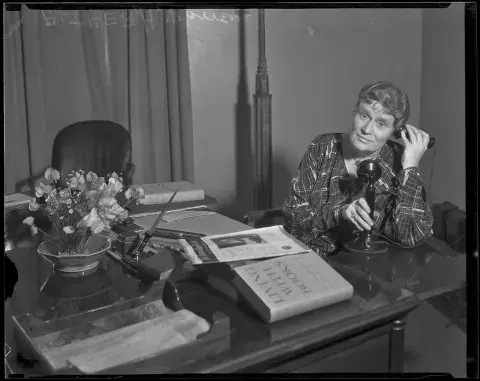
Warren steered the library through the difficult years of the Great Depression. In the 1930s, property values in Los Angeles plummeted, and with it, the funding the library needed to operate. Wages were cut, library hours were reduced, the borrowing limit for materials was cut from five to three, and book budgets were slashed. Central Library became a refuge for folks facing unemployment or needing cheap entertainment; everyday its fifteen reading rooms were filled to capacity.
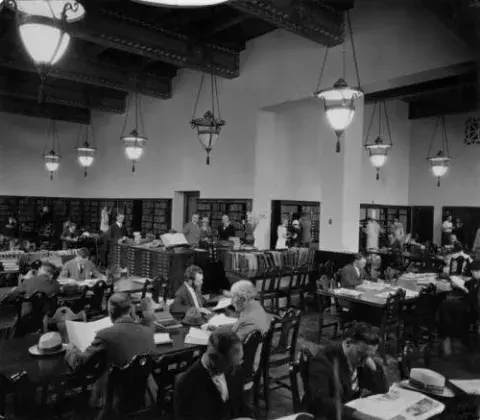
Though times were tough, Central Library continued to be a cultural center, offering lectures, concerts, art, book fairs, and other programs. Its immense collection sustained the library for some time, and circulation shot up sixty percent. There was a rising interest in DIY manuals, such as home winemaking or subsistence gardening, and a strong demand for civil service exam study material. Patrons who could not come to the Central Library to check out a particular book could have it sent to their local branch for pick up, but at a fee: five cents, which included the cost of mail notification. Over time, however, circulation dipped as the limitation on buying new books caused the collection to become somewhat stagnant.
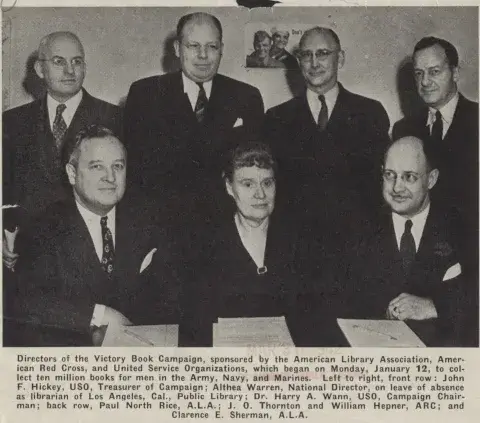
By 1940, Warren was joined by new Assistant City Librarian Roberta Bowler, who was promoted from the Cahuenga branch library. Bowler was assigned to head up the Branches Department, while Central Library departments continued to report directly to Warren. Just as the library was emerging from the difficult Great Depression years, the United States government was preparing for the strong possibility of entering World War II. Warren threw herself wholeheartedly into the war effort. When the American Red Cross, United Service Organizations, and American Library Association needed a "go-getter" to head up a book drive benefitting the troops, they tapped Warren for the job. She was given a four-month unpaid leave of absence to lead the Victory Books Campaign headquartered in the Empire State Building in New York; Bowler took the reins in her absence.
Warren was welcomed back to Los Angeles in April 1942 with a luncheon at the Biltmore Hotel attended by Mayor Fletcher Bowron. By this time, the one-ton bronze Zodiac chandelier in the Rotunda had been lowered to the ground amidst fears of bombing. Blackout curtains were installed on the windows for nighttime library service. A civilian defense question and answer service, called the War Information Desk, was set up in the Rotunda. The Red Cross held a continuous series of first-aid and home nursing classes in the building. For several years, the Central Library grounds even housed a temporary USO Women’s Services dormitory that housed thousands of service members and veterans. Warren was elected American Library Association (ALA) president in 1943-1944, the first Californian to hold that office. She strongly lobbied Congress to increase federal aid to American libraries.
As the war came to a close, the Central Library building, just barely twenty years old, was beginning to show significant wear and tear. It lacked an adequate ventilation system and needed new elevators, improved lighting, an updated telephone system, and larger parking facilities. Also, the library system as a whole was lacking in sufficient administrative supervision. Warren and Bowler were the only twо officials to oversee and supervise the Central Library departments and all forty branches. The paltry budgets of the 1930s and 1940s had taken their toll on the library. By 1947, Warren knew the library would need to undergo a project of tremendous growth to meet the demands of the booming population. Having just turned sixty years old, she decided to step aside to allow someone else the opportunity to see it through.
After retirement, Warren taught courses at library schools in Wisconsin, Michigan, and the University of Southern California. She was accompanied by her long-time companion, Gladys English, former head librarian of the Department of Work with Children. When English passed away in 1956, Warren spent her final years establishing a collection of original illustrations from children’s books in her honor. The Gladys English Collection of American Children’s Books is now part of the Los Angeles Public Library. Warren passed away in 1958 and was inducted into the California Library Association's Library Hall of Fame in 2013.
Annebell "Anne" Fraser Leidendeker
Succeeding Warren as City Librarian was the young Harold Louis Hamill, former director of the Kansas City Public Library. The library finally started appointing more administrative staff, including a new business officer and a personnel officer. Bowler was still the Assistant City Librarian in charge of the Branches Department, which at this point had been reorganized as the Extension Department, covering branches, interlibrary loan service, and bookmobiles. And for the first time since Helen T. Kennedy’s 1930 retirement, the position of Assistant City Librarian in charge of Central Library was filled, this time by Anne F. Leidendeker.
Hailing from La Salle, Illinois, Leidendeker received a Bachelor of Library Science from the University of Illinois in 1908. She worked as a librarian at the Armour Institute of Technology and at the Commonwealth Edison Company, both in Chicago, followed by the University of Arizona library. Marriage and two children interrupted her career for a decade. Her husband was a rancher, and when that life became precarious, Leidendeker went to work as the representative for the salesmanship department at La Salle Extension University.
Leidendeker eventually found herself a single mother. She returned to library work when she had the opportunity to join the Los Angeles Public Library staff in 1927. Within a year, she was promoted to Principal Librarian of the Science and Industry Department, where she stayed for the next nineteen years. The department was among the busiest at Central Library, particularly during World War II. The defense industries made regular use of their collection, especially in the area of shipbuilding, and Leidendeker had to divert much of the book budget to meet the wartime demand.
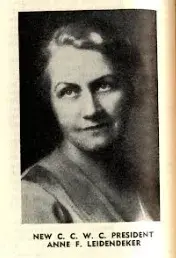
Leidendeker was a well-known personality at work and in the community. A satirical piece in a staff publication noted that “even a dentist can’t keep Anne from talking.” She was a strong feminist, a fierce opponent of state and local efforts to ban married women from civil service, and a strong proponent of helping young girls learn to establish careers or self-employment. The question “Why use only half of the adult brains of a nation?” summarized her feelings on women in the workplace.
At the onset of the Great Depression, she convinced the City Council to appropriate funds to provide relief to unemployed women and place hundreds more on subsidized employment. Throughout the 1930s, she was very active in the Business and Professional Women’s Club, serving as president of the Los Angeles chapter and California federation. Within the national organization, she was considered an authority on women’s issues in the areas of economics, labor, and vocational guidance. She was also very active in the Special Library Association and California Library Association, serving as the latter’s president in 1938. In 1940, she was elected president of the Civil Center Women’s Council, an association of city workers.
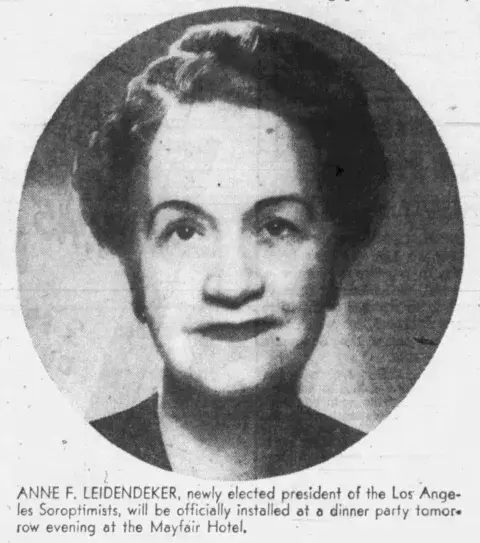
Leidendeker supervised the Central Library in the immediate postwar years, which was a time of recovery and striving to meet the needs of a growing population. The building finally got some needed painting and repairs that had been long deferred because of depression conditions and wartime manpower shortages. Central staff sought to meet patron demand for material on foreign languages and international relations, an interest that may have been sparked by the war’s end and the establishment of the United Nations. However, Leidendeker’s former department, Science and Industry, continued to have the highest stats, with its technical magazines and patents collection being used daily by the aviation industry and other types of businesses. The Popular Library, with its accessible racks of frequently refreshed books, debuted, catering to the on-the-go patron. In the end, Leidendeker’s time in charge of Central Library was limited to three years. In 1950, Leidendeker reconnected with her ex-husband of twenty years, remarried, and retired in short order. They moved to Yuma, Arizona, where she passed away on March 25, 1955.
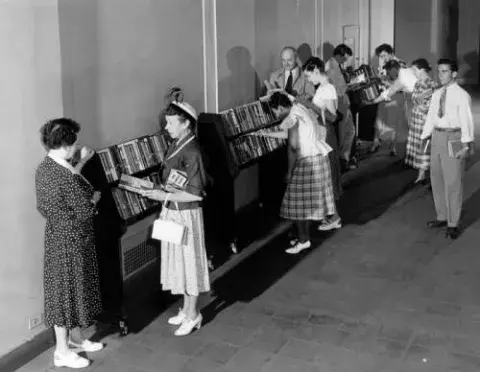
Central Library in Transition
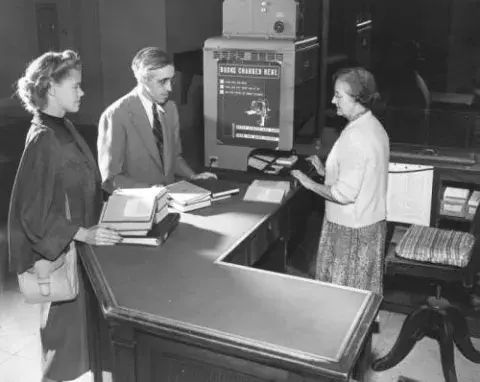
The library’s annual reports from the 1950s are fairly skimpy, and don't provide any insight into who headed up Central Library after Leidendeker’s retirement. If any staff members held that position, their contributions may sadly be lost to history. What’s known is that throughout the decade Central Library aimed to meet the needs of the growing city’s busy residents. Modernization and technology was embraced. A new book checkout system was introduced using the Recordak machine, which used a micro-camera to take pictures of the borrowed material. This significantly sped up the process and made records much more accurate. The Audio-Visual Service opened, providing an extensive collection of 16mm sound films available for checkout.
Recognizing Los Angeles as a center for commerce and industry, Central Library strengthened its specialized service to business. Directories, trade magazines, and essential information about finance, taxes, and labor were brought together in one location. This effort culminated in the creation of a Business and Economics room, administered by the Social Sciences Department, in 1955. Soon after, the former Science and Industry Department was renamed the Science and Technology Department. In other outreach efforts, the Children’s Room continued to send its bookmobile to dozens of centrally located schools, a service established under Warren’s tenure.
Changes were happening at Central Library and throughout the library system. In 1957, a $6.4 million library bond issue was passed by the voters, which would go on to fund dozens of new branches over the next decade. Qualified personnel were needed to supervise this huge expansion, and Central Library needed dedicated leadership.
Check back for the next post and learn about the first official Central Library director!
Information for this blog post was largely pulled from the following databases: California Index, Los Angeles Area Historical Newspapers, and Los Angeles Times Historical Archives. These and more are available to patrons at the Research & Homework webpage.


