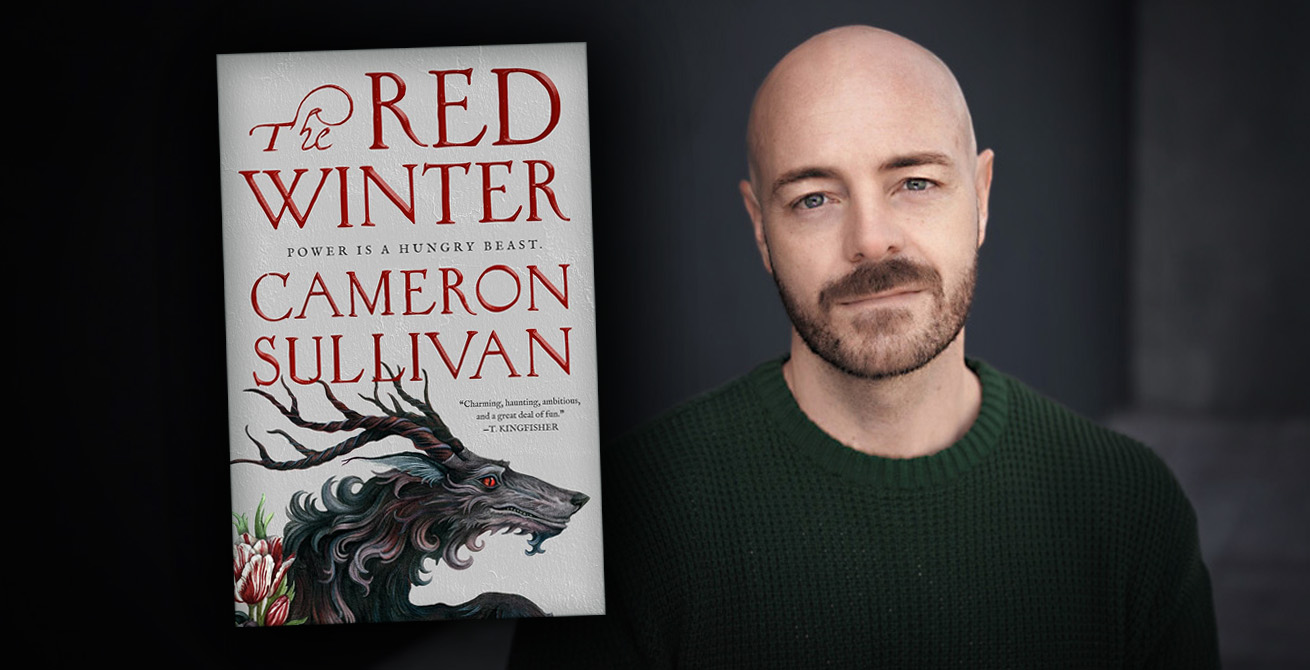
Cameron Sullivan was born in Perth, Western Australia. He grew up with the dark fantasy and horror icons of the 80s and went on to study classics and creative writing at the University of Western Australia. After several years working and studying in Italy and the UK, he returned to Australia and settled in Melbourne, which is the best place for Australians who actually enjoy the winter. He works as a copywriter and will easily lose a weekend to a good book, a new recipe, or games of any kind, from tabletop DnD to pub trivia. His debut novel is The Red Winter, and he recently talked about it with Daryl Maxwell for the LAPL Blog.
What was your inspiration for The Red Winter?
The history! The book is based on the hunt for the Beast of Gévaudan, which is a genuine historical event that already reads like a horror movie. In brief: between 1764 and 1767, a mysterious animal attacked hundreds of people in the Gévaudan region of France. Over a hundred people were killed, and there were numerous witnesses who described a tawny creature like a huge wolf, with dark stripes and a long, tufted tail. The killings attracted the attention of the local nobility and even the king, which gave me an abundance of rich historical sources to draw on, from eyewitness accounts to private letters to detailed posters and woodcuts. The story took shape when I started to build a supernatural narrative and a cast of characters around these sources.
Are Sebastian, Antoine, Jacques, Livia, or any of the other characters in the novel, inspired by or based on specific individuals?
None of the main cast are directly based on real people, though some historical figures do appear in (very) fictionalized form. You could say that Sebastian is a sort of 'wish fulfillment' character for me—an immortal, irresponsible, powerful sorcerer who is always the smartest person in the room (or thinks he is) and acts as a sort of tour guide through this fascinating historical period. Livia's namesake was one of the most powerful people in Ancient Rome, the wife of the first emperor, Augustus. I loved the idea of her taking the name of this ruthless, trailblazing empress from her past.
Same question for Sarmodel (because I think there may be a story there)?
Sarmodel was possibly my favorite character to write, though he's not directly inspired by any one individual. He is Sebastian's shadow in many ways, and he always encourages his worst impulses, which is a tremendous amount of fun to write.
How did the novel evolve and change as you wrote and revised it? Are there any characters or scenes that were lost in the process that you wish had made it to the published version?
The novel changed hugely during the revision process. I started it as a passion project in my spare time, so I didn't really do any planning or plotting until I was over halfway in, which I don't recommend! The biggest changes came when it was time to marry all three main timelines together, and I had a lot of help from my agent, Christabel McKinley, and my editor at Tor US, Ali Fisher. The ending shifted several times, and there were some very intricate changes to the magic system and motivating events for some of the characters. All of the changes (even the ones I resisted at the time) absolutely made it a better book.
How familiar were you with late 18th-century France, and specifically, the Beast of Gévaudan, before you began writing The Red Winter? Did you have to do a bit of research before or while you wrote the novel? If so, how long did it take you to do the research and write The Red Winter?
I had to do a lot of research. Before I started, I would say my familiarity with the history was at the 'pub trivia' level: I knew some of the context around the French Revolution and could name some of the key historical figures. The research was never really finished, as I always had to make sure things were as true to life as I could make them before I moved on from a scene. It took me just over seven years to complete the first draft, and then it was about another three years of editing, getting representation, finding a publisher, and getting published. Those first chapters were written by a much younger man!
What was the most interesting or surprising thing that you learned during your research?
The things I found the most difficult and the most interesting to research were the small, day-to-day details. These were things that would have been obvious at the time and not worth recording, like how many hours an average person worked in a week, how much money was worth, and what you could buy with it—all very important for setting the scene in the lead-up to the Revolution.
The Red Winter puts a classic horror twist on the story of the Beast of Gévaudan. Was it fun to take such a well-known monster and play with their "rule book" to make them your own for The Red Winter? Was it intimidating? A bit of both?
A lot of both! I loved the idea of connecting such a well-known legend to the older mythologies of Europe, and making it part of a secret, occult history. At the same time, people can be very attached to their favorite version of folklore, so I wanted to treat it with respect. Hopefully, I've achieved a good balance of both.
Do you have a favorite classic monster or cryptid story (novels, films, or television)? A least favorite? One that is so bad it is fun?
It's very difficult to choose—I'm a huge horror fan and was largely raised on monster stories. The Xenomorph from the Alien movies is one I always go back to, as is Dracula. One of my absolute favorites from my childhood is the Tailypo. It's such a simple folk story, and it's not explicitly violent, so you can tell it to kids, but I love the premise: the mysterious creature stalking the old hunter in his cabin, gradually picking off his beloved hounds until he's the only one left. Genuinely chilling.
In terms of 'so bad it's good,' I recommend everyone get involved with the original Troll movie from 1986. Practical monster effects, big star cameos, high camp, dark fairytale vibes—*chef's kiss.*
Your biography says that you were born in Perth, Western Australia, that you've worked and studied in Italy and the UK, and have now settled in Melbourne. Do you have any favorite places in Perth, Italy, the UK, and/or Melbourne? A gem that someone visiting should visit but would only learn about from a resident?
It's certainly not a hidden gem, but I fell in love with Florence when I was in Italy. You can absolutely feel the history all around you when you're there, but it's on a very human scale. There are so many beautiful stories there—Dante Alighieri, da Vinci, Botticelli, Michelangelo—and you can still walk the same streets they did and see their masterpieces all around you. It doesn't hurt that the food is also incredible.
Your biography also says that one of the reasons you've settled in Melbourne is because it is "the best place for Australians who actually enjoy the winter." What do you mean by that?
Melbourne tends to get maligned as the greyest and rainiest of the major Australian cities, particularly in my hometown of Perth, which is frequently celebrated as the world's sunniest capital city. I want them to know that there's plenty to enjoy about the cold weather, and that there's no greater punishment than jealousy.
You currently work as a copyeditor. Does your work as a copyeditor inform or influence your work as a writer? If so, how?
I recently wrapped up my copyediting business to focus on my next book, but it was a fantastic way to make a living over the past ten years. It definitely made me a better writer—I learned a lot about rhythm and classic principles like 'show, don't tell'. I think it also made me something of a perfectionist in terms of grammar, which has its drawbacks. I find it almost impossible to move on from a scene until it's exactly how I want it to be, and that slows me down a lot—but I am getting better!
If/when The Red Winter is adapted to a film or series, who would your dream cast be?
I wouldn't want to prejudice how anyone imagines the main characters! I will say that I've promised all of my friends and family roles as extras, so we've had some heated discussions about who gets to be hunters and villagers.
As a debut author, what have you learned during the process of getting your novel published that you would like to share with other writers about this experience?
It's not particularly original, but my advice would be to stick with it and back yourself. I had a lot of trouble getting an agent (it took me over a year), partly because The Red Winter doesn't fit comfortably into any one genre. I started to think I'd written something so niche that it would never find a home. But as soon as I found Christabel, it all started to happen very quickly—it was just a matter of finding someone who loved it as much as I did. So, for other new authors, I would say follow your own weird passions faithfully and be patient. Trust that someone will find your idea as fascinating as you do.
What's currently on your nightstand?
I just finished Fairy Tale by Stephen King, and I have just started The Way of Kings by Brandon Sanderson—looking ahead at The Stormlight Archive, I appreciate I have quite the mountain to climb!
Can you name your top five favorite or most influential authors?
This is so difficult! I have so many, but I think in terms of authors I will always read or re-read:
Stephen King
David Eddings
Anne Rice
Ursula Le Guin
Joe Hill
What was your favorite book when you were a child?
The Magician’s Nephew by CS Lewis. I already loved The Lion, the Witch and the Wardrobe, and I didn't realize there were other books about Narnia. It was like finishing your favorite meal and finding out there was still dessert.
Was there a book you felt you needed to hide from your parents?
Not at all. My parents were very happy for me to choose my own books.
Is there a book you've faked reading?
Yes.
Can you name a book you've bought for the cover?
Dragons of Autumn Twilight, the first book of the Dragonlance Chronicles, back when I was in primary school. It was the first book I ever bought with my own pocket money. I didn't really understand what 'autumn twilight' meant, but there was a group of stalwart adventurers on the cover and some ferocious dragons, so it was an easy sale.
Is there a book that changed your life?
So many! But I think I have to say The Velvet Rage by Alan Downs. It's not fiction, but it was the first book I read about growing up as a gay man, and it felt like someone had been reading my diary. It's hard to explain, but I felt understood in a way that I never had.
Can you name a book for which you are an evangelist (and you think everyone should read)?
Not a single book, but The Dark Tower series by Stephen King. I've bought and given away so many copies of The Gunslinger. It's beautiful and horrific and weird and sprawling and mythic and impossibly ambitious. I think about it all the time, not just in terms of the books, but in terms of how the author managed to finish it and made it all come together, which is a whole separate story.
Is there a book you would most want to read again for the first time?
The Hobbit. I would love to wipe my memory of the entire Tolkien universe—all the books, movies, everything—and experience it as a standalone adventure story again.
What is the last piece of art (music, movies, TV, more traditional art forms) that you've experienced or that has impacted you?
I know I'm not alone in this, but the TV adaptation of Heated Rivalry.
What is your idea of THE perfect day (where you could go anywhere/meet with anyone)?
This is quite easy to answer at the moment because I think I got it very recently! A late start reading in bed, then strong coffee and eggs for breakfast, and some time to enjoy the view from my balcony. Then all my friends and family together from every chapter of my life for a big celebration, followed by messy pub dinner and talking late into the night. Heaven.
What is the question that you're always hoping you'll be asked, but never have been?
I love really specific questions about the religious and mythological references in the book. I would love to dork out with someone about why I chose to connect Ancient Roman myths with Christian 1700s Europe and the Enlightenment, for example.
What is your answer?
The simple answer is that I wanted to show that history is all connected, and the stories we call mythology are all connected alongside it. You can draw a direct line from ancient civilizations all the way through to the present day, with each distinct 'era' (e.g., the Roman Empire, the Middle Ages, the Renaissance) built from the one that preceded it.
What are you working on now?
Without giving too much away, I'm already on my next adventure with Sebastian, Sarmodel, and Livia. We're visiting a different historical period and a different mess for them to figure out, with maybe another complicated love story as well.