Explore Central Library’s story, from the 1921 voter-approved bond that made it possible, to its present-day status as an architectural icon and anchor of the Los Angeles Public Library system.
1920s
- June 1921: Voters approve a $2.5 million bond measure—designed mainly to fund a new Central Library—with an impressive 71% majority. Library promoters had advocated for a permanent central building for decades, and the dream was now within reach.
- November 1921: The library board begins soliciting bids from architects, eventually hiring Bertram Grosvenor Goodhue for the job.
- April 1924: Working plans for the new library are approved two weeks before Goodhue passes away. Final drawings are completed under the supervision of Goodhue’s longtime associate, Carleton Monroe Winslow.
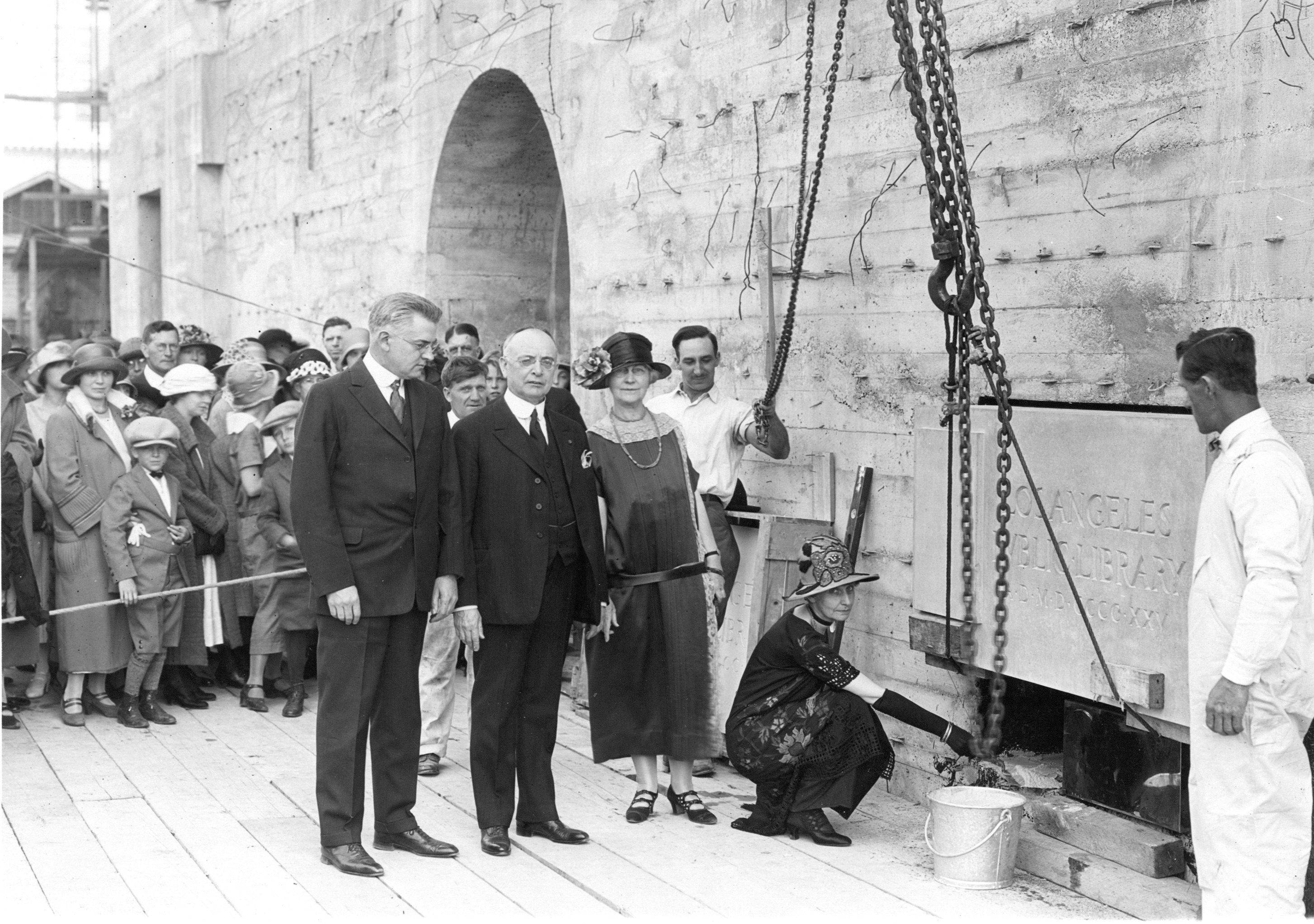
- May 1925: The cornerstone for the library is laid on the grounds of the old Normal School.
- June 1926: The Metropolitan Building Library, housing the core library collection, closes as 300,000 books are transferred to the Central Library. The new facility is 190,000 square feet with a capacity for 1,125,000 volumes and has thirteen public reading rooms able to seat 1,500 patrons.
- July 1926: The Central Library opens to the public on July 5, while a formal dedication ceremony on July 15 is attended by the city elite.
- November 1926: The new children’s room is formally designated the Ivanhoe Room due to the murals depicting Sir Walter Scott’s tale of Ivanhoe.
1930s
- June 1930: A fire started by a gas heater sweeps through the periodical and magazine rooms, causing thousands of dollars in damage. The same month, the American Library Association holds its annual convention in Los Angeles for the first time. Sessions for 2,000 delegates are held at Central Library and across the street at the Biltmore Hotel.
- June 1932: The Library School of the Los Angeles Public Library ends. Created by Tessa Kelso in 1891 as the library’s training class, it became the Library School in 1914. By 1935, the school becomes the purview of the University of Southern California’s accredited library program.
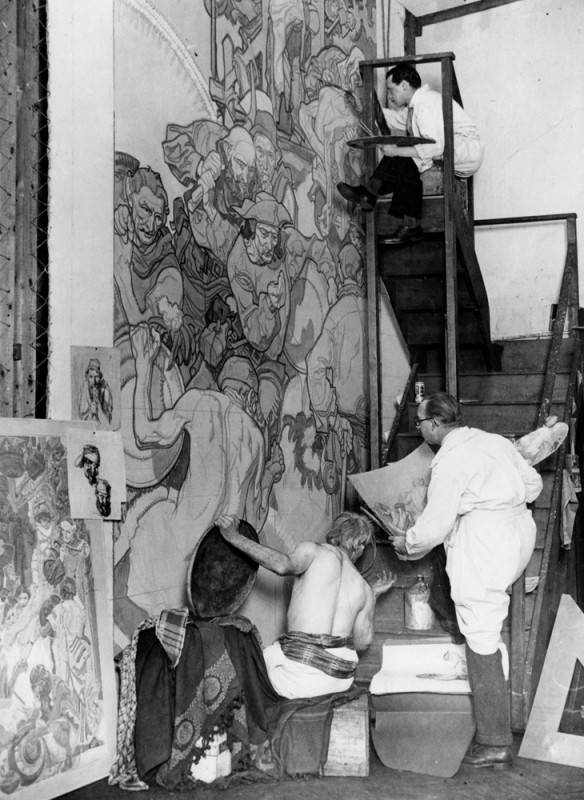
- February 1933: After five years, illustrator Dean Cornwell completes his large-scale mural depicting scenes from California history on the Rotunda walls. The library board considers Central Library officially complete.
- October 1933: Beloved City Librarian Everett R. Perry dies. Since his 1911 arrival in Los Angeles, Perry had campaigned for the construction of the Central Library.
- March 1934: Charles Kassler’s mural Bison Hunt and Gail Cleaves’ pictorial map of the branches are added to Central Library thanks to the New Deal work-relief program, the Public Works of Art Project.
- June 1934: Philanthropist William Andrews Clark, Jr., founder of the Los Angeles Philharmonic, wills his orchestral score collection to Central Library.
- December 1936: A memorial tablet to the late Everett R. Perry is sculpted by Lee Lawrie and installed in the Rotunda.
1940s
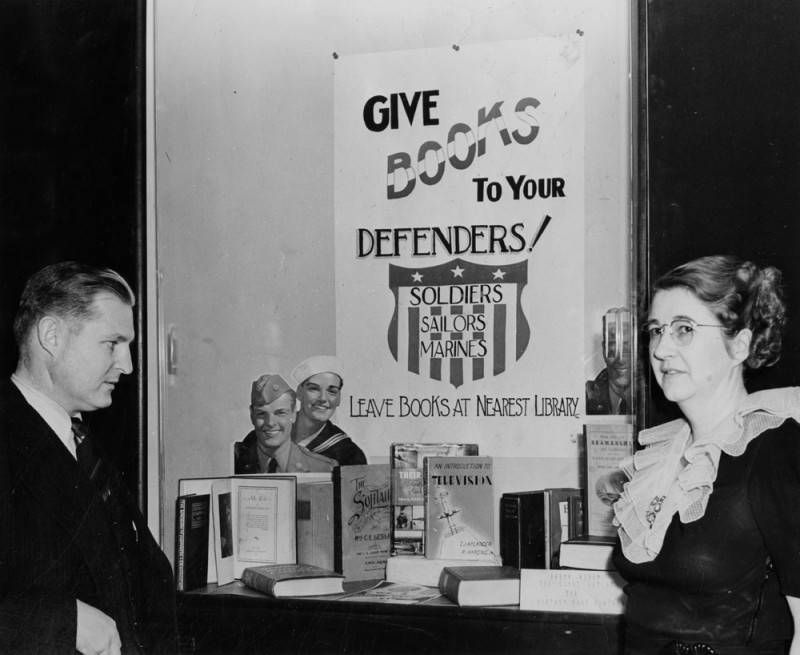
- December 1941: The Wartime Information Desk opens to the public. The desk serves as a clearinghouse for government information on topics like air raids, bomb shelters, and civilian and military defense jobs. The one-ton Rotunda chandelier is lowered to the ground in case of bombing and remains on the floor until 1944.
- May 1942: After months of closing at sunset due to World War II blackout restrictions, the library resumes normal hours with new blackout curtains in place.
- November 1949: Ray Bradbury begins writing The Fireman, which eventually becomes Fahrenheit 451. He spends most of the 1940s at the Los Angeles Public Library and is quoted as saying he was "library-educated." Bradbury said, "The library was my nesting place, my birthing place; it was my growing place."
- November 1949: A new "popular library" for busy patrons debuts, consisting of regularly refreshed books on accessible racks in the corridors.
1950s
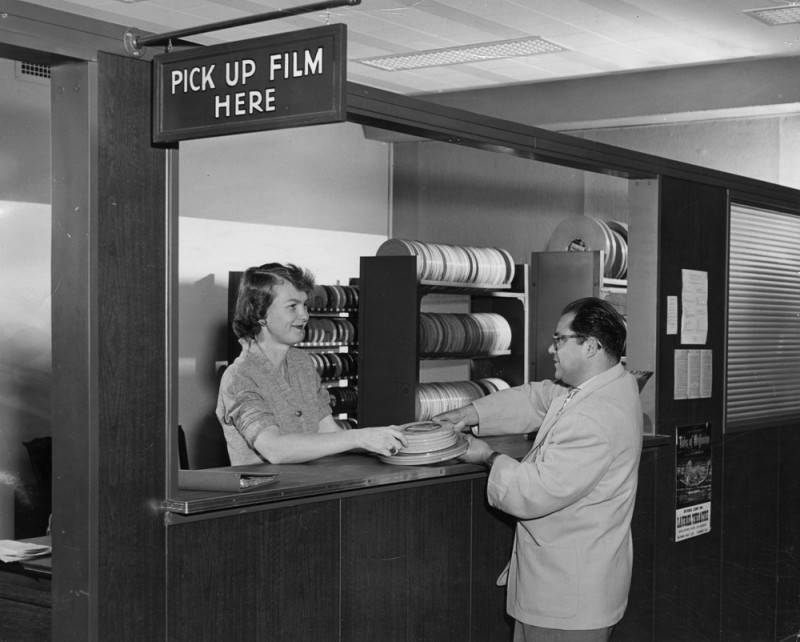
- January 2, 1951: The Audio-Visual Service opens, combining the library’s audiovisual materials. An extensive collection of 16mm sound films is available for checkout to groups and individuals.
- March 1955: The new Business and Economics Department opens in the former first-floor periodicals room. Featuring a 75,000-volume collection—mainly pulled from various subject departments—the department offers specialized directories and reference services to the business community and patrons.
- April 1955: The former Science and Industry Department is renamed the Science and Technology Department.
1960s
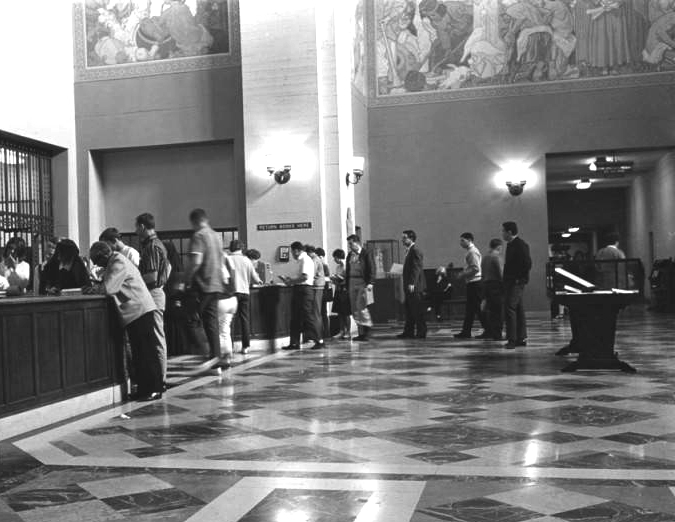
- January 1961: The position of Central Library Director is established. LAPL branch librarian John Bernhill Phillips is promoted to the role.
- December 1966: The "Green Report," written by consultants hired by the Library Board of Commissioners, recommends demolition of the Central Library and construction of a new building. The report cites an outdated electrical system, lack of storage space, inadequate facilities, and insufficient parking.
- March 1967: In response to the Green Report, the City’s Cultural Heritage Board designates the Central Library structure and grounds as Historical Monument No. 46.
- May 1967: Los Angeles voters reject a $57.8 million bond measure for library improvements, which included $26 million for Central Library.
- January 1968: Despite the failed bond measure, plans for a new facility are pursued. Mayor Sam Yorty appoints city executives to the new Central Library Development Coordinating Committee to explore options. Nearly two decades of feasibility studies, delayed plans, and controversy are kicked off.
- February 1969: Central Library is placed on the National Register of Historic Places. Central Library employees stage a one-day "sick-out" to protest a lack of safe and affordable downtown parking. Although delayed by a lawsuit, the Library’s West Lawn is razed to make way for 188 new parking spots. The "Well of the Scribes" sculpture by Lee Lawrie goes missing during the demolition.
1970s
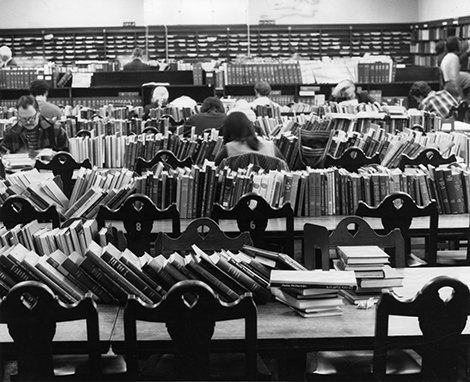
- January 1970: The Southern California Answering Network (SCAN) launches. Complex reference questions are teletyped from branches to Central Library to be answered by subject librarians.
- December 1970: Central Library is listed on the National Register of Historic Places.
- February 1971: The 6.6 magnitude Sylmar Earthquake results in 65 deaths and half a billion dollars in property damage throughout the city. The quake causes the closure of 26 branch libraries. At Central Library, more than 100,000 books fall to the floor and after City Librarian Wyman Jones calls for volunteers, 230 residents respond and all the books are reshelved by the following day.
- 1972: The 100th anniversary gala of the Los Angeles Public Library is held at ARCO Plaza because Central Library cannot handle the electrical output needed to power the event.
- June 1973: The Library begins "Hoot Owl" night information service, 9 p.m. to 1 a.m., seven days a week.
- August 1973: The Los Angeles Fire Department cites Central Library for twenty-six fire and safety violations, stating that the building poses an “extreme life hazard.” The citations are reversed in July 1974 after installation of a smoke detection system and other remedies, which library staff and the Library Board of Commissioners view as inadequate.
- June 1975: City Council hires architect Charles Luckman—who designed the Convention Center and the LA Zoo—to conduct a $58,000 feasibility study for a new Central Library, including a review of 23 potential sites identified by the Central Library Development Coordinating Committee.
- October 1975: Loyce Pleasants leads a field of 17 candidates for the post of Central Library Director. She is the first Black librarian to achieve Division Librarian status.
- January 1976: Luckman’s feasibility study recommends three sites for the new Central Library: the present location at 630 W. 5th Street; the block directly east of Pershing Square; and a two-block site adjacent to the Civic Center in Bunker Hill. The Library Board of Commissioners favors the Bunker Hill option and votes 4–0 for a $70 million facility there. In opposition, architects, historians, and concerned citizens form the Committee for Library Alternatives.
- March 1977: Rather than demolition, Luckman unveils a new plan to refurbish the existing library for $38.3 million. The City Council approves the plan in June, and the Los Angeles Community Development Association commits funds using tax money from the Bunker Hill urban renewal project.
- June 1978: Passage of California’s Proposition 13 drastically cuts tax revenues needed for the Central Library rehabilitation and expansion. With a lack of public funding and continued opposition, the City Council indefinitely kills the project.
1980s

- November 1980: Friends of Children and Literature (FOCAL), the fundraising group for the Children’s Literature Department, establishes its annual award. Pedro, the Angel of Olvera Street by author and illustrator Leo Politi is the first recipient. The award is a unique handcrafted puppet representing a character from the winning book and kept on display at the library.
- June 1981: The Citizens' Task Force for Central Library Development forms to seek a viable solution to the Central Library problem. Members include representatives from the LA Conservancy, LA Community Development Association, Central City Association—representing powerful downtown corporations—the American Institute of Architects, and library and city officials. An innovative scheme to sell the library’s "air rights" to developers funds the project. The sale enables construction of the 72-story First Interstate Bank World Center—now U.S. Bank Tower ("Library Tower")—across the street.
- October 1981: Central Library begins offering free docent tours. Volunteers complete a 12-week training series to lead visitors through the building, highlighting historical and artistic features as well as the library’s services and collections.
- June 1983: Architectural firm Hardy Holzman Pfeiffer Associates is hired to design the Central Library renovation and expansion.
- April 29, 1986: As Central Library Director Betty Gay and architect Norman Pfeiffer meet over renovation and expansion plans, the now-infamous arson fire strikes. More than 250 firefighters from forty-nine city companies respond and battle the blaze for over four hours; forty-four are injured. About 395,000 books are destroyed, and 750,000 suffer water or smoke damage—but the building itself is saved. More than 1,700 volunteers rush to salvage damaged books, working around the clock to freeze and preserve them.
- May 1986: The "Save the Books" campaign begins. Co-chaired by ARCO Chairman Lodwrick M. Cook and Mayor Tom Bradley, the charitable drive reaches its $10 million goal within 22 months through a series of public and private fundraising efforts, including a $2 million donation from the Getty Trust.
- September 3, 1986: A second arson fire strikes, destroying 25,000 more books from the music collection and causing an estimated $1.2 million in damage.
- May 1989: Limited service is restored when a temporary Central Library reopens in the historic Title Insurance and Trust Building at 433 South Spring Street.
1990s
- March 1991: The Hearst Corporation donates the Herald Examiner newspaper archive to Central Library’s photo collection. The donation includes 2.2 million photographs documenting Southern California, the nation, and the world from the 1920s to 1989.
- October 1991: Librarian Carolyn Kozo Cole, with support from the nonprofit Photo Friends, launches the Shades of LA project. Photographs from family albums are collected from LA residents to document the city’s diverse communities. The collection now contains more than 7,000 photographs.
- February 1992: Library Foundation of Los Angeles forms as an independent fundraising organization, working closely with the Library to enhance the resources and services offered to Angelenos.
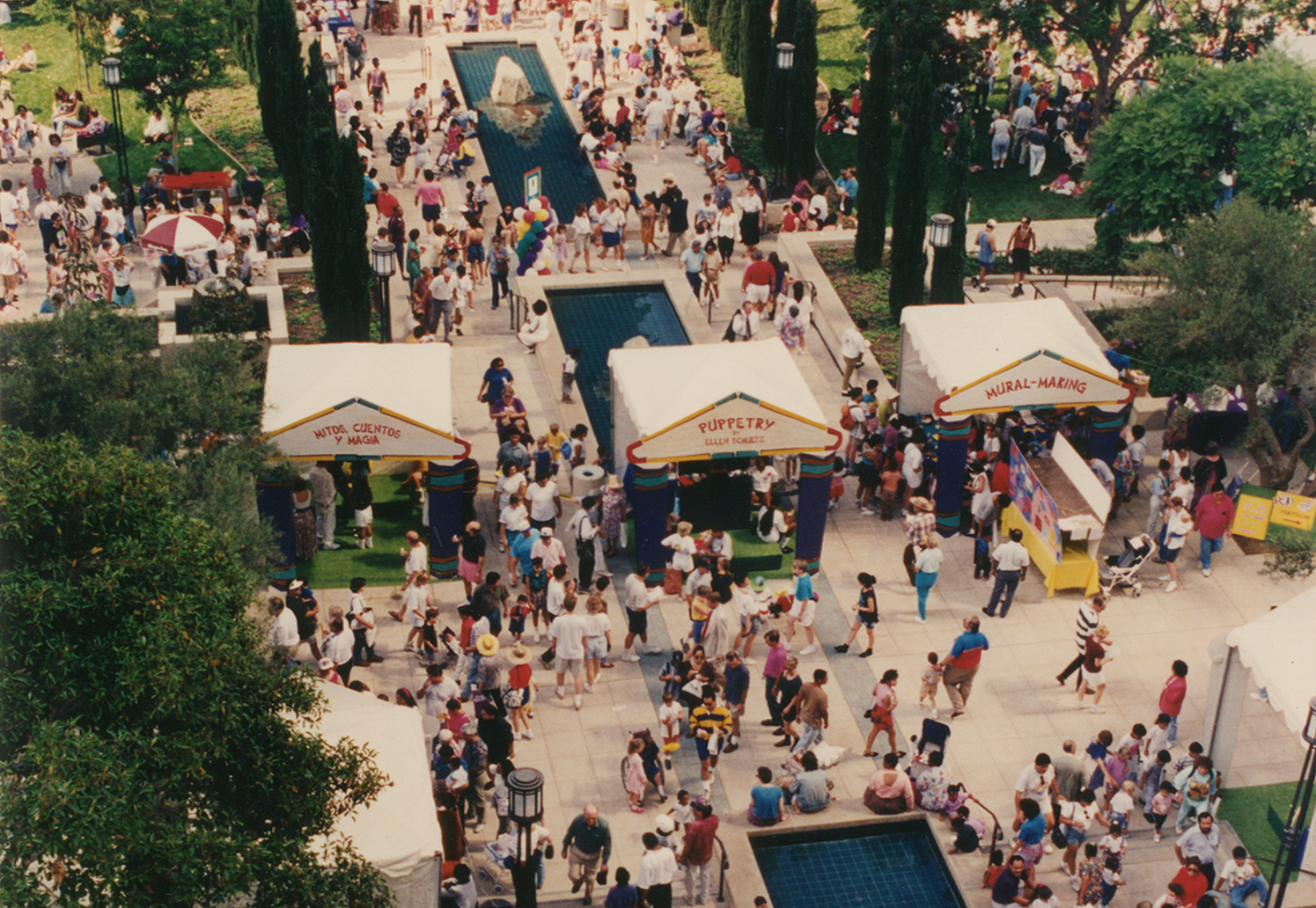
- October 1993: On Sunday, October 3, Central Library reopens with a large celebration that attracts an estimated 80,000 visitors. The event features the University of Southern California marching band and Barney the Dinosaur. Attendees explore the restored 1926 Goodhue building and the 360,000-square-foot Tom Bradley Wing addition—including new works by eleven sculptors and painters—and a re-created West Lawn.
- November 1996: Microsoft Corporation donates $600,000 in software, technical assistance, and cash for LAPL’s electronic catalog expansion and Central Library’s electronic training center.
- November 1997: Teen’Scape opens as a library within Central Library, designed by and exclusively for teens.
- November 1997: InfoNow, the library’s telephone reference service, begins operation. Chat and email reference services are eventually added to the department’s offerings.
2000s
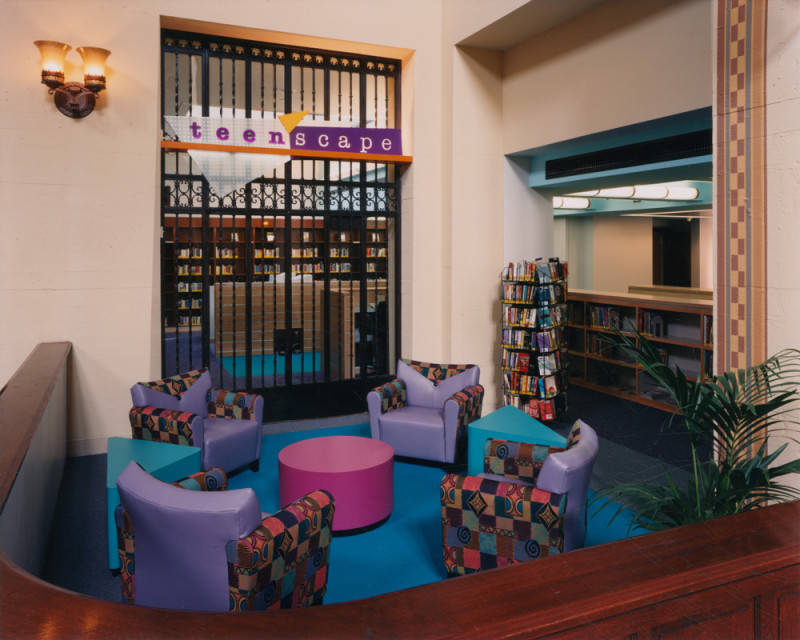
- March 2000: A new, expanded Teen’Scape Department opens. Attendees at the grand opening party include actors Anthony Stewart Head, who played librarian Rupert Giles on Buffy the Vampire Slayer, and a teenage Joseph Gordon-Levitt.
- June 2001: Central Library is renamed the Richard J. Riordan Central Library in honor of the 39th mayor of Los Angeles.
- October 2001: A space dedicated to the library’s literacy program, the Caroline and Henry E. Singleton Literacy Center, opens on the first floor of Central Library.
- September 2002: The Arnold and Blanche Winnick Popular Library, a "library within a library," opens, featuring new, high-demand, easily browsable materials in multiple formats.
- February 2004: The Computer Center opens on Lower Level 3 of the Bradley Wing, featuring fifty-five 1-hour internet stations and eight 15-minute internet stations.
2010s
- March 2011: Voters overwhelmingly pass Measure L to restore library funds and service hours that were cut during the Great Recession of 2009.
- December 2012: Los Angeles Public Library receives the extraordinary map collection of John Feathers. The acquisition doubles the already large map collection at LAPL.
- June 2014: Amanda Gorman becomes the first Los Angeles Youth Poet Laureate at a ceremony at Central Library.
- July 2015: In collaboration with Mayor Eric Garcetti, the Job & Career Center opens in the Business and Economics Department. The center offers patrons access to a WorkSource counselor as well as resources for finding and applying for jobs.
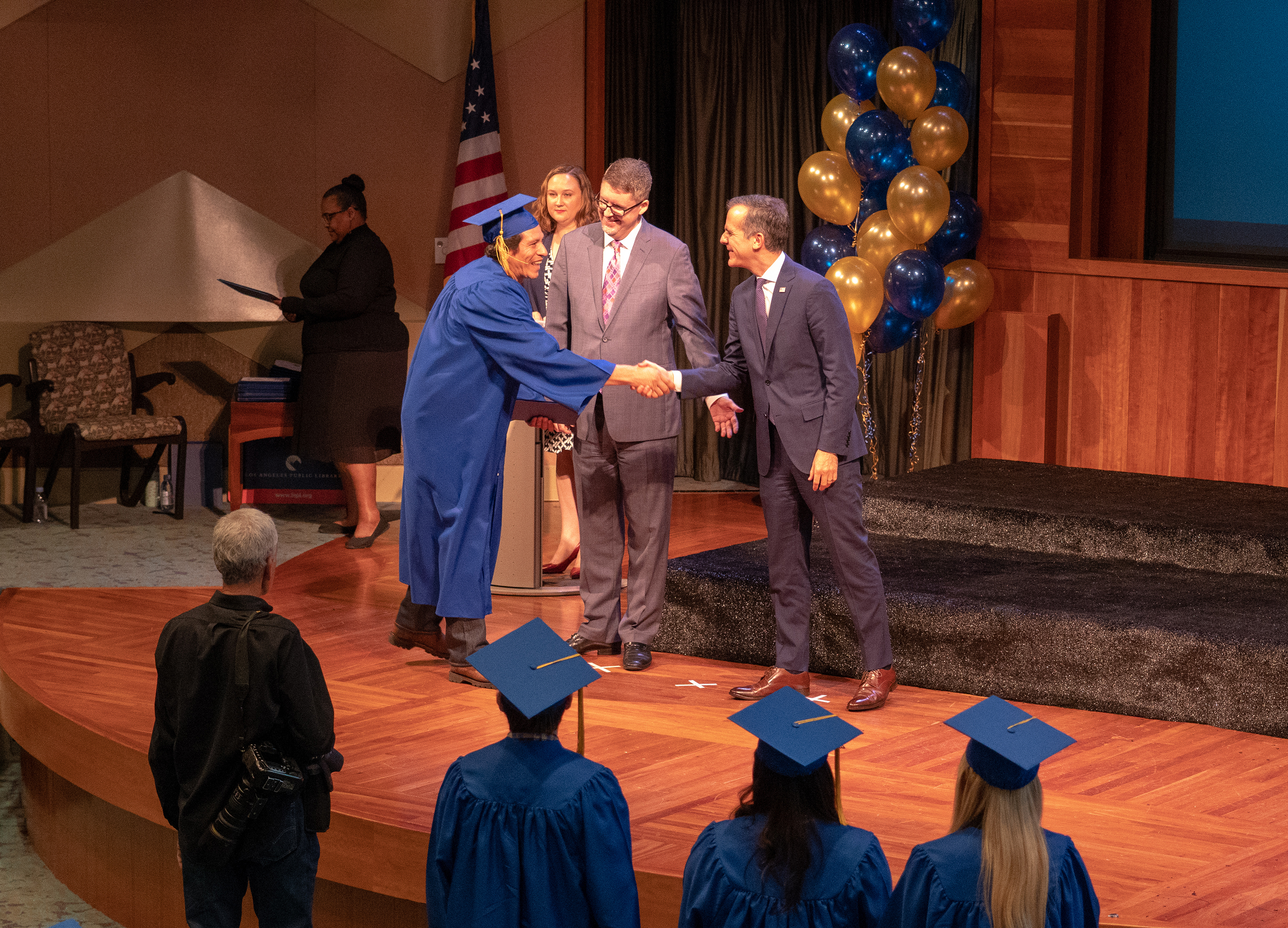
- January 2016: The first graduating class of the Career Online High School receive their diplomas in the Mark Taper Auditorium. Los Angeles Mayor Eric Garcetti and State Librarian of California Greg Lucas help confer the degrees.
- October 2017: Designed by Norman Pfeiffer, the S. Mark Taper Foundation Digital Commons opens on Lower Level 3 of the Bradley Wing. This space provides patrons with electronic charging stations and features the Video Wall—a 28-foot screen that highlights visual stories related to the library and the city of Los Angeles.
- January 2018: The New Americans Center, located in the International Languages Department on the first floor of the Bradley Wing, opens, offering free on-site immigration and naturalization services.
- October 2018: Central Library celebrates the 25th anniversary of its 1993 reopening with a building-wide event. Feels Like Home is published, featuring current and former staff. The same month, author Susan Orlean publishes The Library Book, a compelling nonfiction work investigating the 1986 arson fire and celebrating the enduring importance of libraries.
- June 2019: The Octavia Lab, a digital media lab named in honor of groundbreaking science fiction author Octavia Butler, opens. The lab offers patrons access to do-it-yourself technologies including sewing machines, 3D printers, Wacom tablets, and more.
- September 2019: Central Library hosts the inaugural Los Angeles Libros Festival. The festival, a collaboration between LAPL, LA librería, and REFORMA Los Angeles Chapter, is a free bilingual book festival designed for the whole family.
- October 2019: One panel from the "Well of the Scribes" sculpture resurfaces in an antique store in Arizona and is returned to Central Library. Two panels remain missing.
2020s
- March 2020: The COVID-19 pandemic closes all 73 library locations to the public, only the second full closure in Los Angeles Public Library history.
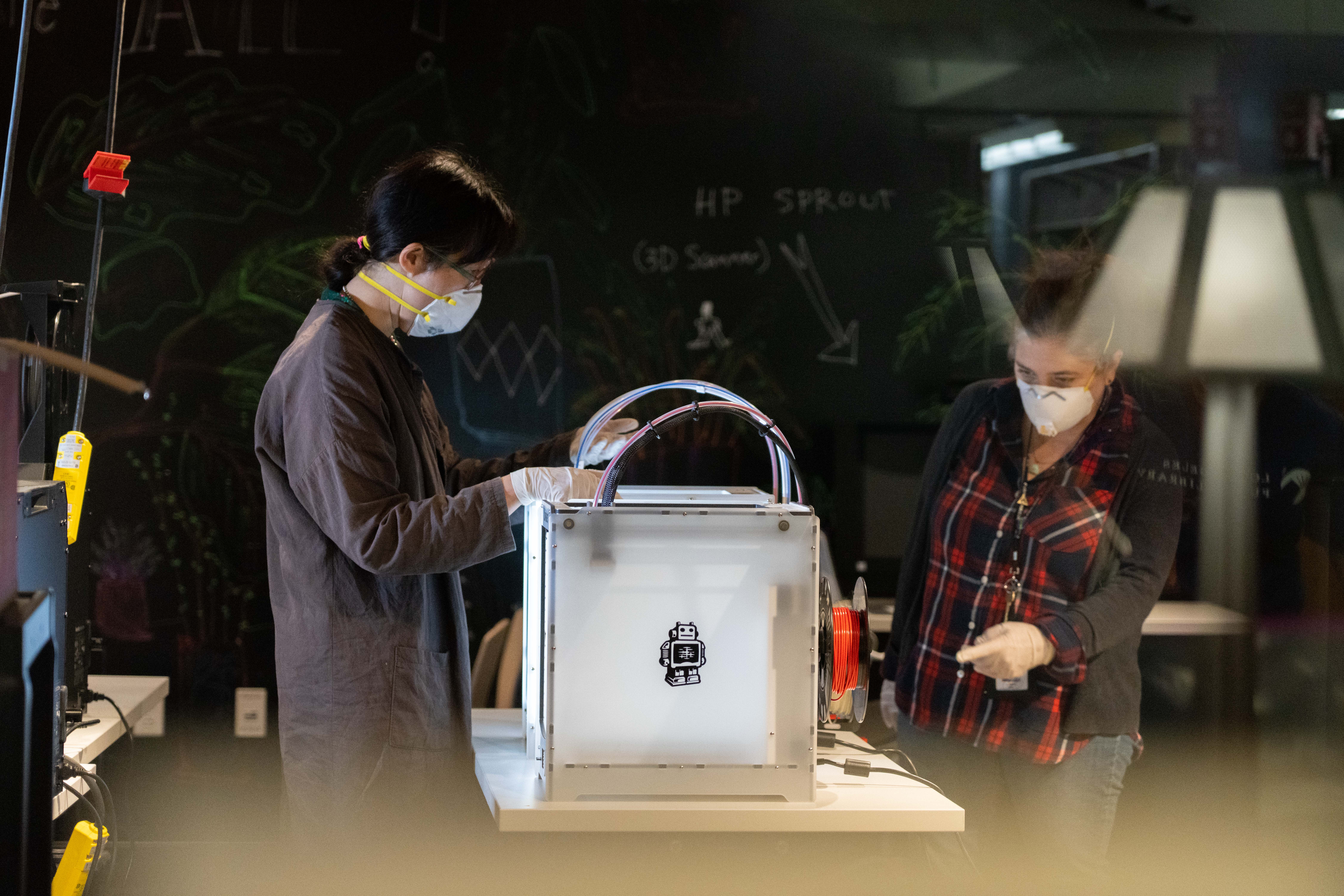
- April 2020: Octavia Lab in Central Library uses 3-D printers to make components of face shields for area hospitals as the shortage of personal protective equipment for healthcare workers becomes critical. Octavia Lab donated more than 126,000 face shields for area hospitals. LAPL staff partner with the Los Angeles Cleantech Incubator (LACI), and the Glendale Public Library donates the use of its six 3D printers.
- May 2021: Central Library and 37 branches reopen with limited in-person services on May 3rd.
- January 2022: Collaborative meeting rooms open in the Literature and Fiction, and Business and Economics Departments.
- April 2022: Punk band The Linda Lindas record an NPR Tiny Desk (Home) concert in the Children’s Literature Department. The band had shot to viral stardom after a performance at the Cypress Park branch one year prior.
- February 2023: As part of a pilot project from the Library Experience Office, social workers and community service representatives are hired for Central Library. The successful program later expands throughout the library system.
- June 2023: Central Library hosts the inaugural June Jubilee: A Celebration of Black Excellence. Presented by the Changing Tones Advisory Committee of the Los Angeles Public Library, the free event celebrates the rich Black culture in Los Angeles with special guest speakers, workshops, live entertainment, and fun activities for the whole family.
- May 2024: The AAPI Joy Festival celebrating the diversity of Asian American, Native Hawaiian and Pacific Islander communities in Los Angeles debuts at Central Library. The free event features dance performances, author talks, Japanese taiko drumming, lei making, and other activities for all ages.
- November 2025: A time capsule is unearthed in anticipation of the Central 100 celebrations. Stay tuned for what’s inside!