The Library will be closed on Thursday, December 25, 2025, in observance of Christmas.

California/The West

LAPL ID: 
19

From Exile to Home: Los Angeles Literary Life 1945 to 1980
In conversation with David L. Ulin
Tuesday, February 21, 2012
01:13:07
Listen:
Episode Summary
In the years since World War II, the literature of Los Angeles, like much about the city, has shifted, becoming less a literature of exile than one of place. Weschler- one of our foremost practitioners of literary nonfiction discusses this definitive period in Los Angeles' literary life.

Part of Pacific Standard Time, Art in LA 1945-1980

Participant(s) Bio
Lawrence Weschler, native of Los Angeles, is commonly regarded as one of the foremost practioners of literary nonfiction. His essays long appeared in the New Yorker, and one of his most recent books, Everything That Rises, out of McSweeney's, was celebrated with the National Book Critics Circle Award for Criticism. Weschler's latest collection, Uncanny Valley: Adventures in the Narrative, a companion to the earlier Vermeer in Bosnia, continues the author's distinctive blending of political and cultural themes. He currently directs the New York Institute for the Humanities at NYU.

David L. Ulin is a book critic for the Los Angeles Times. From 2005-2010 he served as the Times' book editor. He is the author of The Lost Art of Reading: Why Books Matter in a Distracted Time and The Myth of Solid Ground: Earthquakes, Prediction, and the Fault Line Between Reason and Faith, and the editor of Another City: Writing from Los Angeles and Writing Los Angeles: A Literary Anthology, which won a 2002 California Book Award. His essays and criticism are widely published.
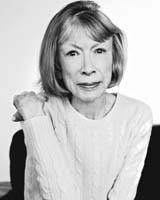
An Evening with Joan Didion

In conversation with David L. Ulin
Wednesday, November 16, 2011
01:12:45
Listen:
Episode Summary
A literary icon for Los Angeles and a cultural visionary for the rest of America, the acclaimed author of The White Album, The Year of Magical Thinking, and most recently, Blue Nights, discusses her current work and life in Los Angeles in the 60s.

Part of Pacific Standard Time: Art in LA 1945-1980

Participant(s) Bio
California-born novelist and essayist, Joan Didion's work explores disorder and personal and social unrest. Her novels include Play It as It Lays, A Book of Common Prayer, Democracy, and The Last Thing He Wanted. Her essay collections Slouching Towards Bethlehem and The White Album are perceptive, clear-eyed analyses of American culture. With her husband, John Gregory Dunne, she wrote a number of screenplays, including A Star Is Born. Her later works of nonfiction include Political Fictions, Where I Was From, The Year of Magical Thinking, and the most recent Blue Nights.

David L. Ulin is a book critic for the Los Angeles Times. From 2005-2010 he served as the Times' book editor. He is the author of The Lost Art of Reading: Why Books Matter in a Distracted Time and The Myth of Solid Ground: Earthquakes, Prediction, and the Fault Line Between Reason and Faith,, and the editor of Another City: Writing from Los Angeles and Writing Los Angeles: A Literary Anthology, which won a 2002 California Book Award. His essays and criticism are widely published.

Hollywood Left and Right

Moderated by Ella Taylor
Wednesday, November 2, 2011
01:15:35
Listen:
Episode Summary
From Chaplin to Schwarzenegger, movie stars have played a leading role in shaping the course of American politics. Join us for a conversation about how Hollywood has evolved into a vital center for American political life.

Participant(s) Bio
Steven J. Ross is Professor of History at the University of Southern California. Ross has written extensively in the areas of film and social history. He is the author of Movies and American Society and Workers On the Edge: Work, Leisure, and Politics in Industrializing Cincinnati, 1788-1890. His book, Working-Class Hollywood: Silent Film and the Shaping of Class in America was named by the Los Angeles Times as one of the Best Books of 1998. Ross' book, Hollywood Left and Right: How Movie Stars Shaped American Politics, received the Academy of Motion Picture Arts and Sciences' Film Scholars Award-the academic equivalent of an Oscar.

Mike Farrell, best known for his eight years on M*A*S*H and five seasons on Providence, is also a writer, director and producer. Beyond his work in the entertainment industry, Farrell has traveled the world for the last 30 years as part of prominent international human rights and peace delegations. He helped establish the California Committee of Human Rights Watch, and his opposition to the war in Iraq resulted in his co-founding Artists United to Win Without War. He is currently involved in an international effort in support of a worldwide moratorium on the death penalty. Farrell is the author of two books: Just Call Me Mike: A Journey to Actor and Activist, and Of Mule and Man.

Roger L. Simon, local author of ten novels and and seven screenplays, including the prize-winning Moses Wine detective series and Enemies: A Love Story, for which he was nominated for an Academy Award. Simon served on the faculty of the American Film Institute, Sundance Institute, and was president of the West Coast branch of PEN. In 2009, he published his first non-fiction book - Blacklisting Myself: Memoir of a Hollywood Apostate in the Age of Terror. It was republished in 2011 as Turning Right at Hollywood and Vine: The Perils of Coming Out Conservative in Hollywood.

Ella Taylor is a free-lance film critic, book reviewer and feature writer. She is the author of Prime Time Families: Television Culture in Post-War America and was a regular contributor to KPCC-Los Angeles' weekly film-review show FilmWeek. Taylor taught media studies at the University of Washington in Seattle, and is now based in Los Angeles.

Huxley on Huxley: Panel Discussion and Film Excerpts

Tuesday, June 21, 2011
01:08:29
Listen:
Episode Summary
The Hollywood home of Laura and Aldous Huxley, psychedelic pioneer and author of Brave New World, was a hotspot for the West Coast artistic avant-garde like Igor Stravinsky and Christopher Isherwood. Join us for a discussion of the Huxleys' influence on American culture, plus excerpts from Mary Ann Braubach's 2009 documentary, Huxley on Huxley.

Participant(s) Bio
Los Angeles born artist Don Bachardy has had a long career of artistic success. His first one-man exhibition was held in 1961 at the Redfern Gallery in London and he has since had many one-man exhibitions in Los Angeles, San Francisco, Seattle, Houston and New York. His work resides in many permanent collections, including that of the Metropolitan Museum of Art, the M.H. de Young Museum of Art, Henry E. Huntington Library and Art Gallery, the California State Capitol Building (official portrait of Governor Edmund G. Brown, Jr.), the Smithsonian Institution, and the National Portrait Gallery in London, among others. Numerous books of his work have been published. In 2008 the documentary Chris and Don: A Love Story, a film about Christopher Isherwood and Don Bachardy directed by Guido Santi and Tina Mascara, was released in movie theatres in the U.S., Canada and Great Britain.

Ann Louise Bardach is the author of Without Fidel: A Death Foretold in Miami, Havana and Washington and Cuba Confidential: Love and Vengeance in Miami and Havana. She is also the editor of The Prison Letters of Fidel Castro as well as Cuba: A Travelers Literary Companion. She is a reporter for The Daily Beast/Newsweek and was a Contributing Editor at Vanity Fair for ten years. Bardach won the PEN USA Award for Journalism in 1995 for her reporting in Vanity Fair on Mexican politics, and was a finalist in 1994 for her coverage of women in Islamic countries. Her book Cuba Confidential was named one of Ten Best Books of 2002 by the Los Angeles Times. Bardach started the International Journalism class at University of California at Santa Barbara and is also a Resident Scholar with the Orfalea Center at UCSB

Director and Producer Mary Ann Braubach met Laura Huxley through her activist work and forged a friendship that evolved into the 2009 documentary, Huxley on Huxley. She is currently working on a variety of feature and documentary projects, including The Book of Jamaica, based on the Russell Banks novel and a film on the American poet, Elizabeth Bishop with Bruno Barreto, with whom she co-produced the Brazilian film, Four Days In September. It was nominated for an Academy Award for Best Foreign Language Film. Braubach was a film and television executive for production companies at Warner Bros., Disney and Universal. She was the Head of Production for Tom Selleck's company, TWS, during which time she produced the Elmore Leonard western, Last Stand at Saber River. Before joining TWS, Ms. Braubach was Vice-President of Production at Spring Creek Productions and also served as the Director of Development for George Lucas' Lucasfilm. She was responsible for bringing together the talents for Mr. Lucas' upcoming production Red Tails.

John Densmore is an original and founding member of the musical group The Doors. John co-wrote and produced numerous gold and platinum albums and toured the United States, Europe, and Japan. His autobiography, Riders on the Storm, was on the New York Times bestseller list in 1991. He was inducted into the Rock & Roll Hall of Fame in 1993. His recent journalistic piece on corporations co-opting music to sell products, was published by The Nation Magazine, and subsequently syndicated in the Guardian and Rolling Stone. In film, he co-produced Road To Return, narrated by Tim Robbins. It won several prestigious national awards, and was screened for Congress, resulting in the writing of a bill. He also executive-produced Juvies, (narrated by Mark Walberg) which aired on HBO. He co-wrote and is producer of the screenplay Unknown Soldier with Eva Gardos,based on his novel, With God On Our Side.

We Are Here: We Could Be Everywhere

Moderated by Kenneth Rogers
Tuesday, June 14, 2011
01:26:27
Listen:
Episode Summary
Are the media arts a sensitizing force? What is media art's capacity to respond to political conditions? Cultural practitioners and scholars explore the role artists play as innovators of media technology and instigators in the public and media art realms. Co-presented with Freewaves

Participant(s) Bio
Anikó Imre is an Associate Professor of Critical Studies at USC's School of Cinematic Arts. Her main interests are global media and cultural studies. She has published several books, including Identity Games: Globalization and the Transformation of Media Cultures in the New Europe; East European Cinemas; and Transnational Feminism in Film and Media. She co-edits the Palgrave book series Global Cinemas.

Henry Jenkins is Provost's Professor of Communication, Journalism, and Cinematic Arts at the University of Southern California. He has written and edited more than a dozen books on media and popular culture, including Convergence Culture: Where Old and New Media Collide. His other published works reflect the wide range of his research interests, touching on democracy and new media, the "wow factor" of popular culture, science-fiction fan communities, and the early history of film comedy. Prior to joining USC, Jenkins spent nearly two decades at the Massachusetts Institute of Technology as the Peter de Florez Professor in the Humanities. While there, he directed MIT's Comparative Media Studies graduate degree program from 1999-2009, setting an innovative research agenda during a time of fundamental change in communication, journalism, and entertainment.

Reed Johnson is an arts and culture reporter for the Los Angeles Times. From 2004 to 2008 he was the paper's Latin America cultural correspondent, based in Mexico City.

Fabian Wagmister teaches audiovisual creativity and new forms of digital creation at University of California, Los Angeles. As a professor in the department of Theater, Film and Television, he was instrumental in the creation and growth of the Laboratory for New Media, the HyperMedia Studio, and the Program on Digital Cultures, a center converging regional studies (Latin America) and digital communications to support the development of empowered technological identities. A native of Argentina, Fabian maintains active collaboration with artists and theorists throughout Latin America. Currently Fabian is director of UCLA's Center for Research in Engineering, Media, and Performance (REMAP), where faculty and students of engineering and of theater, film and television, develop theoretical fundaments, creative procedures, and technological toolsets for participative cultural systems.

Kenneth Rogers is Assistant Professor in the Media and Cultural Studies Department at the University of California, Riverside. His research and publication is broadly concerned with the intersection of attention, labor, political economy, and social media. He is also engaged with the practical application of digital tools and social media in experimental pedagogy and direct action politics. Rogers has been a fellow at the Center for Ideas and Society at UC Riverside. His current book project, The Attention Complex: Media Technology and Biopolitics, maps the complex of political and social forces that have, over the last two decades, dramatically reshaped how human attention is theoretically understood, technologically managed, and psychiatrically and biologically treated.

Gary Snyder, "Song of the Turkey Buzzard: The Poetry of Lew Welch"

Co-presented with the Poetry Society of America
Thursday, May 26, 2011
01:29:12
Listen:
Episode Summary

Join Pulitzer Prize-winning poet Snyder and friends for an evening of spoken word to celebrate the work of Beat poet Lew Welch, on the 40th anniversary of his disappearance.


Participant(s) Bio

Gary Snyder is a poet, author, scholar, cultural critic, and Professor Emeritus of UC Davis. He graduated from Reed college in Portland, Oregon (where his roommates were poets Lew Welch and Philip Whalen) in 1951. In the Bay Area, Snyder associated with Kenneth Rexroth, Robert Duncan, Philip Whalen, Allen Ginsberg, Jack Kerouac and others who were part of the remarkable flowering of west coast poetry during the fifties. In 1956 he moved to Japan to study Zen Buddhism and East Asian culture. For the last thirty-eight years, he has lived in the northern Sierra Nevada. He divides his time between environmental and cultural issues with a focus on the Sierra Nevada ecosystem, and teaching with a focus on creative writing, ethnopoetics, and bioregional praxis. He is the author of numerous books of poetry and prose. He has been awarded the Pulitzer prize for poetry (1975) as well as the Bollingen Prize (1997). His selected poems No Nature was a finalist for the National Book Award in 1992.

Lew Welch attended Reed College in Oregon, where he met future Beat poets Gary Snyder and Philip Whalen. While at graduate school at the University of Chicago in 1951, he suffered a nervous breakdown. He left school and went into psychotherapy while working as an advertising copywriter. (He came up with the famous slogan "RAID KILLS BUGS DEAD.") He moved to San Francisco to pursue his work as a poet, supporting himself as a cabdriver and became an active participant in Beat culture, living at various times with Snyder and Lawrence Ferlinghetti and appearing as the character, Dave Wain in Jack Kerouac's novel, Big Sur. Welch published and performed widely during the 1960s, and taught a poetry workshop as part of the University of California Extension in San Francisco from 1965 to 1970 and as poet-in-residence at Reed College in January 1971. On May 23rd 1971, he left behind a note and walked out of Snyder's house in the mountains carrying a revolver. His body was never found. Lew Welch is included in many Beat Generation retrospectives or anthologies, and his book of collected poems, Ring of Bone, was first published in 1973.


Art Collectives and the Current State of Literary Culture

Moderated by Susan Salter Reynolds
Tuesday, March 22, 2011
01:23:27
Listen:
Episode Summary

A reading and panel discussion Moderated by Susan Salter Reynolds, L.A. Times book reviewer

With Chuck Rosenthal, Alicia Partnoy, Ramón Garcia, & Gail Wronsky. Projected paintings by Gronk.

Members of the L.A.-based Glass Table Collective read their work and discuss publishing outside the lines.


Participant(s) Bio

Ramón Garcia is the author of a book of poetry Other Countries. He has published poetry in a variety of journals and anthologies including Best American Poetry 1996, Ambit, The Floating Borderlands: Twenty-Five Years of U.S.-Hispanic Literature, Crab Orchard Review; Poetry Salzburg Review, Los Angeles Review and Mandorla: New Writing from the Americas. He is a Professor in Chicana/o Studies at California State University, Northridge.

Alicia Partnoy is a survivor of Argentina's detention camps during the dictatorship in the late 1970s. Best known for The Little School: Tales of Disappearance and Survival, Partnoy also published the poetry collection Little Low Flying/Volando Bajito. Poems from her Revenge of the Apple/Venganza de la Manzana rode the metro in New York, Dallas, and Washington D.C., are sung by "Sweet Honey in the Rock" and were translated into several languages, including Hebrew. Partnoy edited You Can't Drown the Fire: Latin American Women Writing in Exile, and co-edited Chicana/Latina Studies: the Journal of Mujeres Activas en Letras y Cambio Social. Her most recent book is the translation of Gail Wronsky's poetry collection So Quick Bright Things.

Susan Salter Reynolds has been a book critic and features writer at the Los Angeles Times for twenty years. Prior to that she was an assistant editor at The New York Review of Books.

Chuck Rosenthal is the author of eight novels: The Loop Trilogy, Loop's Progress, Experiments with Life and Deaf, and Loop's End; Elena of the Stars, Avatar Angel, the Last Novel of Jack Kerouac, My Mistress Humanity, The Heart of Mars; and Coyote O'Donohughe's History of Texas. He has published a memoir, Never Let Me Go, and most recently a travel book, Are We Not There Yet? Travels in Nepal, North India, and Bhutan. Rosenthal teaches fiction writing at Loyola Marymount University. He is the manager of the Glass Table Artists' Collective and Managing Editor of What Books Press.

Gail Wronsky is the author, coauthor, or translator of nine books of poetry and prose, including Dying for Beauty, Poems for Infidels, and Volando Bajito, among others. She teaches creative writing at Loyola Marymount University.

Gronk is a nationally renowned painter and performance artist from Los Angeles. During the 1970's, he was one of the founding members of ASCO, an avant-garde multi-media arts collective in Los Angeles. He is best known for his murals and his very physical approach to painting. Much of his recent work has been done as temporary, mural-scale, site-specific paintings, the latest for the Fowler Museum at UCLA in April 2010.


Parts Per Million: The Poisoning of Beverly Hills High School

In conversation with Judith Lewis
Tuesday, July 24, 2007
01:10:29
Listen:
Episode Summary
An unsettling and timely investigation into the ties between Beverly Hills, its oil wells, and a local cancer cluster. A compelling legal drama by a journalist and member of the Beverly Hills High School class of '71.

Participant(s) Bio
Joy Horowitz is a freelance journalist and former staff writer for the Los Angeles Times. Her work has appeared in the New York Times, The New Yorker, Los Angeles magazine, and many other national publications. At Harvard University, she began writing sports for The Harvard Crimson. After graduating cum laude in 1975, she worked as a copy girl, sports writer and investigative reporter for the old Los Angeles Herald-Examiner. After stints as an investigative producer at the local CBS-TV news station in L.A. and feature writer at the Los Angeles Times, she received a Masters in Studies of Law (MSL) degree from the Yale Law School in 1982. She has been the recipient of numerous journalism awards, including a Ford Foundation Fellowship (1981), a Pulitzer Prize nomination for her reporting on indoor air pollution for the Los Angeles Times (1982), and Sunday Magazine Editors' Association award for her Los Angeles Times magazine article "Greetings from Pearlie and Tessie" (1995), which was the basis for her 1996 book, and several Brandeis University National Women's Committee honors.

Judith Lewis is a senior editor at the LA Weekly, where her writing on technology, the arts, natural resource issues, public health and the environment has appeared since 1991. Her work also appears in High Country News, WIRED, Salon, Sierra Magazine and the Los Angeles Times. She won an Association of Alternative Newsweeklies award for her reporting on nuclear power and global warming. Judith is a member of the Society for Environmental Journalists, and is currently at work on a lay person's guide to nuclear energy.

Shepard Fairey, "MAYDAY: The Politics of Street Art"

Presented in conjunction with LA Weekly
Monday, March 7, 2011
01:19:31
Listen:
Episode Summary

The Los Angeles-based artist and designer behind the ubiquitous Obey Giant stencil and the now legendary Obama HOPE poster, talks about his life, his work and his move from the street to large-scale museum exhibitions.


Participant(s) Bio

Shepard Fairey is the man behind OBEY GIANT. What started with an absurd sticker he created in 1989 while a student at the Rhode Island School of Design has since evolved into a worldwide street art campaign. In 2003, Fairey founded Studio Number One, a creative design firm dedicated to applying his ethos at the intersection of art and enterprise. In 2008, Fairey's HOPE portrait of Barack Obama became the iconic image of the presidential campaign and the original image now hangs in the Smithsonian Institution's National Portrait Gallery in Washington, D.C. In May of 2010, his exhibition MAYDAY was the final show to be mounted at Dietch Projects, in New York City. His work has also been exhibited in museums worldwide.


How the West Was Lost

Tuesday, February 22, 2011
01:16:17
Listen:
Episode Summary
One of Time Magazine's 100 most influential people and best-selling author of Dead Aid reveals the economic myopia of the West and the radical solutions it needs to adopt in order to assert itself as a global economic power once again.

Participant(s) Bio
Born and raised in Zambia, Dambisa Moyo received a PhD in economics from Oxford University and went on to work at Goldman Sachs for nearly a decade, as well as at the World Bank in Washington D.C. Ms. Moyo was named by Time magazine as one of the "100 Most Influential People in the World", and was nominated to the World Economic Forum's Young Global Leaders Forum. Her writing regularly appears in economic and finance-related publications such as the Financial Times, The Economist magazine and the Wall Street Journal. She is the author of the New York Times bestseller, Dead Aid.


Pages

Top