
Hope (Street) Springs Eternal: Central Library During the Great Depression

In periods of falling budgets and depressed spirits, it is well to turn our eyes towards a goal of achievement, a goal so distant that we visualize only the rising levels necessary to attain it, and minimize the intervening valleys of discouragement and difficulty.
—City Librarian Althea Warren, Forty-Sixth Annual Report of the Board of Library Commissioners of the Los Angeles Public Library (1934)
The 1930s were indeed difficult years for the Los Angeles Public Library, as they were for the whole country. The library’s budget, hours of operation, and staffing levels all suffered at a time when the city needed services the most. People packed the reading rooms of Central Library, often waiting in line when the doors opened. More people were signing up for library cards than ever before, and the number of cardholders had been rising for years. The 1930 annual report announced that 28.5% of Angelenos had a library card. The 1934 annual report reported that an average of 140 people signed up for a library card daily at the Registration Desk in Central Library’s rotunda. Declines in the book-buying budget varied by department, but the 1934 annual report cited a 66% decrease in the Sociology Department’s budget from 1931 to 1934. Despite the difficulties, the library and staff persevered. Let’s take a look at just a few of the happenings at Central Library during the 1930s.
Completion of the Rotunda’s Iconic Artwork
In studying Mr. Goodhue’s achievement, it gives me the feeling of a certain uprightness which, carried into symbolism, can be taken to signify ‘youth, America, the West.’ There is a certain simplicity and joyousness about this building, which must be reflected in the color and design of these paintings.
—Artist Dean Cornwell on Central Library in History Comes Alive on Library Walls by Faith Holmes Hyers in Pacific Bindery, September 1932
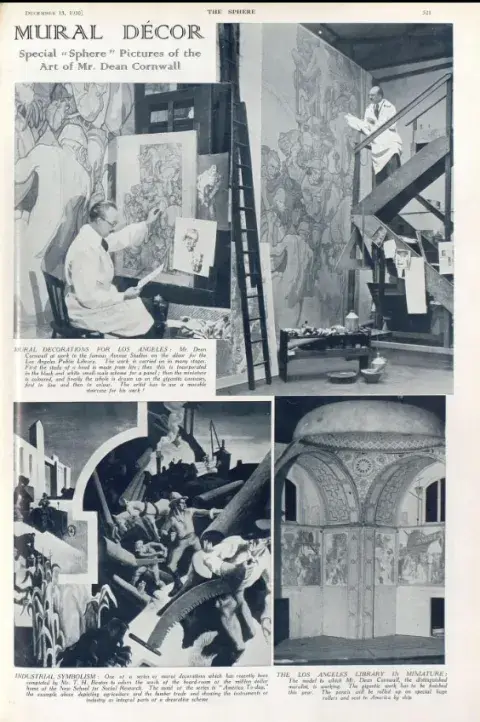
In 1927, artist Dean Cornwell beat out several other artists, among them Maynard Dixon, in a competition to decorate the walls of Central Library’s rotunda. Over the next five years, Cornwell researched California history using “guidebooks, school texts, and historic volumes,” according to a 1932 article by library publicist Faith Holmes Hyers. He began painting the murals in New York and London, using 100 models to stand in for the 300 figures in each mural. Forty-foot canvases were created on special looms in Belgium, shipped to London, and "carefully prepared by an old shipbuilder for their journey around the Panama [Canal] to Los Angeles."
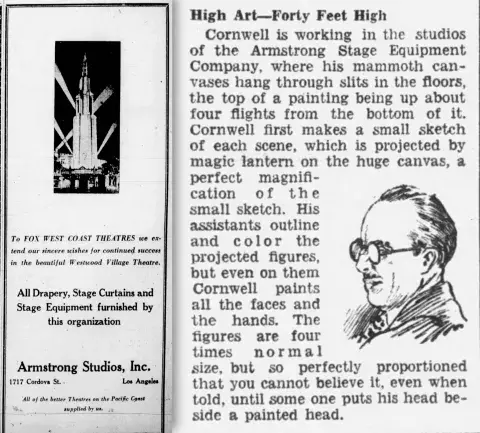
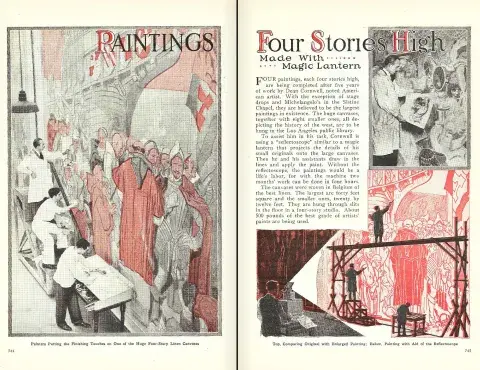
Once in Los Angeles in June 1931, Cornwell found a scenic four-story workspace at Armstrong Studios, a business that supplied stage equipment to theaters. Their building had frames that “allowed the large canvas to be raised and lowered through a slit in the floor, permitting the artist to reach any spot of canvas from floor level,” according to Hyers.
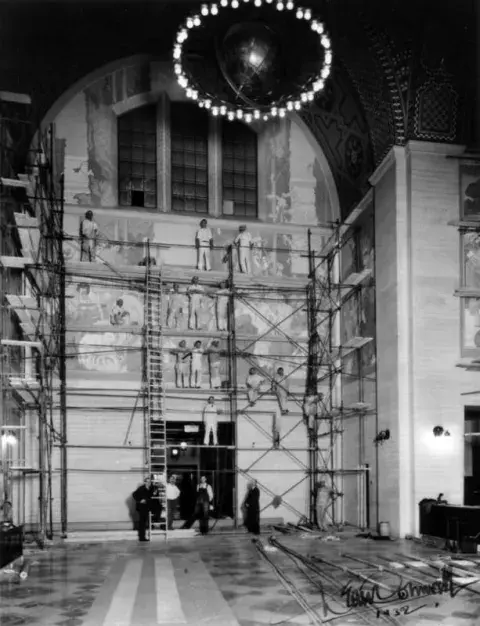
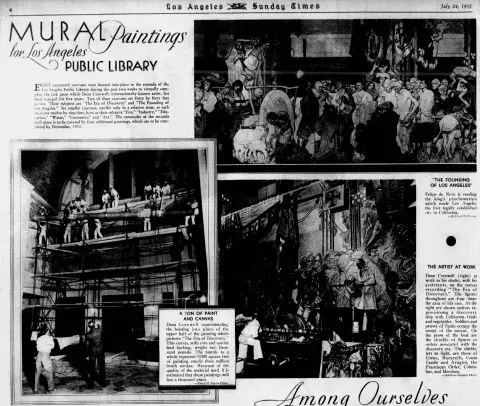
The first of Dean Cornwell’s panels were hung in the rotunda at night, after the library closed, in July 1932. The first to be unfurled was “The Founding of Los Angeles,” according to Faith Holmes Hyers, who was present for the midnight hanging. During the month of July, eight of the twelve murals were hung in the rotunda, and it was estimated that the rest would be hung by November. They were not.
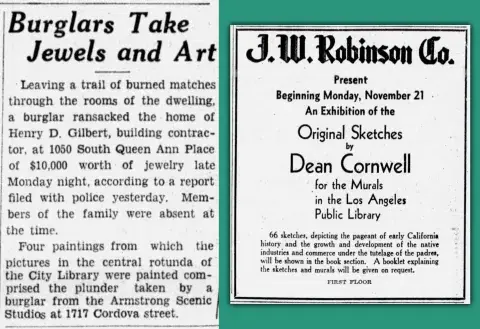
Shockingly, it was announced in early November that "four paintings from which the pictures in the central rotunda of the City Library were painted" had been stolen from the Armstrong Scenic Studios, where Cornwell was working on the murals. However, Cornwell did show some of his sketches at the J.W. Robinson department store during the month of November 1932.
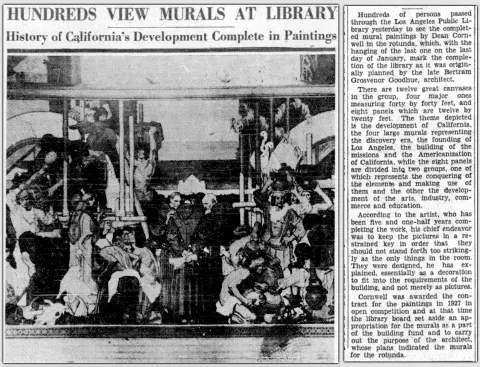
The hanging of the last mural panel finally took place on January 31, 1933. The Los Angeles Times noted this marked the “completion of the library as it was originally planned by the late Bertram Grosvenor Goodhue, architect.” I heartily recommend taking a docent tour of the Central Library to learn more not only about Dean Cornwell’s murals but also about all the art at the Library.
Relief Work in the Library
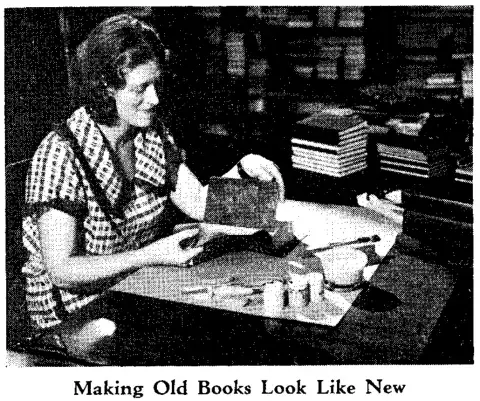
A variety of work relief projects were carried out at Central Library during the 1930s through several local, state, and national organizations, including the State Emergency Relief Administration (SERA) and the Works Progress Administration (WPA). The majority of work, which took place across multiple departments, was clerical in nature and freed up library staff to help the increasing number of people who visited Central Library. As book budgets shrank and the need to mend tattered books grew, relief workers cleaned books, taped pages, typed replacement pages, re-lettered spines, and erased pencil marks. WPA workers operated Central Library’s outdoor reading rooms and helped run the noonday recorded music concerts. Two works of art at Central Library, Gail Cleaves’ Library Map and Charles Kassler Jr.’s Bison Hunt, were also relief work, funded by the Public Works of Art Project (PWAP).
![The Union List of Serials in Libraries of Southern California [1939]](/sites/default/files/styles/embedded_480w/public/media/image/2026-09/111939serials.jpg.webp?itok=rAdNGf85)
The Union List of Periodicals in Libraries of Southern California [1941] was a WPA project headquartered at Central Library. Note the names of WPA workers on the right side, via Hathitrust.org
Work relief projects at Central Library paired unemployed clerks, typists, newspaper writers, and librarians with overworked library staff, often for just a few months at a time. Two relief projects that began in 1934-35 deserve special mention. Librarian Dorothy Thompson began updating a 1925 master list of periodicals available in Southern California Libraries with help from SERA and WPA workers. The reference tool, which listed the periodicals available in Southern California’s public, academic, and special libraries, was invaluable to librarians at the time. The 1920s had been a boom time for magazines and journals, with upwards of 20,000 different publications printed. The Thompson-compiled edition was published by the Southern District of the California Library Association in 1939, and another update was published by the Special Libraries Association Southern Chapter in 1941. Both editions list the WPA and SERA contributors by name.
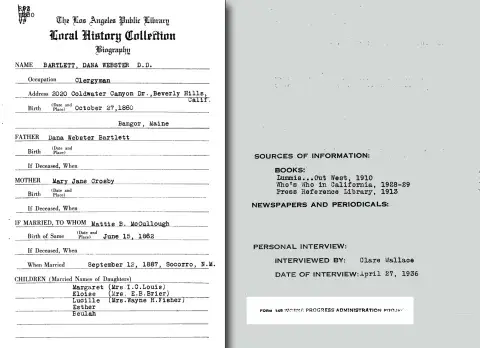
Another WPA project was the resumption of biography cards created by the Library on prominent Angelenos. Charles Lummis started the practice during his tenure as City Librarian (1905-1910), but it fell by the wayside due to a lack of staff time. These biography cards can still be found in the History Department at Central Library.
Staff Cafeteria
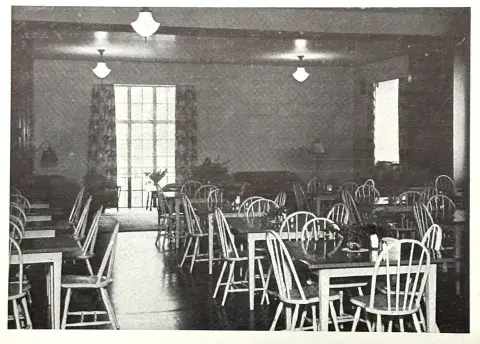
Did you know that the Central Library once had a staff cafeteria? This story starts before the Great Depression. The lunch room/cafeteria was a popular spot when the Central Library opened in July 1926, with the annual report boasting that 200 staff members dined there daily. The kitchen and lunch room were on the third floor, overlooking Fifth Street. The staff could choose from a small variety of items, including meals and à la carte options such as salads, soups, vegetables, sandwiches, and desserts. The creation of the cafeteria’s "Outside Inn" and the reign of the Marshalls both deserve special mention.
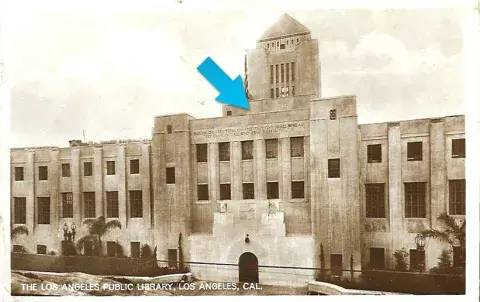
Early on, the staff wanted to take advantage of the lovely Los Angeles weather and approached the administration about extending the lunchroom onto a portion of the roof, thereby creating a patio for staff to dine al fresco. The Library Board agreed to fund the building changes necessary to create the Outside Inn, as it was dubbed, but staff were responsible for funding any needed equipment for the outdoor space. A fundraiser for the Outside Inn, held at the Majestic Theater in October 1929 and starring Edward Everett Horton, netted $543.50. [Retired librarian Glen Creason remembered the lunch room (sans cafeteria) and roof patio as a spot to take breaks in the 1980s.]
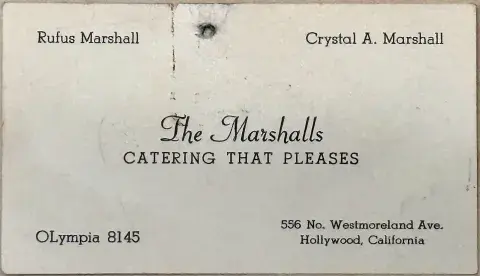
It was difficult to keep the not-for-profit cafeteria open during the Great Depression. Salaries, equipment, and provisions all came from the money taken in at the cafeteria. Budget cuts and reduced staffing levels necessitated closing the cafeteria more than once. One bright spot was the reopening of the newly redecorated cafeteria in 1937, with Mrs. Crystal Marshall in charge of the kitchen, assisted by her husband, Rufus, who was also a private chef. The Marshalls came highly recommended by private clients who were members of the Friday Morning Club and other socially prominent groups.
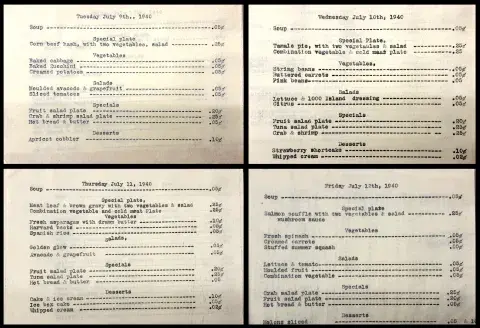
A trip to Special Collections yielded several of the Marshalls' menus. One undated menu for the Central Library cafeteria showed offerings of ham timbales with sweet potatoes and salad, rolls and butter (25 cents); individual chicken pie with salad (25 cents); spinach soufflé with mushroom sauce (20 cents); and asparagus with cheese sauce served in a toast basket with spiced beets (20 cents). A July 1940 menu listed more than a dozen different salads, including tuna, crab, egg, Waldorf, beet, avocado with grapefruit, and a molded potato salad. Desserts ran the gamut from homemade cakes to pies, ice cream, pudding, cobbler, and sliced fruit. The Marshalls were beloved, but sadly, the cafeteria struggled to be profitable and was closed yet again on November 1, 1941. A letter in Special Collections noted that while an average of 105 staff members visited the cafeteria daily, more than half brought lunch from home. The remaining number of people who purchased a meal at an average cost of 30 cents was not enough to cover food and supplies, cafeteria staff salaries.
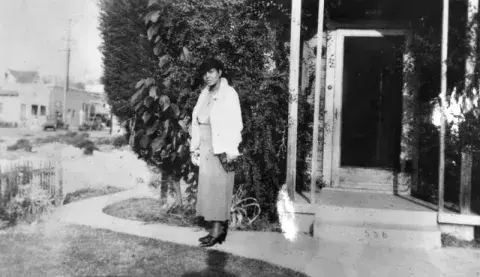
Serendipity led me to photos of Crystal Marshall in the library’s Shades of LA collection, where I first learned of her remarkable life and enduring legacy. Digging a little deeper online, I learned more from stories shared by her family. The impact she and Rufus made in their East Hollywood/J-Flats community, from sharing home-cooked meals on a grand scale to protecting the possessions and property of their Japanese neighbors during WWII internment, continues to be felt decades later. Their story deserves a book! [The story of the staff cafeteria originally appeared in the Summer 2026 issue of the Culinary Historians of Southern California newsletter.]

