Interview With an Author: Janna Ireland

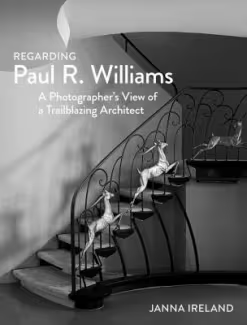
Janna Ireland was born in Philadelphia, but has chosen Los Angeles as her home. She holds an MFA from the UCLA Department of Art and a BFA from the Department of Photography and Imaging at NYU. Ireland is the 2013 recipient of the Snider Prize, presented by the Museum of Contemporary Photography, Columbia College Chicago. Her work has been shown in solo exhibitions in Los Angeles, San Francisco, New Orleans, and Chicago, and in group exhibitions across the United States and internationally. She has been published in Aperture, Harper’s, Art Papers, Vice, and The Los Angeles Times. Her latest book is Regarding Paul R. Williams, and she recently talked about it with Daryl Maxwell for the LAPL Blog.
What was your inspiration for Regarding Paul R. Williams? What brought you back to create the expanded edition?
The initial idea for the project came from the amazing local architect Barbara Bestor. She thought it would be interesting to see what kind of work a young photographer might do about Paul R. Williams, who was criminally underappreciated at the time. That was back in 2016, and here we are, 10 years later, in a moment of incredible recognition for him at institutions across the city. After the original version of the book was published in 2020, I kept working on the project, because my interest in Williams didn’t go away.
Over time, the book sold out three printings. Angel City Press offered me the opportunity to expand the book to include some of the newer work instead of reprinting it the same way.
In the opening of the book, you state that, at the outset of this project, you were only "vaguely familiar" with Paul Revere Williams’ work, that your knowledge of architecture was limited, and that you were neither an architectural nor a documentary photographer. What drew you to take on this project and continue it as you have?
Curiosity is what brought me into the project, and what kept me returning to it again and again. I love to learn, and I love to try new things in my work just to see what will happen.
I’m guessing that, as your work has progressed, you may have done some research into Williams’ work and/or architecture in general. What are some of the most interesting or surprising things that you’ve learned while working on Regarding Paul R. Williams?
About a year into the project, I learned that much of his archive, which at the time was widely thought to be lost altogether, was actually safe in storage. That was a welcome surprise. That’s the material that eventually made its way to the Getty Research Institute and the USC School of Architecture.
You’ve been photographing Williams’ buildings for approximately a decade. How large is your photographic collection? What was your process for determining what would be included in Regarding Paul R. Williams?
I took thousands and thousands of photographs. I have no idea how many. After every visit to photograph a building, I would put together a small group of my favorites, or the ones that I thought did the best job of contributing to the longer story I was trying to tell about Williams’ work. The book is made up of a selection of those photographs. There is no one quality I was looking for–it is a very vibes-based editing process.
When you’re photographing a Williams building, what is it that captures your eye?
I am often looking at Williams’ use of materials, or the way the light hits a particular part of a room.
Given the varieties of styles and types of buildings that Williams designed over his career, do you have any favorite buildings?
I do love the Guardian Angel Cathedral in Las Vegas. Here in Los Angeles, it would probably be the house he designed for himself.
If you could magically restore a Williams building, or buildings, that have been lost, what would it/they be?
I would love to see the return of every beautiful, functional Williams home that was knocked down to make way for something ugly, tacky, or dull.
We lost Paul R. Williams in 1980. If you could ask him something, what would it be?
I think I would have about a million questions for Mr. Williams. If I could ask only one thing, I would ask what his work and career would have looked like if he had had the freedom to be as uncompromising as Frank Lloyd Wright. How would his personality, personal taste, artistry, and style have looked on full display, without compromise?
Is there something you would tell him if you had the chance?
I would tell him that he is remembered, and that Los Angeles loves him.
What’s currently on your nightstand?
Hand lotion, last night’s glass of water, a blood pressure cuff, and a copy of bell hooks’ All About Love.
Can you name your top five favorite or most influential authors? Favorite or most influential photographers?
In terms of literature, Toni Morrison, Denis Johnson, Zadie Smith, Claire Keegan, Mike Davis.
In terms of photography and photographers, I have too many favorites. The best I can do is tell you what I’m looking at and thinking about right now:
I recently got a copy of Justine Kurland’s Highway Kind, and it’s been on my mind. It is such a beautiful meditation on balancing art and motherhood. I think Anthony Hernandez is probably my favorite photographer of Los Angeles. He really sees the city. Eileen Cowin has a new solo show at LACMA that I’m going to see as soon as I have a free day to get across town; she’s amazing. LaToya Ruby Frazier’s work has been an inspiration to me for many years, and I always come back to looking at it. I own more books by Mark Steinmetz than any other photographer. I have a little print of one of his cat photographs, too.
What was your favorite book when you were a child?
Harriet the Spy by Louise Fitzhugh. I was so afraid of my journals being found and read that I left people’s names out, and now, when I look back on them, I don’t know which boys I was writing about having crushes on.
Was there a book you felt you needed to hide from your parents?
I had so many questions about puberty, but was embarrassed to ask them! I borrowed books from my middle school library and read them in secret.
Is there a book you’ve faked reading?
As a student, I certainly faked my way through a class discussion or two when I hadn’t done the reading. Today, I wouldn’t pretend to have read something I haven’t. There are books I have read that I wouldn’t admit to, though!
Can you name a book you’ve bought for the cover?
I have so many books, I can’t buy them impulsively. When I buy a book, I have to want it for what’s inside.
Is there a book that changed your life?
Scott McCloud’s Making Comics. It changed the way I thought about sequential storytelling through still images.
Can you name a book for which you are an evangelist (and you think everyone should read)?
I just read Pride and Prejudice for the first time last year. It is truly funny at points. I had no idea. I like to be reminded every once in a while that people in the past were a lot like people are today.
Is there a book you would most want to read again for the first time?
Tove Ditlevsen’s Copenhagen Trilogy.
What is the last piece of art (music, movies, TV, more traditional art forms) that you’ve experienced or that has impacted you?
I ask this question as an ice breaker on the first day of all my classes. Lately, I’ve been rewatching and rereading things that impacted me when I was young, and it has been really interesting to think about the way perception changes over time.
I first saw Francis Ford Coppola’s The Conversation when I was a junior in high school (thank you, Ms. Litman!). Now I’m just a couple years younger than Gene Hackman’s character, Harry Caul, and the movie is heartbreaking in a new way.
What is your idea of THE perfect day (where you could go anywhere/meet with anyone)?
My family and I love to travel. A perfect day would be a lightly scheduled–maybe a museum and then some time to wander around–with a dinner reservation at a great local restaurant at the end. No one would be jet-lagged, and everyone would be in a good mood.
What is the question that you’re always hoping you’ll be asked, but never have been?
It’s already been such a treat to be able to talk about books in this interview. I never get to talk about Harriet the Spy! It would be so fun to do a similar interview about the way movies have influenced me. No one ever asks me what my favorite movie was when I was a child.
What is your answer?
It was Tommy. My parents had a VHS copy that I would watch over and over. In the 80s and 90s, kids kind of just watched whatever was around.
What are you working on now?
I have a solo show opening at the Amon Carter Museum in Texas in April. The Carter is publishing a book to accompany the exhibition that will be an overview of the last 15 or so years of my practice. I’m most well-known for the Williams project, but the majority of my work is about my family. I’m currently neck-deep in administrative tasks related to the show and the book.