Interview With an Author: Tony Lee Moral

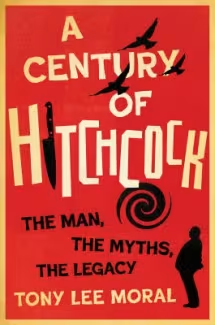
Tony Lee Moral is a British filmmaker and author who specializes in film history, especially the work of Alfred Hitchcock. He is the author of Hitchcock and the Making of Marnie, The Making of Hitchcock's The Birds, The Young Alfred Hitchcock's Moviemaking Master Class, and Alfred Hitchcock Storyboards. His latest book is A Century of Hitchcock, and he recently talked about it with Daryl Maxwell for the LAPL Blog.
In your introduction, you describe your inspiration for A Century of Hitchcock as being to challenge Donald Spoto’s widely accepted characterization of Hitchcock in his books The Dark Side of Genius and Spellbound by Beauty. What spurred you to take on this challenge?
Whilst I was researching my two books on the making of The Birds and Marnie, I spoke to many of Hitchcock’s collaborators—and their portrayal was very different to the one by Donald Spoto presented. After spending more than three decades interviewing Hitchcock’s collaborators, friends, family members, and creative colleagues, I increasingly encountered contradictions between the myth and the man people actually remembered. I felt there was a more nuanced, complicated, and human portrait waiting to emerge.
What ultimately pushed me to write A Century of Hitchcock was the sense that his biography had become overly simplified. Hitchcock was capable of controlling flaws, contradictions, and emotional complexity, but he was also extraordinarily collaborative, generous to many of his cast and crew, and deeply committed to his craft. I wanted to revisit the evidence with fresh eyes and ask whether the accepted version of Hitchcock had become too dependent on personal grievances, selective testimony, and repetition over time.
Can you describe how you approached your research for A Century of Hitchcock? How long did it take you to do the research and write the book?
The research was really the culmination of twenty-five years of conversations, archival visits, and new discoveries. I began writing it in 2012, after publishing my second book on the making of The Birds, at a time when the biopics Hitchcock, starring Anthony Hopkins, and The Girl, starring Toby Jones, were generating renewed debate about Hitchcock’s legacy.
Over the years, I gathered unpublished correspondence, production documents, and personal testimony that slowly formed a much larger picture. For this particular book, I revisited many earlier interviews while also examining newer archival material and reassessing long-held assumptions. The actual research process took several years, but in many ways, the book has been forming since I wrote my first Hitchcock book 25 years ago.
What was the most interesting or unexpected thing that you learned during your research?
One of the most fascinating discoveries was how carefully constructed Hitchcock’s public persona really was. The image of the cool, omniscient "Master of Suspense" concealed someone who could also be insecure, emotionally sensitive, and surprisingly self-aware. I was also struck by how many collaborators spoke warmly of him privately, even when their experiences were professionally demanding or when Hitchcock found it difficult to relinquish control. History often prefers simple heroes or villains, but real people are rarely that straightforward.
Do you remember the first time you were exposed to Alfred Hitchcock? Was it one of his films, the television show, or the books published under his name? Something else?
I was enthralled with the Alfred Hitchcock Investigators mystery books when I was a child. And the first Hitchcock film I saw when I was 10 years old was I Confess with Montgomery Clift and Anne Baxter. Even at that young age, I was struck by the moral ambiguity and greyness of the characters.
Do you have a favorite of Hitchcock’s films?
It’s difficult to choose just one. For me, Hitchcock’s greatest run is Vertigo, North by Northwest, Psycho, The Birds, and Marnie—five remarkably different masterpieces made in little more than half a decade. I’d always recommend North by Northwest to a general audience for its wit, style, polish, and exciting plot.
Donald Spoto passed away in 2023. Did you ever have the opportunity to meet him or talk with him about his characterization of Hitchcock in his books?
Yes, I met him a couple of times, first in 1999 in New York at the Hitchcock Centennial conference, and also in 2012 at a BFI screening of The Girl in London. Although I never spoke to him at length, I observed him and listened to his presentations. What I hoped to do with A Century of Hitchcock was not simply "argue against" Spoto, but broaden the conversation and encourage readers to re-examine the evidence for themselves rather than relying on a single interpretation.
We lost Alfred Hitchcock in 1980. Did you ever have the chance to meet him?
Sadly, no. I was too young. But through the many people I interviewed over the years, I sometimes felt I encountered him indirectly, through memories, anecdotes, production stories, and personal impressions that revealed different sides of his personality. And of course, through his films and production sketches, which I also document in his book Alfred Hitchcock Storyboards. Looking at his original drawings, I feel very close to Hitchcock.
If you could ask him something, what would it be?
I think I would ask whether he was ever surprised by how personally audiences interpreted his films and his life. Hitchcock understood fear and voyeurism better than almost any filmmaker, but I sometimes wonder whether he anticipated how intensely people would later psychoanalyze him.
Is there something you would want to tell him?
Probably, his work still matters profoundly. Not simply because of suspense techniques or famous scenes, but because he changed the grammar of cinema itself. His films continue to influence directors, advertisers, television creators, and even the visual language of social media without many people fully realizing it. Luckily, I did interview his daughter, Pat Hitchcock, and was able to tell her how grateful I was to study his work.
Do you have a theory regarding why Alfred Hitchcock and his films continue to fascinate both viewers and filmmakers?
Hitchcock understood universal human experiences and anxieties: guilt, desire, identity, loneliness, obsession, and the fear that everyday life can suddenly collapse into chaos. His films are entertaining on the surface, but psychologically, they often touch something deeper and more uncomfortable. He said that The Birds was about complacency and what happens when we take nature for granted.
What’s currently on your nightstand?
Usually, a mixture of film history, biographies, and novels. At the moment, there are books on classic Hollywood, architecture, psychology, and a few half-finished novels competing for space.
Can you name your top five favorite or most influential authors?
F. Scott Fitzgerald, Gabriel Garcia Marquez, Thomas Hardy, Ernest Hemingway, and Patricia Highsmith all left a strong impression on me for different reasons. I admire writers who combine psychological depth with clarity and atmosphere.
What was your favorite book when you were a child?
I loved adventure stories such as the Willard Price books and the Alfred Hitchcock mystery novels as a child. Books that suggested hidden worlds or dangerous secrets fascinated me early on.
Was there a book you felt you needed to hide from your parents?
I can’t recall any. I had a few guilty pleasures, such as John Jakes’ historical novels, but most of the time I was reading Thomas Hardy as a teenager.
Is there a book you’ve faked reading?
I suspect most people have at some point. There are certain classics people feel culturally obliged to claim familiarity with, even if they only made it halfway through.
Can you name a book you’ve bought for the cover?
Absolutely. Beautiful cover design still matters enormously to me. Film books, especially, can feel like objects of art as much as reading experiences, such as Ingmar Bergman’s Images, which I bought for the beautiful cover.
Is there a book that changed your life?
I’d cite David Attenborough’s Life on Earth, and Robin Wood’s Hitchcock’s Films for altering the course of my life. The first inspired me to study science and the natural world, and the second set me on the course for a lifetime study of Hitchcock.
Can you name a book for which you are an evangelist (and you think everyone should read)?
Daphne du Maurier’s Rebecca. It’s psychologically rich, beautifully written, and astonishingly modern in its treatment of identity, insecurity, and obsession.
Is there a book you would most want to read again for the first time?
I’d love to read The Great Gatsby again for the first time. It’s one of those rare novels that seems deceptively simple until you realize how much is happening beneath the surface.
What is the last piece of art that you’ve experienced or that has impacted you?
Recently, I revisited Ozu’s Tokyo Story on the big screen. No matter how many times I see it, I’m struck by how modern and emotionally daring it feels. The film becomes richer and more haunting with age.
What is your idea of the perfect day?
Probably wandering through a European city with no schedule, bookstores, cafés, and conversations with interesting people, with a rooftop drink at sunset.
What is the question that you’re always hoping you’ll be asked, but never have been?
“What do you think Hitchcock was ultimately afraid of?”
What is your answer?
I think Hitchcock feared emotional vulnerability more than anything else. Beneath the precision and wit, many of his films are about fragile people trying desperately to maintain control in worlds that feel unpredictable.
What are you working on now?
I’ve recently completed a biography of Sir David Attenborough, which my agent is currently submitting to publishers. I’m also developing a large-format illustrated book on Hitchcock’s life and creative legacy, inspired in part by his connections to Scotts Valley, where he maintained a weekend retreat and entertained friends and Hollywood colleagues.