Interview With an Author: Jerry de Wilde

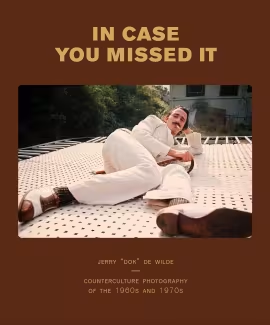
Jerry de Wilde was born in Brooklyn, NY, where he lived until he left to attend college at Columbia University in 1955. In late spring of 1965, he and friend, Anton Greene, an artist and filmmaker, rented the old 46-acre Barham Ranch in the hills above Warner Bros. Studios in Los Angeles. Over the next seven to eight years, it became known as "The Farm," a creative environment that was a notorious haven for actors, writers, musicians, artists, designers, filmmakers, and poets with something to say. In 1992, de Wilde was invited to be an associate professor of fine art photography at Woodbury University, where he taught for seven years. Most recently, he has been photographing and printing large and medium format black and white abstract landscapes shot mostly in the American Southwest and Scotland. His most recent collection is In Case You Missed It: Counterculture Photography of the 1960s and 1970s, and he recently talked about it with Daryl Maxwell.
What was your inspiration for In Case You Missed It: Counterculture Photography of the 1960s and 1970s?
I was inspired by my dear friend and mentor, Robert Frank, who encouraged me to look beyond just pretty pictures and consider what I was trying to say. What were the photographs about, and what poetry can you find in your images? He encouraged me to go out into the world and be a part of what was happening at that time.
What was your process for selecting the photographs for? How did you decide which to include and which to leave out?
Yes, it was difficult. When doing a book, you are limited by the space available. Some of the things to consider are the flow of the story and the design layout of the images and colors that work together. The bottom line is that while certain images were important to me to be included, I relied on my daughter Autumn de Wilde and our designer Nic Taylor to cull my collection and use what made sense in telling the story. I love all my photographs, so there was no such thing as a bad choice.
Both you and Jessica Hundley, in her introduction, state that many of the photographs you’ve taken over your career have been lost. Are there photographs that you would have liked to include but no longer exist? If you could save one (or a few) of the photos that have been lost, what would they be?
The Big Sur cabin I lived in, along with early Farm photos and lots of Monterey Pop Black & White images of Otis Redding, Paul Butterfield, and Janis Joplin, to name a few. Let’s not leave out Bill Evens, Frank Zappa, and the negatives from my New York collection, Concrete, Steel, and Irony.
I’m familiar with the Burbank area, but am finding it a bit of a challenge to determine the location of "The Farm." Can you tell us where it was located? Are there any current landmarks that would indicate where it was located?
It was the old 46-acre Barham Ranch in a canyon below Mt. Cahuenga. The address was 3480 Barham Blvd. If you drive on Barham from West Cahuenga Blvd, at the top of the hill is Lake Hollywood Drive. As you descend, on Barham, towards Warner Bros. Studios, on your left is Craig Drive, and directly across the road was the driveway leading to The Farm. Now it is The Barham Court Apartments, 46 acres, and just below are The Oakwood Apartments.
Jessica Hundley also describes in her introduction your ability to “observe without intrusion, to photograph without disturbing the moment.” Was this a difficult skill to develop at a time when almost no one would have been carrying a camera with them?
In the beginning, I would spend hours of practice manipulating the controls of my camera with my eyes closed until I felt it was an extension of my body. My portrait of Robert Frank with his hand over his mouth makes the statement “Keep your mouth shut and your eyes open.” Follow a situation that looks interesting and at the decisive moment, shoot before they see the camera.
Do you believe that the types of photographs you are known for taking are easier or more challenging to capture in a time when almost everyone is carrying a camera?
Cell phones and pocket cameras are good for capturing images quickly and discreetly, but what they lack are the alchemical aspects of analog photography. The cellphone camera determines the exposure and normal image for you, eliminating your personal choices in determining the final look. Ansel Adams put it best when he said, “Think of the negative as the sheet music and the print you make in the darkroom is the performance.”
Your biography says that from 1992-1999, you were an associate professor of fine art photography at Woodbury University in Burbank. Did your teaching photography inform or influence your work as a photographer? If so, how?
It was a great pleasure handing students a key to a door, and when they entered and produced images, I was their biggest fan. I was amazed at what they produced, and it made me love the photographic medium even more.
What would you tell someone who is considering pursuing a career as a photographer?
Do it for the love of the art form and as a means of expression. Forget about the money.
What’s currently on your nightstand?
Hard Boiled Wonderland and The End of the World by Haruki Murakami.
Can you name your top five favorite or most influential authors?
John Steinbeck, William Shakespeare, Haruki Murakami, Jack Kerouac, and Krishnamurti.
Favorite or most influential photographers?
Henri-Cartier Bresson, Robert Frank, Edward Weston, Ansel Adams, and Man Ray.
What was your favorite book when you were a child?
Was there a book you felt you needed to hide from your parents?
No.
Is there a book you’ve faked reading?
Synagogue Prayer Books.
Can you name a book you’ve bought for the cover?
Not really, but I do love the cover of the Tashen limited edition of Manly Palmer Hall’s Secret Teachings of All Ages, designed by Nic Taylor of Thunderwing Studios.
Is there a book that changed your life?
The Americans by Robert Frank.
Can you name a book for which you are an evangelist (and you think everyone should read)?
Think on These Things by Krishnamurti.
Is there a book you would most want to read again for the first time?
The Grapes of Wrath by John Steinbeck
What is the last piece of art (music, movies, TV, more traditional art forms) that you’ve experienced or that has impacted you?
Jessie Buckley’s performance in Hamnet.
What is your idea of THE perfect day (where you could go anywhere/meet with anyone)?
Being with the Dalai Lama.
What is the question that you’re always hoping you’ll be asked, but never have been?
What’s love got to do with it?
What is your answer?
You’ve got to love what you are doing and who you are doing it with in order to produce meaningful work.
What are you working on now?
My portfolio of large and medium format black-and-white archival silver prints of the American Southwest.