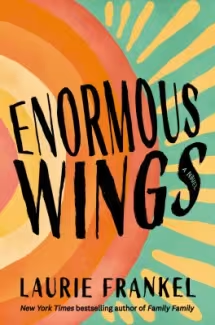
Interview With an Author: Laurie Frankel

Laurie Frankel is the New York Times bestselling, award-winning author of the novels Family Family, One Two Three, Goodbye for Now, The Atlas of Love, and the Reese’s Book Club Pick This Is How It Always Is. Frankel lives in Seattle with her husband, daughter, and border collie. Her latest novel is Enormous Wings and she recently talked about it with Daryl Maxwell for the LAPL Blog.
What was your inspiration for Enormous Wings?
Well, Enormous Wings is about a pregnant seventy-seven-year-old grandmother, so it’s definitely not autofiction. But what is true is that when my own grandmother got sick with what we soon learned was cancer, her symptoms—feeling off, lightheaded, nauseated, headachy, confused—made us joke that maybe she was pregnant. Two-and-a-half decades later, that joke seeded this book.
Are Pepper, Moth, or any of the other characters in the novel, inspired by, or based on, specific individuals?
Based on? Not really. I think characters always start as part me, part people I know and love, part whatever I need for the book. Then, as I revise, they develop into people I get to know on their own, at which point they seem entirely real and distinct from anyone they used to resemble. But inspired by? For sure. I was very close with both my grandmothers. One was very social. One was very bookish. Pepper is pretty evenly split between them. My husband is Pepper’s kids’ age, not Moth’s, but like Moth, he is just unimpeachably trustworthy, loving, and good, and will be dynamite to grow old alongside. Lola, with her good sense and snarky love, definitely has much in common with my own teenager.
How did the novel evolve and change as you wrote and revised it? Are there any characters or scenes that were lost in the process that you wish had made it to the published version?
I first wrote this novel in 2017, and I don’t think a single sentence of that original version remains in the final one. The premise was the same, but I just couldn’t quite convince you that anyone in Pepper’s situation would do anything other than have an abortion. When I turned fifty in 2023 and reopened the file, all I had to do was reset the book in Texas—or any of the thirteen other states where abortion had become illegal in the intervening six years—which not only bridged that plot hole, it refocused the story where it was meant to be all along, which was on issues of agency and bodily autonomy. And that change changed everything. The novel got shorter and more concentrated. I shifted it from multiple third-person points of view to a single first-person so Pepper—and only Pepper—gets to speak for herself. And interestingly, never mind many of the issues here got more serious, I think the novel got warmer and funnier—less satire, more romantic comedy.
Is Vista View Retirement Community based on a real place or your own creation?
My grandmothers both lived in the same retirement community. I spent so much time there with them that I eventually got a job waiting tables in the dining room. But that was thirty years ago, and retirement communities have changed since then, so I had to make some updates as well as stretch some points for my purposes. (For instance, real retirement-community residents get to choose what to eat for dinner rather than the take-it-or-leave-it sweet and sour chicken situation Pepper bemoans in the book.)
The novel’s title, Enormous Wings, is a reference to Gabriel García Márquez’s short story "A Very Old Man with Enormous Wings," which Pepper muses about several times. Is "A Very Old Man with Enormous Wings" your favorite of Márquez’s works? If not, what is?
I mean, favorite is hard. It’s my favorite short story of his. It’s certainly the work of his I think of and return to most often. It’s really a perfect story. But I also love One Hundred Years of Solitude, and I almost always love novels more than other forms of fiction (or, really, anything).
While Enormous Wings is incredibly funny, it also deals with some very real and very serious issues and concepts. What do you think it is about comedy that makes difficult subjects more easily approached/considered by readers than a more “direct approach”?
First of all, thank you! My favorite thing is to make readers laugh. That said, to me it always feels like these characters are funny on their own, nothing to do with me, never mind I wrote them. I do think that the first thing a novel has to do is entertain. If readers aren’t turning pages and having fun and recommending the book to family and friends, it doesn’t matter what it has to say about anything else. And humor is a good way to make sure readers are having fun. Also, life is absurd. And aging? Extra absurd. Quite simply, there is funny in the serious and ridiculous in the real—I don’t make the rules (but in this case, I do use them to my advantage).
You are a mother, and I’m guessing your age when you became one was closer to the average than Pepper’s. As someone who has been through the experience, do you find the circumstance you created for Pepper exciting? Terrifying? Both? Something else?
Good guess! I was in my mid-thirties when I became a mother, and even that was both, exciting and terrifying. The point Moth makes in the book is that yes, some aspects of parenting are harder for older parents (playing on the floor, say, lugging a growing child around). But some aspects would be easier—not having to parent while also working for a living or while also caring for an aging parent are little-considered perks. I think no matter what age you undertake it, if you’re doing it right, parenting is pretty much exactly that: exciting and terrifying.
Your biography says that you currently live in Seattle. Do you have any favorite places? A hidden gem that someone visiting should not miss, but would only learn about from a resident?
Le Panier in Pike Place Market. The water tower in Volunteer Park. The hike to the lighthouse in Discovery Park. The Waterfall Garden Park in Pioneer Square. Lincoln Park in West Seattle. Taking the ferry from Lincoln Park to Vashon Island or the ferry from downtown to Bainbridge Island, and then going to an island park. (Seattle has a lot of really great parks.)
Your biography also states that you make “good soup”. What is your favorite soup to make? The best one you make (if it is not your favorite)? What is your personal favorite soup to eat?
I love this question! I make a wide variety of lentil soups, and I make them often. They’re easy because I usually have all the ingredients already in my house (the lengths I will go to to avoid the grocery store are long), and they’re useful for getting protein, fiber, and vitamins into children. But my favorite is probably French onion soup because: butter, bread, cheese.
If/when Enormous Wings is adapted to film or a series, who would your dream cast be?
There are SO MANY wildly talented older actresses! I would be honored and grateful to have any one of them playing Pepper. Becky Ann Baker did the audiobook, and she was fantastic and would be a terrific choice for screen as well. For Moth, I would choose Mark Rylance, though I would choose Mark Rylance for anything anytime forever.
What’s currently on your nightstand?
Ruth Ozeki’s new one, The Typing Lady, Douglas Stuart’s new one, John of John, Nina LaCour’s new one, Meet Me In the Garden, Sarah Domet’s new one, Everything Lost Returns. And rereading Karen Russell’s The Antidote because I just spent the weekend with her, and she signed a copy for me. (Is the signed copy different from the unsigned one I read previously? Only one way to be sure.)
Can you name your top five favorite or most influential authors?
Favorite? Shakespeare. Most influential? Harder because I can’t write that well (no one can write that well), but also because Shakespeare wasn’t writing novels and I am. Five novelists who have helped me learn how to write novels? Karen Joy Fowler, Ruth Ozeki, Naomi Alderman, Richard Russo, and David Mitchell.
What was your favorite book when you were a child?
I had dozens of favorites. Dozens and dozens. I loved all of Beverly Cleary’s books, especially the Beezus and Ramona books. I loved all of Judy Blume’s books, especially the Superfudge ones. I loved all of E.B. White’s (children’s) books (although, listen, The Elements of Style is nothing to sneeze at, and the Maira Kalman illustrated edition is just delightful), especially Charlotte’s Web. But also Pippi Longstocking, A Wrinkle in Time, Mary Poppins, The Jungle Book, and the Little House books. This list could go on for paragraphs. I had a lot of favorites.
Was there a book you felt you needed to hide from your parents?
Nope, and let that be a lesson: If you want to raise a reader (and who wouldn’t?), let them read whatever books their little heart’s desire.
Is there a book you’ve faked reading?
No, but only because I am a terrible actor and a terrible liar, and I basically suck at faking anything. Also, because whatever the book under discussion, odds are good I have actually read it. I read, like, a lot.
Can you name a book you’ve bought for the cover?
My favorite cover of the year last year was Shobha Rao’s Indian Country. Even if the cover weren’t great, I would have bought it anyway because Shobha is a friend. Even if Shobha weren’t a friend, I would have bought it anyway because Shobha is an outstanding writer and storyteller. But had neither of those things been true, I’d have bought it for the cover, which is terrific.
Is there a book that changed your life?
All of them? Well, many of them anyway. Some more than others certainly. Some books’ stories and morals and arguments and ideas have changed my life. Some books have changed my life by teaching me something about language or form or storytelling. Some books have changed my life by being so good I had to find a way to become friends with their authors. (This is a perk of the job.) Some books changed my life by being not for me, thus revealing what it was important for me to edit out or avoid in my own writing. Sometimes a book has changed my life and I don’t even know it until years later—some books are like that.
Can you name a book for which you are an evangelist (and you think everyone should read)?
So many. So, so many. Really, everyone should read what I tell them to. An entirely unscientific survey suggests my most recommended books are Karen Joy Fowler’s We Are All Completely Beside Ourselves and Naomi Alderman’s The Power (though there’s an argument for her follow-up, The Future). Everyone should read Toni Morrison’s Beloved, and I sort of assume everyone has, but once I was in a bookstore talking to someone who hadn’t read Beloved, and I bought a copy on the spot and sent it home with her.
Is there a book you would most want to read again for the first time?
Anna Karenina. I mean, there are lots, but Anna Karenina is where I’d point that particular magic wand first.
What is the last piece of art (music, movies, TV, more traditional art forms) that you’ve experienced or that has impacted you?
Ooh, I love this question too. I recently saw Jonathan Groff in Just In Time on Broadway. I am a Jonathan Groff superfan, and seeing him do that show in the small cabaret space at Circle in the Square was life-changing. Before that, I’d seen him along with Lindsay Mendez and Daniel Radcliffe in Stephen Sondheim’s Merrily We Roll Along, which was beyond life-changing. I would describe it more like world-altering. And I’m going to see him play Rosalind (!!) in As You Like It in England in the fall, and my expectations are so high it’ll be hard to meet them, but I’m not worried.
What is your idea of THE perfect day (where you could go anywhere/meet with anyone)?
Did I mention I’m going to England to see Jonathan Groff play Rosalind in As You Like It?
What is the question that you’re always hoping you’ll be asked, but never have been?
What are the two most important words in Hamlet?
What is your answer?
“Let be.” (Act 5, scene 2, line 222)
What are you working on now?
At the moment, spreading the word about the new book (so thank you for this lovely interview). But in and around and before and after that, writing the next one. I’m always writing the next one. Novels are so daunting from the base of the mountain, so if you’re not constantly climbing, you’ll just stand in the parking lot gawping up at the peak. It’s also true that the real world is not in my control (believe me, it would look very different if it were), so spending time in a world that is—the one I’m making up—feels like a spa day.