Book List

Banned Books Week

Updated:

Books in this List

  • Cover image for The Bastard of Istanbul

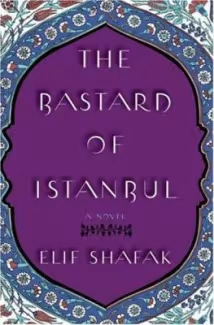
    The Bastard of Istanbul

    In 2006 Shafak was tried and acquitted for “insulting Turkishness” because one of the characters in this novel refers to the massacre of Armenians, during World War I, as genocide. Shafak no longer lives in Turkey and has stated that, “Turkey is the world’s leading jailer of journalists.”

  • Cover image for Chroniques: Selected Columns, 2010-2016

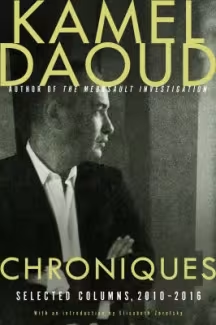
    Chroniques: Selected Columns, 2010-2016

    Daoud is a journalist whose award-winning novel, The Meursault Investigation, is a modern response to Albert Camus’ The Stranger. For many years he has written for Le quotidien d’Oran. His questioning of traditional Islam and praise of the West brought forth condemnation by other journalists, and a fatwa (death threat) by a Salafist Imam.

  • Cover image for The Culture of Lies: Antipolitical Essays

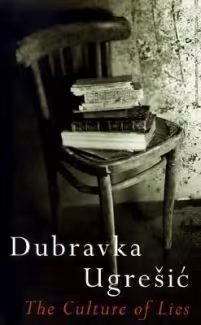
    The Culture of Lies: Antipolitical Essays

    Ugresic is originally from Croatia, and is a journalist who has written critically about the most recent Balkan War that tore apart Yugoslavia. For her questioning and criticism, her work has been censored, and she has been continuously threated with violence and death.

     
  • Cover image for Journalism, Satire, and Censorship in Mexico

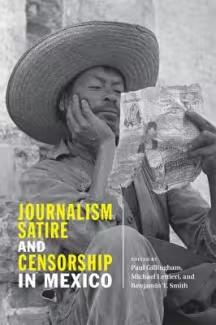
    Journalism, Satire, and Censorship in Mexico

    Since 2000 over 150 journalists have been murdered in Mexico. This collection of essays are by journalists, scholars, political cartoonists and others who examine if it is possible to have true freedom of the press and freedom of speech in a country that has been dominated by political terrorism and drug cartels. Fear of violence and death has created self-censorship by many writers and artists.

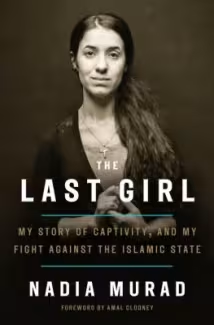
  • Cover image for The Last Girl: My Story of Captivity, and My Fight Against the Islamic State

    The Last Girl: My Story of Captivity, and My Fight Against the Islamic State

    The Nobel Peace Prize, 2018. This prize was shared with Dr. Denis Mukwege, "for their efforts to end the use of sexual violence as a weapon of war and armed conflict." Nadia Murad is a member of the Yazidi community who lived in Kocho, northern Iraq. She and her family lived a peaceful rural life with other families until their village was caught in the crosshairs of ISIS in 2014. People were killed and Nadia was abducted, beaten, tortured, repeatedly raped, and became part of the ISIS slave trade. She escaped and this is her story. Even though she is free, ISIS has continued to issue death threats because Nadia continues to speak out.

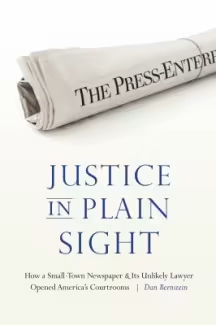
  • Cover image for Justice in Plain Sight: How a Small-Town Newspaper and its Unlikely Lawyer Opened America's Courtrooms

    Justice in Plain Sight: How a Small-Town Newspaper and its Unlikely Lawyer Opened America's Courtrooms

    Censorship can take place anywhere and from anyone. In the 1980s, the Press-Enterprise, a hometown newspaper in Riverside, California, took two cases to the U.S. Supreme Court. The demand was that all court proceedings be open to the public and the press. Their successes have made it possible for, “...the public to witness jury selection and preliminary hearings.”

     
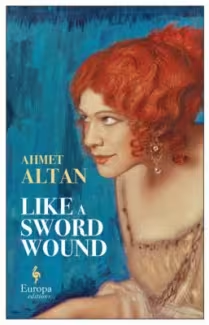
  • Cover image for Like a Sword Wound

    Like a Sword Wound

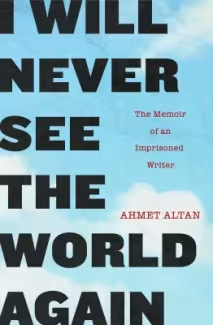
    Ahmet Altan is a journalist and novelist who has been sentenced to life in prison in Turkey. This is volume 1 of his Ottoman Quartet, a series of novels about the last fifty years of the Ottoman Empire.

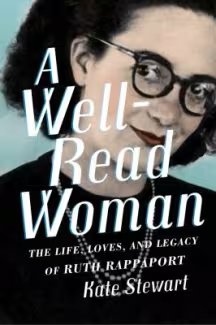
  • Cover image for A Well-Read Woman: The Life, Loves, and Legacy of Ruth Rappaport

    A Well-Read Woman: The Life, Loves, and Legacy of Ruth Rappaport

    This is the biography of a woman who was a librarian. The majority of Ruth Rappaport’s career was at the Library of Congress where she was a cataloger, delving into pornography collections that had been seized by the FBI. Her early life well prepared her for what a life under a repressive regime could be like. She escaped from her birth place, Leipzig, Germany, in 1938.

     
  • Cover image for Censored

    Censored

    The title of a series of books, published yearly, that documents, “News that didn’t make the news—and why. The top censored stories and media analysis. Press freedoms on a ‘post-truth’ world."

  • Cover image for Dalton Trumbo: Blacklisted Hollywood Radical

    Dalton Trumbo: Blacklisted Hollywood Radical

    Dalton Trumbo was one of the Hollywood Ten who opposed and refused to answer questions before HUAC. He lived in exile but continued to be a ghostwriter for Hollywood. In 1993, he received his long overdue Academy Award for The Brave One, and later a posthumous Academy Award for Roman Holiday, 1953.

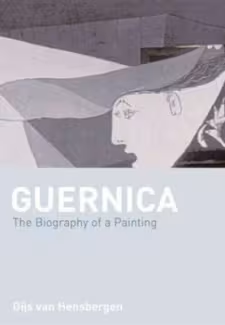
  • Cover image for Guernica: The Biography of a Twentieth-Century Icon

    Guernica: The Biography of a Twentieth-Century Icon

    In 1937 Picasso created a huge mural painting (11’ 5” by 25’ 6”) in shades of gray, black and white to protest the Nazi German and Italian bombings of Guernica, a village in Basque Spain. The painting was a political and humanitarian protest, and its journey to different countries became a protest in itself. There are two reputed comments made by Picasso, one in response to being shown a photograph of the painting by a German officer, who said, “Did you do that?” Picasso responded, “No, you did.” In response to being asked about his political views, Picasso pointed to the large mural.

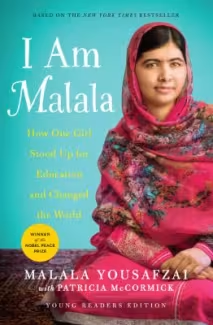
  • Cover image for I Am Malala: How One Girl Stood up for Education and Changed the World

    I Am Malala: How One Girl Stood up for Education and Changed the World

    Learn the story of the youngest Nobel Peace Prize winner ever, who risked her life to fight for the rights of girls in Pakistan to attend school. Malala was a young girl who would not be denied an education, despite being threatened by the Taliban, who shot her in the head. She lives in exile and continues to speak out for justice and human rights. In 2014, she was awarded the Nobel Peace Prize.

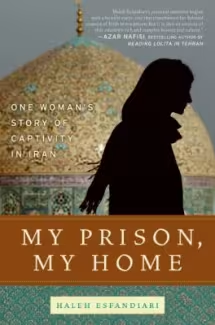
  • Cover image for My Prison, My Home: One Woman's Story of Captivity in Iran

    My Prison, My Home: One Woman's Story of Captivity in Iran

    In 2006 while visiting her mother in Tehran, Iran, the American Director of the Woodrow Wilson Center's Middle East Program, Haleh Esfandiari was suddenly imprisoned and interrogated for nearly eight months. For part of that time she was in solitary confinement in the notorious Evin Prison where focus, self-discipline and determination were attributes that sustained her through a living nightmare in a country that once had been her home.

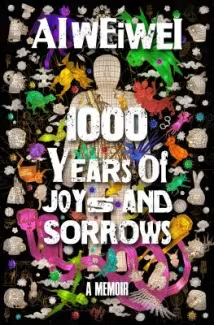
  • Cover image for 1000 Years of Joys and Sorrows: A Memoir

    1000 Years of Joys and Sorrows: A Memoir

    Ai Weiwei is one of China’s most famous and infamous internationally known artists. On April 3, 2011, as he was about to fly out of Beijing's Capital Airport, he states, " ...a swarm of plainclothes police descended on me, and for the next eighty-one days I disappeared into a black hole." The title of the book is part of a poem written by his father, Ai Qing, who was imprisoned during the Cultural Revolution in China. This book is a memoir about his father, himself, his country, and the necessity for freedom of expression everywhere in the world.

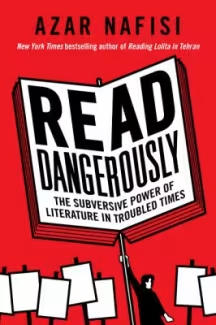
  • Cover image for Read Dangerously: The Subversive Power of Literature in Troubled Times

    Read Dangerously: The Subversive Power of Literature in Troubled Times

    Literature plays a major role in freedom of expression. Azar Nafisi, professor, and writer, presents her thoughts in a series of letters to her late father, who was the Mayor of Tehran. In examining the books of selected writers, she urges us to examine the motivations of those who stand in the way of freedom of expression. At the same time, she cautions us not to replicate the behavior of those who seek to suppress this precious freedom.

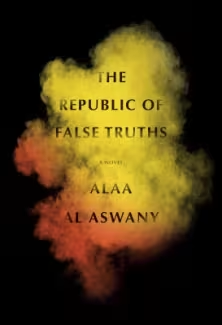
  • Cover image for The Republic of False Truths

    The Republic of False Truths

    The books of renowned Egyptian novelist Alaa Al Aswany have been translated into 30 languages and published in more than 100 countries all over the world. However, his books have been banned in Egypt and a great many places in the Arab world. This novel is a satiric look at a modern repressive government that is thrown into turmoil when a revolution takes place.

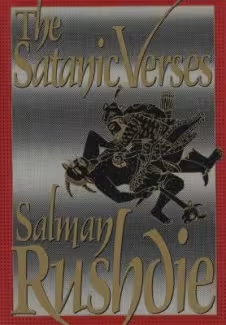
  • Cover image for The Satanic Verses

    The Satanic Verses

    The Satanic Verses by Salman Rushdie was published in 1988. The title refers to a group of verses in the Quran about three pagan Mecca goddesses. At the time, the Ayatollah Ruhollah Khomeini issued a fatwa that ordered Muslims to kill Rushdie, and Rushdie went into hiding and was under constant protection. In August, 2022, while at a public reading, he was attacked with a knife.

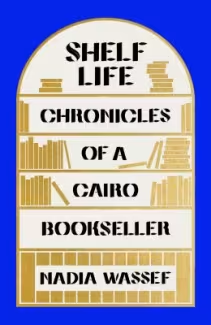
  • Cover image for Shelf Life: Chronicles of a Cairo Bookseller

    Shelf Life: Chronicles of a Cairo Bookseller

    Starting an independent bookstore is no easy task, but doing so in modern Egypt had more than the usual obstacles, especially one opened by three women who had no business degrees or business plans but had a lot of moxie and drive. This all began in 2002, and business is thriving. As told by the chief instigator, Nadia Wassef, this book sparkles with vitality, humor, candor, and joy.

  • Cover image for The Story of the Banned Book: Naguib Mahfouz's Children of the Alley

    The Story of the Banned Book: Naguib Mahfouz's Children of the Alley

    Since it was first published in Egypt in 1959, Naguib Mahfouz's novel <em>Children of the Alley</em> has been controversial: banned; allowed to be sold; sold under the counter; pirated; illegally reprinted, and the author’s life was threatened. This book examines that history and opens “... a window onto some of the fiercest debates around culture and religion to have taken place in Egyptian society over the past half-century.”

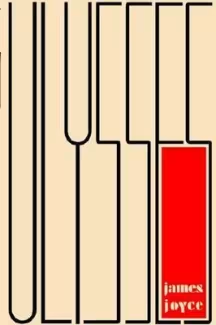
  • Cover image for Ulysses

    Ulysses

    2022 marked the 100th anniversary of the publication of this novel by James Joyce. Since its first publication it has been burned and banned. All of this was based on charges of obscenity.

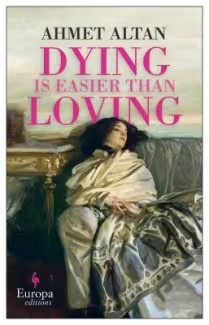
  • Cover image for Dying is Easier Than Loving

    Dying is Easier Than Loving

    The third volume in the Ottoman Quartet series which continues with an array of characters set against the Ottoman Empire prior to World War I. Written by Ahmet Altan while he was in a Turkish prison for alleged involvement in a failed coup.

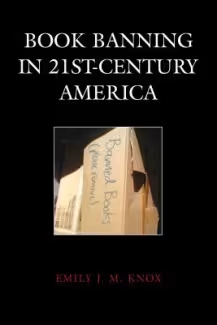
  • Cover image for Book Banning in 21st-Century America

    Book Banning in 21st-Century America

    A study that examines the arguments of those who challenge certain books being allowed in libraries. Knox writes, "…the practices of censorship demonstrate the relationship between knowledge and power." She is a former professional librarian who interviewed challengers because she had a keen interest in their arguments. Knox and the challengers are in agreement about one idea, "…reading is powerful. Books change lives."

  • Cover image for The Last American Newspaper: An Institution in Peril, Through the Eyes of a Small-Town Editor

    The Last American Newspaper: An Institution in Peril, Through the Eyes of a Small-Town Editor

    In recent years, the news media has been attacked for providing inaccurate information. In addition, there has been a diminishing number of local newspapers, often due to the economic needs of corporate owners. Independent newspapers are a source of unrestricted examination of local issues. "When authoritarians subvert democracy, the first thing they do is kill the messenger of free-flowing information." Ken Tingley was the editor of The Post-Star in Glens Falls, New York, from 1999 to 2020.

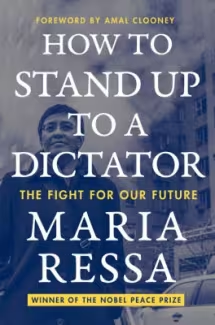
  • Cover image for How to Stand up to a Dictator: The Fight for Our Future

    How to Stand up to a Dictator: The Fight for Our Future

    Maria Ressa worked as a journalist in the United States and the Philippines. She was co-founder of Rappler, an online news website. The dictatorial regime of Philippine President Rodrigo Duterte charged her with cyber-libel and arrested her. Her memoir is hopeful, yet she cautions that globally, we are all at risk if freedom of the press is threatened.

    With Dmitry Andreyevich Muratov, she shared the 2021 Nobel Peace Prize "for their efforts to safeguard freedom of expression, which is a precondition for democracy and lasting peace."

     
  • Cover image for Old Truths and New Clichés: Essays

    Old Truths and New Clichés: Essays

    Isaac Bashevis Singer was well known for his novels, but this collection of his essays examines many subjects, including an essay, "Why Literary Censorship is Harmful." In another essay, "The Ten Commandments and Modern Critics," Singer cheekily speculates how Moses would be received today if he issued his commandments in a booklet or brochure. The 1978 Prize in Literature was awarded to him "for his impassioned narrative art which, with roots in a Polish-Jewish cultural tradition, brings universal human conditions to life."

      
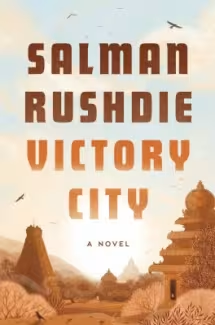
  • Cover image for Victory City

    Victory City

    The plot and characters are based upon a fictional translation of an epic Sanskrit work. Pampa Kampana is blessed/cursed to live for 247 years. Her super powers enable her to create the Bishnaga Empire, which is a proto-feminist construct, and to interact with all manner of people over the decades, but the complexity of her court and her life are counter-productive. In 2022, at a public presentation, Rushdie was stabbed by an attacker. In 1989, a fatwa calling for his assassination was issued after the publication of his novel, The Satanic Verses.

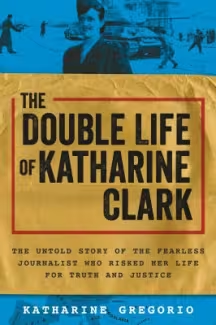
  • Cover image for The Double Life of Katharine Clark: The Untold Story of the Fearless Journalist Who Risked Her Life

    The Double Life of Katharine Clark: The Untold Story of the Fearless Journalist Who Risked Her Life

    In 1955, during the Cold War, Katharine Clark was a foreign correspondent for the International News Service in Eastern Europe. While in Yugoslavia, she met Milovan Djilas, who had been a high-ranking Communist Party official but was relieved of his post for having criticized the government. Katharine Clark smuggled out a series of detailed, critical articles written by him.