
History of the Vermont Square Branch Library
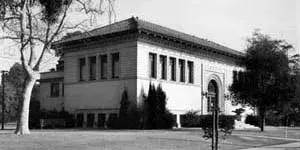
The Vermont Square Branch of the Los Angeles Public Library was built in 1913 with monies donated by the Carnegie Foundation of New York City. This library was the first of six Carnegie buildings funded by this grant. It is also the only city library building that didn't cost Los Angeles any money to build. In addition to the money provided by the Carnegie Foundation to build and initially equip the Vermont Square Branch, it was built on parkland donated to the city by the developers of the residential area surrounding it.
Although Vermont Square is not the oldest branch of the Los Angeles Public Library, the building itself is the LAPL's first library building to be owned by the LAPL. Until the time that the Vermont Square Branch was built, all other library branches and facilities, including the Central Library, were housed in rented quarters.
The building's architectural style of the building is Italian Renaissance. The floor plan is very typical of the Carnegie library buildings being built at this time. On the upper area level inside the front entrance, there is a circulation area in the center of the building. The adult and children's reading rooms are on either side of the circulation desk. Partitions of glass and oak separate the reading rooms to contain noise and create a more pleasant library environment. Many windows on all exterior walls let in abundant natural light. Off of the adult reading room, on the northeast corner of the building, there was an outdoor reading porch furnished with wicker furniture. On the lower floor, in 1913, there was a story hour room, a coal storage room for the furnace, and an auditorium for public use.
The Vermont Square Branch was formally opened to the public on March 1, 1913. It was a simple ceremony, with the members of the Vermont Square Improvement Association in attendance to accept the library on behalf of the Vermont Square community. The Manual Arts High School orchestra provided music.
The new library quickly became a very important part of community events. Many community organizations,, both new and old,, used the library for organizational events. The Vermont Square Improvement Association, which was instrumental in getting the library for the location, held its meetings in the auditorium. The West Ebell Club, the largest women's group in the city at the time, was formed in and held the club meetings in the auditorium. In 1917, the Vermont Square Improvement Association and the West Ebell Club presented the library with a motion picture projection machine. On July 6, 1917, The Prince and the Pauper was shown to an enthusiastic crowd that filled the library's auditorium to capacity.
The library opened its door with only 2,000 new books in a space designed to hold 16,000 volumes. However, it did not take long for the collection to grow rapidly. At the end of the first month, the collection grew to 2,285 and circulation to 3,769. 710 new library cards were issued, and the total number of Vermont Square library cardholders was 1,061. Four months later, at the end of the current fiscal period, the number of books in the collection totaled 4,008, cardholders totaled 2,013, and the circulation of the month of June was 5,086, surpassing that of many of the other branches.
Both World Wars disrupted the branch's normal routines. During World War I, the Local Exemption Board, four Red Cross auxiliaries, and the Women's Council for Defense made their headquarters at the Vermont Square Branch. The West Ebell Club, as well as many other clubs and organizations, continued to hold meetings and host events at the library. The club hosted a reception there as a send-off for the first group of drafted soldiers to leave the area.
World War II brought about drastic changes in the library's operations. The library was closed in the evenings until the building was equipped for blackouts and possible air raids. The hours of operation changed from a twelve-hour day (9 a.m. to 9 p.m.) to an eight-hour day (1 p.m. to 9 p.m.), which was maintained after the war. Due to gasoline rationing and other wartime activities that prevented frequent trips to the library, Vermont Square Branch changed its checkout policy to allow ten books, rather than five, to be checked out at a time, and this policy has remained in effect since the war's end. Libraries throughout the city were closed for two weeks at the end of August due to the war, as it was hard to find staff substitutes. The library was also designated as an air-raid shelter and a Red Cross Casualty Center. The U.S.O. (United Service Organization) also held its Southwest District meetings at the branch. It was also an accredited Civilian County Defense Information Center manned by the regular library staff.
Due to the rapid increase in demand for services and materials, the library collection was in danger of outgrowing its building even before the first decade of its existence was over. Various changes were made to accommodate the growing collection more urgently. The coal furnace was replaced with a gas furnace, allowing the large coal storage room to be converted into staff space, freeing space upstairs for storing library materials. Shelves were added behind the circulation desk in 1925, and more were added in the middle of the adults' and children's reading rooms. Later, the need for space became an even greater concern due to the designation of the Vermont Square Branch Library as a Regional Branch of the Los Angeles Public Library's Central District.
The Vermont Square Branch Library was the regional branch of the Central Region from 1949 until the current Exposition Park building was built to take over that position in 1978. The future of Vermont Square's historic Carnegie building became uncertain. Plans to replace it with a new building at another location, were being discussed within library administration. The need for earthquake retrofitting added to that uncertainty. On May 26, 1990, the library was closed due to the city-mandated earthquake hazard reduction order, and moved to a temporary location in a mall at 5401 S. Figueroa Street. A strong community movement to save the historic Carnegie building was successful, and Los Angeles first permanent library building was given a new lease on life. With a comprehensive retrofit program combined with a large restoration/renovation program, the library has been guaranteed a busy future within the Los Angeles Library organization.
Improvements made during the renovation/restoration program included renovating the auditorium downstairs into a more user-friendly multipurpose room for community and library events, installing new climate control systems, and reinforcing the building's structure to protect its patrons during an earthquake.
Other improvements made during the renovation/restoration were made possible by the development of relationships between the business community and local artists with the Los Angeles Public Library. Vermont Square Branch has been designated a virtual electronic library. Wells Fargo Bank provided multimedia computer workstations that provide patrons with Internet access and access to a vast array of databases. Two works by artist Nobuho Nagasawa grace the public areas on the library's main floor. In the children's reading room, there are eleven stools shaped in the letters that spell IMAGINATION. In the reference area, a glass table stands, its surface etched with the titles of books banned in libraries across the United States.
After weeks of moving the collection of books and other media from the Figueroa Street location and reorganizing it in the historic Carnegie building by the dedicated staff, the Vermont Square branch was dedicated and reopened to the community on May 11, 1996.
Photographs from the Los Angeles Public Library Security Pacific National Bank Historic Photograph Collection.