

Gajin Fujita
Born and raised in the historic Los Angeles neighborhood of Boyle Heights, Gajin Fujita draws on his Japanese American heritage and his identity as a native Angeleno to create paintings that bridge traditional and contemporary cultures. His earliest artistic influences came from his father, a painter, and his mother, a conservator of Japanese antiquities. The Japanese folklore, heroes, and legends passed down by his parents, who immigrated to Los Angeles from Japan, also became an important part of his artistic foundation.
Fujita first established himself in the Los Angeles art scene through graffiti crews KGB and K2S before earning a Bachelor of Fine Arts from Otis College of Art and Design. His paintings combine graffiti language and traditional iconography drawn from Japanese and Western art with vivid, metaphorical interpretations of contemporary urban life, society, and culture.
His work has been exhibited internationally at institutions including the Getty Research Institute, the UCLA Hammer Museum, the Los Angeles County Museum of Art, the Metropolitan Museum of Art in New York, and L.A. Louver, as well as museums and galleries in Germany, Switzerland, Greece, and Australia.
In 2019, Fujita created the Los Angeles Public Library's second artist-designed limited-edition library card and led art workshops at Library branches across the city. In 2026, he created 100 Years L.A. Central Library, a painting commemorating the Central Library's centennial and celebrating its place in the cultural life of Los Angeles.
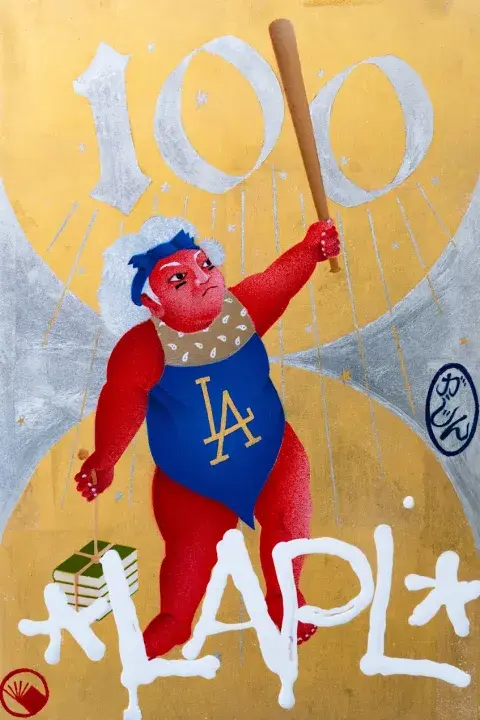
Created by internationally acclaimed artist Gajin Fujita to commemorate Central 100, this artwork blends traditional Japanese mythology with the vibrant energy of Los Angeles graffiti culture.
At its center is Kintaro, the legendary "Golden Boy," celebrated for his extraordinary bravery and strength. He stands before two luminous golden orbs, while a platinum "100" bursts like fireworks, radiating rays of light and evoking the "Light of Learning"—the enduring theme of the Los Angeles Public Library's Central Library.
In one hand, Kintaro carries a rope-bound stack of books, a tribute to Fujita's childhood memories of walking home from school with his books before heading out to play baseball; it also symbolizes the power of learning and knowledge. On the other hand, he raises a bat in a pose inspired by Los Angeles Dodgers star Freddie Freeman's iconic celebration following his walk-off grand slam in Game 1 of the 2024 World Series.
Across the bottom of the artwork, "LAPL" is rendered in the bold graffiti style synonymous with the street culture of Los Angeles; "LAPL" highlights the Library as open and welcoming to everyone, uniting the city’s cultural heritage, artistic innovation, and the love of storytelling.
About the Importance of the Library
I feel honored to contribute my artwork for this special-edition library card. Growing up in
Boyle Heights, the Robert Louis Stevenson Branch was a refuge for me and my brothers. At that
library, there was a Japanese American librarian named Pearl who really looked out for me. And
beyond access to books and magazines—the library had air conditioning on hot days!
The library made a big impact on me as a kid. It’s where my imagination and curiosity were
stirred, and it began to open up my mind. Going to the library was liberating—from reading
Mark Twain’s Tom Sawyer to looking at reference books of animals, or flipping through a
National Geographic and coming across amazing pictures from around the world. I’ve always
been very visual, even as a youngster, so the images were really inspiring.
For me, the library is important because it stimulates us to be open-minded and creative. It
makes us curious about all the things that are out in the world that we don’t know about.
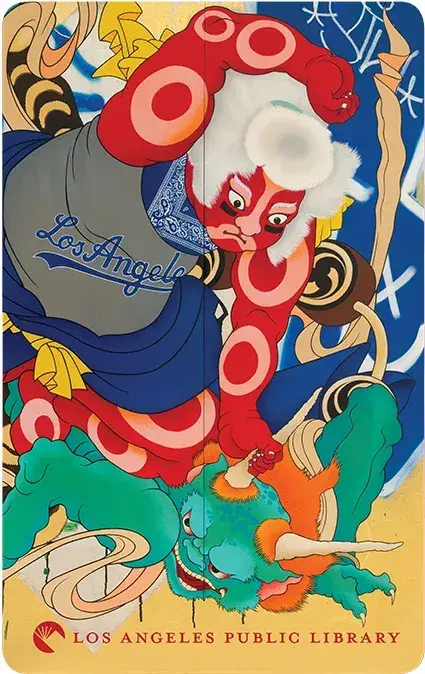
Items featuring Gajin Fujita’s artwork are available at The Library Store.
As a child, Gajin Fujita dreamed in the aisles of his local library in Boyle Heights, reading about the Japanese folkloric heroes and legends that would later play across his celebrated paintings.
Those paintings grace museum walls in Los Angeles, Switzerland, Greece, Australia, and Belgium.