Interview With an Author: Rasheed Newson

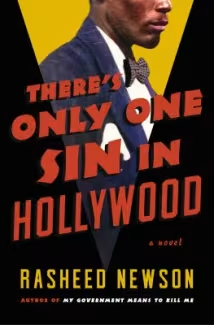
Rasheed Newson is the author of the national bestseller My Government Means to Kill Me, which was selected as a Lambda Literary finalist for Gay Fiction and was named one of the “100 Notable Books of 2022” by The New York Times. He is also a television drama writer, producer, and showrunner. He co-developed Bel-Air and worked on The Chi, Animal Kingdom, and Narcos, among other drama series. Newson is a 2025–26 American Library in Paris Visiting Fellow. He currently lives in Pasadena with his husband and their two children. His latest novel is There Is Only One Sin in Hollywood, and he recently talked about it with Daryl Maxwell for the LAPL Blog.
What was your inspiration for There’s Only One Sin in Hollywood?
I’d read the stories about how Rock Hudson, James Dean, Montgomery Clift, Anthony Perkins, and Sal Mineo fared in Hollywood as queer white men, and I wondered about the circumstances under which a Black, gay actor could have managed to become a major movie star in the 1950s and 1960s. I just couldn’t shake the ideas surrounding the rise and fall of a gay Black rival to Sidney Poitier. The novel blossomed from that seed.
Are Aaron, Xavier, Horace, or any of the other characters in the novel (beyond those representing actual people), inspired by or based on specific individuals?
What intrigued me was that by the 1970s, there were two prominent Black actors living in the glass closet: Paul Winfield, who earned an Oscar nomination for best actor for his role in Sounder (1972), and Sherman Hemsley, who received an Emmy nomination for best actor in a comedy for his starring role on The Jeffersons (1975-1985). Both Paul and Sherman had decades-long relationships with male partners but kept that part of their lives out of the spotlight. I imagine it was a challenging position to maintain. Yet, they must have felt it was the best possible arrangement at the time. I wanted to explore a character willing to strike the same bargain a generation before Paul and Sherman.
How did the novel evolve and change as you wrote and revised it? Are there any characters or scenes that were lost in the process that you wish had made it to the published version?
So much changed during the revisions of the novel. I don’t suggest this method, but I tend to write between 20,000 and 30,000 words before I can see what’s working and what isn’t. I need to dive into that deep before the book starts to reveal its story to me.
Originally, I thought this novel would be focused on a movie studio lawyer who gets the manuscript for a tell-all that accuses the studio of conspiring to kill an unruly Black movie star. The lawyer is tasked with discrediting the account, only to discover that the studio’s owner did, in fact, orchestrate a murder. That, however, denied me access to the inner thoughts and emotions of the movie star at the heart of the book. The story demanded a more intimate telling. So, I repositioned the entire narrative onto the movie star’s fixer and closest confidant.
The thing that got cut in the process that I sort of miss was a nudist pool party at Anthony Perkins’ house in Palm Springs. Those were fun scenes to write, but they didn’t serve the story.
There’s Only One Sin in Hollywood covers a significant period of Hollywood’s history, and Aaron’s & Xavier’s love of film seems to reach into the earlier periods prior to their story. How familiar were you with Hollywood (the industry, the myth, and the films) prior to writing your novel? Did you have to do a bit of research? If so, how long did it take you to do the research and write There’s Only One Sin in Hollywood?
I am a lifelong film buff. I watched old movies with my grandmother, and I made little distinction between a film in black and white versus a film in Technicolor. During my teenage years, I had a lot of free time and a Blockbuster card. Often, the newest releases were snapped up by the time I walked through the door, so I’d rent the classics. Blockbuster was the key to my film history education.
I’ve also worked in Hollywood for almost 25 years. I picked up on how things operate, and I also prodded my older coworkers to tell stories about how it used to be. I suppose that’s a form of research I didn’t realize I was doing. I’m quite good at unintentional research. I read a book, watch a documentary, or listen to a lecture, and I have no idea when or how it might be useful. I’m just curious. Then I’m writing, and the info proves vital.
What was the most interesting or surprising thing that you learned during your research?
I’m so grateful for this question because my answer concerns a tidbit of a subject that I couldn’t stop the book and dedicate too many sentences to, but I discovered that what became the common design (or neglect) for men’s bathrooms is grounded in a sort of gay panic. The fear of that space being used for cruising between homosexual men is a big reason why there are partitions between the urinals, and why there is often no entrance door that might creak and give a warning to people fooling around inside. It’s part of the reason why men’s rooms are allowed to smell disgusting and be poorly maintained. A situation is being created to discourage anyone from doing anything more than holding their breath, rushing in, using the facilities, and hurrying out. Men’s rooms reek of masculine fragility.
Since it’s probably unfair to ask you if you have a favorite film, actor, or director, can you name your top five films, actors, or directors?
This is tough. My list of favorites is subject to my mood. Here are the films that come to mind today: Notorious (1946); Carmen Jones (1954); Layer Cake (2004); Gattaca (1997); and Sinners (2025).
Have you ever had the chance to watch a movie from the projection booth?
Yes, in college, I fooled around with a guy who was a projectionist, and we’d watch the films and make out between the reels. Look how handy that experience turned out to be! It’s another case of unintentional research.
In your Acknowledgments, you mention Paul Winfield, Sherman Hemsley, and Howard Rollins. What are your favorite roles for each of these actors?
I won’t argue that this is the best work from these actors, but these are the roles that first made a strong positive impression on me: For Paul Winfield, it would be his turn in Star Trek II: The Wrath of Khan (1982). For Sherman Hemsley, it was his portrayal of the conniving deacon in the sitcom Amen (1986-1991). And for Howard Rollins, it was his determined investigator in A Soldier’s Story (1984). Of the three, Rollins was the only one that also stirred a sexual attraction within me. That was a fine-looking man.
We lost Howard Rollins in 1996, Paul Winfield in 2004, and Sherman Hemsley in 2021. Did you have the chance to see them in person or meet them prior to their passing?
I wish I had, but I never met any of them.
If you could ask them each about something, what would it be?
I’d want to know if they felt expressing their talent was more central to their happiness and sense of being than being out and proud. I don’t underestimate the difficulty of the choices they made. I wonder if my speculation that their artistic ambitions overrode their personal affairs is accurate.
Is there something you wish you could tell each of them?
Their work endures. I imagine that’s what they cared about most deeply.
If/when There’s Only One Sin in Hollywood is adapted to a film or series, who would your dream cast be?
Sorry, I’ve worked in show business too long to dare answer this question. Seriously, I’ll get calls and emails that begin with, “I noticed you didn’t mention me.”
What’s currently on your nightstand?
Two pairs of reading glasses. I wear the regular pair when I read books at night, and I wear the strong pair when I’m reading really small type—like the instructions on prescribed medication. Oh, and there are books: Death of the Soccer God by Dimitry Elia Léger; The Remarkable Life of Reed Peggram by Ethelene Whitmire; Bread of Angels by Patti Smith; One Day, Everyone Will Have Always Been Against This by Omar Akkad; Believe Nothing Until It is Officially Denied by Patrick Cockburn; and rereading Gay Bar by Jeremy Atherton Lin.
Can you name your top five favorite or most influential authors?
Nikki Giovanni, poet and activist. I try to imitate the grace she offered humanity. Kurt Vonnegut, novelist and iconoclast. His writing looks effortless—like all that humor and wisdom came off the top of his head. That’s a difficult polish to achieve. Pamela Sneed, poet and essayist. Her candor and vulnerability are breathtaking. Melvin Dixon, poet and novelist. He was Black, gay, and died too soon. I’m in his debt. I love his last novel, Vanishing Rooms. Gabriel García Márquez, need I say more? I’ve reread The Autumn of the Patriarch more than any other book in my life.
What was your favorite book when you were a child?
When I was a junior in high school, I thought Toni Morrison wrote Song of Solomon for me, personally. I didn’t understand it all then, and after several rereads across the decades, I’m certain I still don’t understand it all even now. But the story and the language filled me up like I’d eaten a sumptuous meal.
Was there a book you felt you needed to hide from your parents?
Breaking the Surface by Greg Louganis. I hadn’t come out yet, and I was in eighth grade when I got my hands on a copy of that book. I needed to read it. His story gave me the hope that I could move forward. Yet, I’d have denied knowing how that memoir got into my bookbag had anyone discovered it there.
Is there a book you’ve faked reading?
Anything by John Updike. Rabbit… Rabbit is Rich… Rabbit is Dead… Rabbit Bores Me. His language and perspective clash too violently with my own. I was arguing with the books as I read them. I never made it far into them.
Can you name a book you’ve bought for the cover?
House of Leaves by Mark Z. Danielewski. I saw it at the bookstore right before final exams during my sophomore year in college. I almost failed out of school because I read that book instead of studying.
Is there a book that changed your life?
I borrowed Revolutionary Suicide by Huey P. Newton from my father’s bookshelf and began reading it when I was in high school. Walking around with that book through the halls of my school in Indiana got me summoned to the dean’s office. I don’t know if the words "revolutionary" or "suicide" alarmed several of the teachers and school administrators more. That was a big moment in my young life. I realized that reading certain kinds of books could unnerve conservative people. I also became more aware of how out of step I was with my peers and the adults in my life. I saw nothing wrong with my book selection, yet I got a lot of hostile questions about why I was reading it.
Can you name a book for which you are an evangelist (and you think everyone should read)?
Sonata Mulattica: A Life in Five Movements and a Short Play by Rita Dove. It’s a poetry collection with the narrative force of a novel. I am in awe of it every time I read it or dip back into it. I also evangelize for Pamela Sneed’s Funeral Diva. That book is heart-wrenching and reaffirming.
Is there a book you would most want to read again for the first time?
The Imperfectionists by Tom Rachman hit me from so many different unexpected angles the first time I read it. I wish I could be jumped like that again and again.
What is the last piece of art (music, movies, TV, more traditional art forms) that you’ve experienced or that has impacted you?
Kyle Dillon Hertz’s debut novel, The Lookback Window, builds and builds and pulls you so tightly into the skin of its protagonist that when the ending came, it felt inevitable and unexpected. I burst into tears as I read it.
What is your idea of THE perfect day (where you could go anywhere/meet with anyone)?
Can I go back to being a visiting fellow at the American Library in Paris? I read, walked, and ate my way through Paris. My family joined me for a week. Those were perfect days.
What is the question that you’re always hoping you’ll be asked, but never have been?
What am I most proud of about my writing life?
What is your answer?
I’m awfully proud that I managed to write while being a loving, active parent, a caring and attentive spouse, and a reliable and encouraging friend. I might have gotten further faster professionally if I’d dropped people by the wayside. But it has been more challenging and fulfilling to write around the needs of my personal life.
What are you working on now?
I am writing my third novel. It is set in San Francisco in the 1970s during a period when at least three active serial killers were terrorizing the Bay Area. One of them was a gay Black man, making it quite tricky for innocent Black gay men to date, among other complications. I’m enjoying how the story is unfolding.