Interview With an Editor: Ellen Datlow

Ellen Datlow has been editing science fiction, fantasy, and horror short fiction for over forty-five years as fiction editor of OMNI Magazine and editor of Event Horizon and SCIFICTION. She currently acquires short stories and novellas for Reactor and Tor.com. In addition, she has edited about 100 science fiction, fantasy, and horror anthologies, including the annual Best Horror of the Year series.
She's won multiple World Fantasy Awards, Locus Awards, Hugo Awards, Bram Stoker Awards, International Horror Guild Awards, Shirley Jackson Awards, the Splatterpunk Award, and the 2012 Il Posto Nero Black Spot Award for Excellence as Best Foreign Editor. Datlow was named recipient of the 2007 Karl Edward Wagner Award, given at the British Fantasy Convention for "outstanding contribution to the genre," was honored with the Life Achievement Award by the Horror Writers Association, in acknowledgment of superior achievement over an entire career, and honored with the World Fantasy Life Achievement Award at the 2014 World Fantasy Convention.
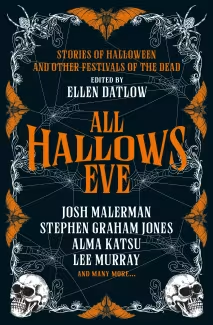
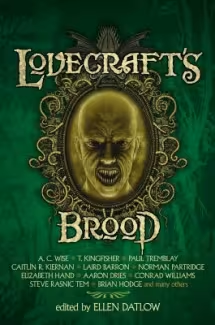
She lives in New York and co-hosts the monthly Fantastic Fiction Reading Series at KGB Bar. Her most recent publications are Lovecraft's Brood and All Hallows Eve, and she recently talked about them with Daryl Maxwell for the LAPL Blog.
What was your inspiration for Lovecraft’s Brood?
Jacob Weisman of Tachyon, publisher of Lovecraft’s Monsters, suggested it. The theme is broader than the mere Lovecraftian—I wanted to encompass different kinds of cosmic horror. We came up with the title together. They wanted it to complement the earlier volume: John Coulthart did the new cover and the interior illustrations and design, as he did for LM.
Lovecraft’s Brood is what you referred to last time we spoke as a “reprint anthology” and comprises previously published stories. What was your process to select materials for this anthology? How many stories did you read and choose from to create Lovecraft’s Brood?
My process for reprint anthologies is to think about the theme and consider what writers whose work I like may have published stories that fit the theme. Sometimes I recall stories I’ve published or have read that fit the theme. That happened as I was reading for my Best Horror of the Year: Volume Eighteen. I read a story that’s perfect for my next reprint anthology, contacted the author, and contracted for it.
But I take a scattershot approach. I’ll send out a lot of emails with guidelines and ask writers to submit no more than three stories fitting the theme. I’m also open to those I contact suggesting appropriate stories by other writers.
I read more than 145 stories for Lovecraft’s Brood and chose nineteen.
What was your inspiration for All Hallows Eve?
Christmas and Other Horrors, my last original “holiday” themed anthology for Titan, was enough of a success that they asked me for another anthology. I thought stories based around the idea of Halloween and the particular time of the year might be fun and fruitful, and it was.
All Hallows Eve is described as a collection of 19 original stories. What was your process for putting together this anthology? Did you ask specific writers for stories that fit your theme, open up a submission process, or did you approach it in a different way?
For original anthologies, I don’t have an open submission process. I contact writers whose work I love and hit them up for new stories. I usually ask about one third more writers than I need because sometimes someone will drop out, or I’ll reject a story that doesn’t work.
Were there any surprises for you amongst the contributors (names you were not
expecting to participate or writers you were certain would but were not able to
contribute)? Are there any authors that you were hoping to include but were unable to for some reason?
There are always writers I approach who don’t have the time or don’t have an idea related to the theme. But every editor has a regular "stable" of writers we know we can count on to submit amazing work.
Which type of anthology, reprint or new material, do you prefer as an editor? As a reader?
Reprint anthologies are much easier to edit, as the stories I choose already exist and presumably don’t need editing. Original anthologies require a lot more work. Soliciting stories, choosing those that work for the anthology, and editing them.
But I love editing both types of anthologies.
I only read anthologies for work (Best Horror of the Year, and for that, only previously published stories).
How was Lisa Morton selected to provide the Foreword for All Hallows Eve? I’m guessing your paths have crossed before or that you may have worked together before. Or was there some other factor?
She’s the expert on all things Halloween, so asking her was a no-brainer.
In addition, we’ve known each other for decades and co-edited one anthology for HWA: Haunted Nights—coincidentally, also a Halloween-centric anthology, published in 2017.
While they have always been popular, the works of H.P. Lovecraft seem to be enjoying a bit of a renaissance, providing inspiration to a number of authors, filmmakers, and producers of television content. Do you have a favorite pastiche, television, or motion picture adaptation/interpretation? A least favorite?
Lovecraft’s influence has never waned. His work has been in the public eye from its first publication, through the pastiches of the Lovecraft Circle, the creation of the Call of Cthulhu role-playing game, and S. T. Joshi’s scholarship. So today’s interest is just a continuation of all that.
I dislike pastiches of any kind. I’ve loved the first season of True Detective, the adaptation of Matt Ruff’s novel Lovecraft Country, and the novella The Ballad of Black Tom by Victor LaValle (which I acquired and edited for Tor.com)
H.P. Lovecraft was famously racist and sexist (which is reflected in his fiction). The stories in Lovecraft’s Brood reflect the growing number of writers who are reclaiming some of Lovecraft’s ideas and making them into something new and wonderful. Do you have a theory regarding why Lovecraft’s stories continue to influence and inspire contemporary authors?
Despite the ugliness of his personal beliefs, Lovecraft created worlds that are imaginative, fertile, and fun for writers to play in. And he developed the idea of cosmic horror, which inspires so many different takes.
In your introduction to All Hallows Eve, you state that you have loved Halloween since you were a child. Do you have a favorite memory or two of Halloween you can share?
Candy candy candy. Bags of it, and separating out those I liked and those I didn’t like as much.
What would be your idea of the perfect Halloween (where you could celebrate anywhere and with anyone)?
Going trick-or-treating in the neighborhood where I grew up. It was safe and fun, and we got lots of treats.
H.P. Lovecraft passed away in 1937. If you could ask him something, what would it be?
Do you really believe the shit you spout?
If you could tell him something, what would you want to tell him?
Open your eyes to the panoply of humankind—and relax.
What’s currently on your nightstand?
I’ve recently finished what will be the final 2025 novel I’ll be reading: A strange and wonderful book called The Country Under Heaven by Frederic S. Durbin. I don’t recall how/when I heard about it, but I know it was recommended to me. It’s a weird western about a man who has visions post-Civil War-visions of monsters, visions of places he needs to go. I’m almost finished, and I love it.
And I read Mick Herron’s Slow Horses, on which the brilliant TV series is based. The book is my "guilty pleasure," the one or two novels I make time to read that are too old or not horror to cover for my Best of the Year series.
Can you name your top five favorite or most influential editors?
Judith Merril, Maxwell Perkins, and Harlan Ellison are the only three who influenced me as a reader and as an editor.
What is the last piece of art (music, movies, TV, more traditional art forms) that you’ve experienced or that has impacted you?
Books: Daniel Kraus’s amazing Angel Down, about doughboys in no-man’s-land during WWI who find an angel, which happily won the Pulitzer Prize, The Lamb by Lucy Rose (about a family of cannibals), The Buffalo Hunter Hunter by Stephen Graham Jones, an epic novel about the tragic/anger-making history of indigenous people in the west and vampires.
Movies: Project Hail Mary, Dust Bunny, and Disclosure Day.
Art: An exhibition of Dutch clothing designer Iris van Herpen’s work, which is just astounding.
While I was visiting a friend in Tucson, I was introduced to the work of a terrific sculptor, Nancy Cervenka, who uses film to create sculptures and earrings. From 6 inches to several feet high, I’d buy a large one in a minute if I had the space. I don’t, so I bought a couple of small ones.
What are you working on now?
A reprint anthology of sexual horror I’m hoping to call Bad Sex, for Tachyon, and two original anthologies (neither of which I can discuss).