Interview With an Author: Meg Elison

Bestselling writer Meg Elison is the author of The Book of the Unnamed Midwife, winner of the 2014 Philip K. Dick Award. The sequel, The Book of Etta, was a PKD finalist in 2018. Her third novel, The Book of Flora, was published in 2019. In 2020, she published her first young adult novel, Find Layla, which was named one of Vanity Fair’s best books of the year. Her first collection, Big Girl, contains the Locus Award-winning novelette, The Pill. Her thriller novel, Number One Fan, was published in 2022.
Elison has published dozens of science fiction, fantasy, and horror short stories, and her work has been collected in several anthologies for the best stories of the year. An essayist and satirist, Elison has published nonfiction in McSweeney’s, Electric Literature, Tor.com, The Wild Hunt, and Psychopomp. She is also an author of the nonfiction book, Fifty Years of Free Speech: Perspectives on the Movement that Revolutionized Berkeley.
Elison is a high school dropout and a graduate of UC Berkeley. She was a Clayton B. Ofstad endowed distinguished writer-in-residence at Truman State University, as well as a Fred Case and Lola Austin Case Writer-in-Residence at Western Illinois University. She is married to the cartoonist Colin Lidston, and lives in the Berkshires.
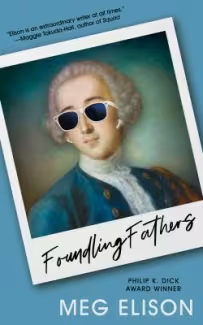
Her latest novella is Foundling Fathers, and she recently talked about it with Daryl Maxwell for the LAPL Blog.
What was your inspiration for Foundling Fathers?
My husband and I were having sushi, and he was talking excitedly about a race from the tabletop game, Warhammer 40k. He was describing a group of people who had brought their own illustrious founders back to life, after a fashion, to receive their eternal wisdom. I was paying attention, but I was also thinking: what if we could do that? Gods, what a mess we would make. This novella is that mess.
Are Mary, Jeff, Minsky, Stephens, or any of the other characters in the novella inspired by or based on specific individuals?
I am inspired every day by the clownery of real people who are public figures and thus available for commentary, such as Elon Musk. You might recognize someone in this story who resembles his jester affect. Mary is sort of an amalgam of every woman on the right who I think should be smart enough not to carry water for her own oppressors, but there she goes, weighed down with gallons again. Stephens, too, is a lot of graying puppet masters who can’t stop interfering in government, like Peter Thiel.
Similar question regarding Ben, Tom, John, and George. Did you research their historical counterparts prior to creating your characters? If so, what was the most surprising or interesting thing you discovered? Something you learned that influenced one or more of the characters?
I did so much research! I got into their letters, their personal papers, diaries, autobiographies, anything I could find. Each of them led a well-documented life. The big surprise for me was that Thomas Jefferson wrote to Abigail Adams (wife of John) to complain about her husband and to whine in general. He clearly felt contempt for women, yet went to her to referee and help him manage himself. I also read a very funny story about Adams and Franklin on a road trip, sharing a bed in a room at an inn, and arguing all night about whether or not to open the window until Adams simply fell asleep as Franklin held forth.
It’s impossible for me not to favor Ben Franklin. He owned people, and there’s no way around that fact. But among the four boys in this book, among the four men whose papers I read, he had the personality most like my own: sensual and pleasure-seeking, wry, sarcastic, iconoclastic, a little bawdy. I thought of the boys as the Ninja Turtles often while writing, as shorthand for their personalities and to figure out how they would relate as siblings. Franklin was clearly Michaelangelo, and that made him the most fun to write.
Each of these men was very human: fallible, contemptible, and venal, with moments of insight granted largely by their unearned place in life. They weren’t gods. They were just dudes. I let that guide my hand.
How did the novella evolve and change as you wrote and revised it? Are there any characters or scenes that were lost in the process that you wish had made it to the published version?
I went back and forth about including Hamilton. He’s had a great deal of focus in the last ten years, and in the end, I cut him down to a single reference.
Do you remember when you first saw 1776? Was it a stage production or the film?
My fifth-grade teacher showed it to our class, back when they used to wheel in a CRT television and a VCR to let you know that this was going to be a good Friday afternoon. He explained what the show was like on Broadway, and warned us that there was some hell-and-damn level swearing, which I think he did to whet the appetites of the kids who didn’t like musicals. I didn’t care what those kids liked: I was hooked. I bought my own VHS copy at Tower Records and watched it to death. When I saw William Daniels as Mr. Feeny on Boy Meets World a few years later, I flipped out. I also realized, while watching Mad Men, that John Cullum (Edward Rutledge) had reappeared as a Carolina tobacco man for Lucky Strike. 1776 stuck with me, still does. I watch it every year on the 4th of July. It always makes me think of that Langston Hughes poem: O, let America be America again—The land that never has been yet.
Cloning was a bit of a "hot topic" in the 1970s & 1980s. What are some of your favorite cloning novels, films, and/or series episodes?
Foundling Fathers is directly inspired by Ira Levin’s bicentennial novel The Boys from Brazil. It’s fallen out of conversation, which is a shame considering we’re in a foul Nazi renaissance right now. It’s about a group of scientists attempting to clone Hitler, but also to recreate the conditions of his life, to develop his character. I think about that book (and Levin) often, and the way that some science fiction books don’t get counted as science fiction.
Do you have a least favorite? (I realize that you may not want to address this one, and if that is the case, please don't. But I also realize it might be so bad that it could be fun to answer.)?
Because of Mystery Science Theater 3000, I have an abiding love for The Clonus Horror (1979), which was ripped off in 2005 to become The Island (they proved it in court!). It reflects the way people thought about cloning in the decades before Dolly, and it’s so bad that it’s funny even if some robots aren’t riffing on it the whole time.
If you could choose a person, or four, to be cloned, who would they be and why?
I think about people who died while they still had work to do, work they wanted to do. Octavia Butler comes immediately to mind; her life was far shorter than it should have been. Not to spoil the book, but ultimately, I think it’s impossible to recreate a person even if they are genetically identical. Butler might not be a writer in a second life, but I hope she would enjoy doing something else.
If/when Foundling Fathers is adapted to film or a series, who would your dream cast be?
Oh, I love this game:
-
The role of Hancock must be played by Anthony Rapp; no other option exists for me.
-
Ben Franklin should be Gaten Matarazzo from Stranger Things.
-
Thomas Jefferson is Thomas Barbusca; he has the perfect look.
-
George Washington needs someone young with gravitas, like Iain Armitage (Young Sheldon).
-
John Adams needs powerful, annoying younger brother energy, so I picture Owen Cooper (Adolescence).
-
Mary Libertas, in my mind, is Rebecca Ferguson, and she would absolutely kill in the role: tough, vulnerable, ethically committed.
-
Leon Minsky should be played by someone devilish but also very adept at being gross, so I want Andrew Scott.
-
Rodney Stephens, our elder statesman, would be smashingly portrayed by Stanley Tucci if he could tone down how hot he is for five minutes.
If you could ask John Adams, Benjamin Franklin, Thomas Jefferson, and/or George Washington something, what would it be?
I don’t think they have the answers. They didn’t then, and they certainly wouldn’t now. They were in the right class at the right juncture in history, and that’s like 90% of their legacy.
Is there something you would want to tell them?
I would like to take them to Jamaica, Queens, for a meal of hot dumplings and try to show them a country they never could have imagined, full of people they never dreamed of. I want to walk them down Venice Beach and tell them all the things that women and people of color have discovered and done. I’d like to show them what worked and what didn’t in all their plans, and how badly we need to move on from their toxic myth. Then I’d like to have them speak to Congress. The whole idea behind this book is that certain people might be more likely to listen to them than to me.
What’s currently on your nightstand?
Angel Down by Daniel Kraus, and it is taking me apart without the benefit of punctuation.
Can you name your top five favorite or most influential authors?
What was your favorite book when you were a child?
The Bridge to Terabithia. Not only is it a beautiful tragedy, but it also deals with class in a way that few of my books did back then. I felt very seen by that construction of poverty in the context of imagination and escape.
Was there a book you felt you needed to hide from your parents?
My parents were uninvolved and totally uninterested in their children. In some ways, that was very freeing; I read Peter Benchley’s Jaws when I was ten (spoiler alert: I was too young).
Is there a book you’ve faked reading?
Faked finishing, for sure. I know enough about Philip Roth’s work from throwing it away in disgust during the first third to fake the rest.
Can you name a book you’ve bought for the cover?
Kushiel’s Dart by Jacqueline Carey. I saw that on the shelf at Borders on a day when I was hungry for something decadent, and I knew it was for me.
Is there a book that changed your life?
The first book I knew had changed me was The Rubaiyat of Omar Khayyam, which I also read when I was ten. It was my first introduction to that kind of old-world philosophy and cosmology, and it seemed to hook me in my throat and drag me back through time. I learned later about how biased and warping the English translation was, and I’ve read better versions. What I loved about it is still there.
Can you name a book for which you are an evangelist (and you think everyone should read)?
Everyone should read Fearing the Black Body by Sabrina Strings. I love fiction, I write fiction, but everybody struggles with the body and its image, and this book gets at exactly why that is.
Is there a book you would most want to read again for the first time?
The Secret History by Donna Tartt. It is great to reread, but it hit so hard that first time that I felt like I was on drugs.
What is the last piece of art (music, movies, TV, more traditional art forms) that you’ve experienced or that has impacted you?
I think about I Saw the TV Glow at least once a day. I am very interested in media about media, and about our relationships with it. That movie is profound beyond the specificity of a trans narrative. The pure of heart will see themselves in it, even if it is not about them. Maybe that’s always true, maybe that’s the empathy river running through everything.
What is your idea of THE perfect day (where you could go anywhere/meet with anyone)?
My perfect day begins with waking up well-rested and feeling good in my body. It’s a misty morning, and I see the person I love most when I open my eyes. We have breakfast together, iced coffee, egg sandwiches, and fruit. There’s nothing looming and no pressure on the day at all. Together, we go to a museum that shows us something awe-inspiring, something we can’t stop thinking about like a James Turrell experience or an Amy Sillman exhibit fully of those paintings that make you feel like you’re falling down the stairs. We have lunch outside but in the shade, and the St Germain spritzes keep coming, as do the petit fours.
We ride a free public tram or a streetcar home, unhurried and able to watch people and hold hands as the town goes by. In the afternoon, he paints, and I write. Some small piece of good news comes our way: something will be published, or some important threshold has been met. We share the joy of it, and my best friend calls to congratulate us.
An early supper of raw oysters, caviar on potato chips, lobster rolls, summer corn, ripe tomatoes, and good white wine happens without much fuss, and somehow there are no dishes to do afterward. The sunset is long and deep orange, and music drifts over the hills. We read poetry aloud as dusk turns purple. I take off the stunning dress I’ve been wearing all day and sink into a marble bathtub big enough to do laps in. We read all evening.
There is no breaking news. I don’t think about money once. My enemies cannot reach me. My life is pleasurable and serene, and I have every reason to believe tomorrow will be similar, but not the same.
I go to bed without worry, and I fall asleep in minutes, loved and secure and untroubled.
What is the question that you’re always hoping you’ll be asked, but never have been?
Genre writers are never asked about language. Rarely, if ever, am I asked about technique, about prosody, about register. In some ways, I know it’s working because it never comes up. In other ways, it feels like a glaring omission.
What is your answer?
In the case of Foundling Fathers, I would point out the obvious lexical choices and register differences I picked up from the founders’ own writings, and the belabored fakery in the way English is spoken on their island. I would love to share my amusement at Adams’ indirect irony, or Franklin’s endless amusement with himself. The boyish melancholy and affected worldliness of Jefferson was easy to absorb, and the quiet desperation of Washington’s yearning desire to be left alone was harder to imitate. I worked hard on all that in this book, and if I’ve done my job right, I assume I’ll never give anything like this answer.
What are you working on now?
I’m finishing a dark academia novel set at a community college. As a community college grad, I am on fire about this idea. I hope I get to share it sometime soon.