Review
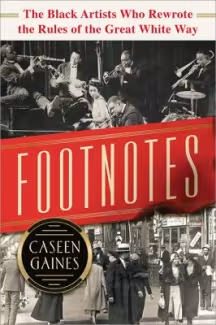
Footnotes: The Black Artists Who Rewrote the Rules of the Great White Way
Synopsis:
A show-stopping theatrical history about contributions made by artists of color, beginning with the story of the 1921 Broadway hit, Shuffle Along, whose influence continues today, and was created and performed by people of color. The creative team behind that hit fought, incorporated, endured and overcame every type of impediment: the Spanish Flu pandemic, Prohibition, the 1929 Stock Market Crash, the Great Depression and World Wars I and II. During the twentieth century, in the theatrical world, as elsewhere, artists of color were challenged by prejudice and what white audiences expected of them.
Review
From its off-Broadway premiere, Hamilton was a hit. When it moved to Broadway in August, 2015, it became a world-wide sensation. It was nominated for a record-breaking 16, and won 11, Tony Awards. It was also awarded the 2016 Pulitzer Prize for Drama. The show chronicles the life of Alexander Hamilton and his role in the creation and development of the newly formed United States of America. The show’s creator, Lin-Manuel Miranda, cast actors of color in the roles of the historical figures portrayed and used hip-hop, R&B, and a few more typical musical “show tunes” to tell the story, describing Hamilton as "America then, as told by America now".
In 2015, the idea of a Broadway show populated by actors of color was not surprising. There had been earlier hit shows starring all-Black casts, The Wiz, Porgy and Bess, and Bring in 'da Noise, Bring in 'da Funk for example. But when was the first Broadway hit created and performed by people of color? That would be 1921’s Shuffle Along. And now, a century later, historian, educator and author Caseen Gaines tells the story of that groundbreaking musical, how it came to be and how it continues to influence musical theatre today.
Beginning in 1885, Gaines gathers the threads of the disparate stories of the contributors, cultural developments, world events and personal histories that coalesced into the team of Eubie Blake, Aubrey Lyles, Flournoy Miller, and Noble Sissle who wrote, composed, and performed the original production of Shuffle Along. Gaines also documents the career, and premature loss, of James Reese Europe, whose influence on Shuffle Along and its creative team is undeniable. Without Europe, it’s hard to imagine Shuffle Along having happened, even though he died before the show was created.
Moving through the 20th century, Gaines illustrates clearly how the creative team behind Shuffle Along fought, incorporated, endured and overcame every type of impediment from the Spanish Flu pandemic to both World War I & II to Prohibition to the Stock Market Crash of 1929 and the resulting Great Depression. The common theme running through the ages is the continued prejudice against performers of color and the risks and rewards of challenging what white audiences expected of them.
Gaines ends the book with an examination of recent attempts to revive Shuffle Along and the resulting questions about balancing history and earlier sensibilities with contemporary expectations regarding the portrayals of characters of color. As Gaines points out, earlier works from white writers and composers are regularly mounted and reimagined, always dismissing earlier problematic attitudes as “that’s how things were.” And yet, Shuffle Along is regularly dismissed for use because it is dated and problematic. One cannot help but wonder why shows by white sources aren’t subjected to the same scrutiny or why one of the most significant contributions to theatre history from an all-Black creative team and cast isn’t allowed to be viewed through a lens allowing for the passage of time and the changing of attitudes to appreciate the achievement for what it was and is.
Thoroughly researched and engagingly written, Footnotes tells a story that, once heard, one wonders why and how they are just learning of it. It is a story that needed to be told and Gaines has done a showstopping job of telling it. You can read an interview with Gaines here.