Interview With an Author: Arvind Ethan David

Arvind Ethan David is a writer and producer whose work spans Broadway, television, and film. He was a lead producer of the Tony- and Grammy-winning musical Jagged Little Pill and has written and produced extensively in television, including Dirk Gently’s Holistic Detective Agency, Anansi Boys, and the Asian Academy Award winner The Garden of Evening Mists. He was recently nominated for an Olivier Award for his adaptation of The Boy with Wings (Best Family Show category).
His graphic novels include the Stoker-nominated Darkness Visible, and his stage work includes the adaptation of his late mentor Douglas Adams' legendary The Hitchhiker's Guide to the Galaxy.
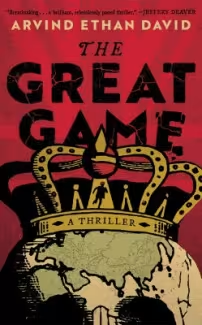
Arvind Ethan David was born in Kuala Lumpur, Malaysia, educated in England, and currently lives in Southern California with his family. His debut novel is The Great Game, and he recently talked about it with Daryl Maxwell for the LAPL Blog.
What was your inspiration for The Great Game?
I wanted to write an old-fashioned mystery thriller that took place in the London of Sherlock Holmes, that maybe had something new to say about both the genre and the world it comes from.
What drew you to revisit A.J. Raffles and reimagine Harry "Bunny" Manders as Balvinder Dev Singh?
I wanted to acknowledge my friend and colleague, the television writer Paul Redford (The West Wing, The Newsroom, Madam Secretary). He suggested to me over lunch about a decade ago that Raffles and Bunny were worth a fresh look. He was, as he so often is, completely correct. We tried to rejuvenate them ourselves with a television pilot that, in the way of so much network development, went down the drain, but Paul was kind enough to bless my return to them and my taking them in this new direction.
How did the novel evolve and change as you wrote and revised it? Are there any characters or scenes that were lost in the process that you wish had made it to the published version?
The first draft was perhaps a little more indulgent in spending too much time meandering around the monolith that is Sherlock Holmes, but ultimately, this isn't a Holmes adventure. It is a Holmes-adjacent one, and I was grateful to my excellent editor for keeping my fanboy impulses in check.
You reference and pay homage to a number of late 19th and early 20th century authors, including Sir Arthur Conan Doyle, Sir J.M. Barrie, Rudyard Kipling, H.G. Wells, and Edgar Rice Burroughs, and their works. Do you have a favorite among them? A favorite work? Someone you wanted, but were unable, to include?
It's hard to pick a favorite from such a genius lineup like that. One of the things I find so amazing about that group of late-Victorian and early-Edwardian literary figures is that most of them knew each other. Indeed, at some point, Conan Doyle, Barrie, Hornung, Jerome K. Jerome, and several others were all members of the same cricket team! There's also an amazing story about Wilde, Conan Doyle, and Bram Stoker all being invited out to lunch by the editor of Lippincott’s Magazine and asked to contribute pieces of fiction for it. Stoker was unable to attend but separately agreed to write a piece, and out of that lunch came The Sign of the Four, The Picture of Dorian Gray, and Dracula.
You provide a bibliography of titles about Great Britain’s colonization of India. How familiar were you with the history between Great Britain and India prior to writing The Great Game? Did you need to research the topic? What was the most interesting or surprising thing you learned while preparing to write your novel?
I knew the raw facts of the history, but, like many of my generation, I had bought into the convenient fiction that Britain was a more benevolent imperial force than, for example, the Belgians or the French. The close reading of the true history, and in particular the wonderful work that historians like Caroline Elkins have done, exposes that as a dangerous lie that has been taught for too long. From the days of the East India Company through the Raj, the British were motivated only by their own financial and venal interests, and too often in violent and brutal ways. There is no such thing, sadly, as a good empire.
You also mention in your bibliography that you have long been obsessed with Winston Churchill and Oscar Wilde. Do you have a favorite of Wilde’s works?
It is, of course, impossible to quibble with the towering perfection of The Importance of Being Earnest, but for some reason, An Ideal Husband has always been my personal favorite of Wilde's plays. I think it genuinely has something to say about marriage, mature love, and trust.
Oscar Wilde passed away in 1900, and Winston Churchill in 1965. If you could ask them a question, what would it be?
I think having them sit down together for dinner and just being a fly on that wall would be more interesting than anything I could ask either of them. I suspect they would find much common ground in the joint love of the classics, great oratory and conversation, and good champagne and whisky. I think that they would have some strong differences in their political views.
If you could tell each of them something, what would you tell them?
I’d take Oscar to a Pride parade and tell him that it started with him.
I'd take Winston to Number 10 Downing Street and show him the picture of Britain's first Indian Prime Minister that sits alongside his on the staircase wall.
You have worked in theatre, television, and graphic novels. The Great Game is your debut novel. Is there a format that you prefer over the others?
You know, there really isn't. For me, the joy is in the variety. The variety means there is never writer’s block or boredom.
Is there something you haven’t done yet but are hoping to have the opportunity to try?
I’m flirting with writing some computer games at the moment, and am both curious and apprehensive about that process.
If/when The Great Game is adapted to film or series, who would your dream cast be?
Because I actually am in conversation with some wonderful actors about this, I’m prevented from answering this question!
The Great Game is your debut novel. What have you learned during the process of getting this novel published that you would like to share with other writers about this experience?
I'll feel in a better place to answer this question in a couple of months, once the book is out in the world and I have some perspective. At the moment, it's been an exhilarating dream come true.
What’s currently on your nightstand?
Book-wise: James by Percival Everett, which I am loving. I deliberately didn’t read it until The Great Game was done and in the world, as I think, whilst he is playing a more literary game than I, we are doing similar things in interrogating a canonical piece of beloved and definitional national literature from the perspective of the marginalized.
I’m also reading (with my 8-year-old daughter) Three Bags Full, the book that inspired The Sheep Detective movie, and we are both giggling and delighting in it, though generally not at the same bits.
What is the last piece of art (music, movies, TV, more traditional art forms) that you’ve experienced or that has impacted you?
My two best TV shows of the year are Widow’s Bay and DTF: St. Louis. They are very different from each other and from everything else out there. I’m also very happy to see the recognition and the love that The Pitt is getting. I think it's an important and brilliantly made show, and my friend Fiona Dourif is hopefully going to win an Emmy for it…
What are you working on now?
Mainly answering Q&As like this one!
When the book tour is done, I have a fantasy novel that I want to write next, and also a new play about Richard Potter, America’s forgotten first magician, that we’re putting together.