Genius and Grief: The Fruitful Yet Shattered Life of Komitas

While his output is modest, among Armenians, Komitas Vardapet (1869-1935) is widely celebrated as the father of modern Armenian classical music and as an ethnomusicologist who collected and preserved possibly 4000 Armenian folk songs from extinction.
Born Soghomon Soghomonian to a Turkish-speaking Armenian family, he was orphaned by the age of 11. He was then sent to the Gevorgian Seminary in Etchmiadzin to pursue his education, where he showed a particular aptitude for music. After graduating, he remained at the Seminary as a music teacher. In 1895, Soghomon was ordained as Komitas Vartapet, a celibate priest. Concurrently, he published his first compilation of transcribed music, The Songs of Agn, preserving traditional Armenian love, wedding, dance, and lullaby melodies.
He spent that year in Tiflis, Georgia, studying harmony with composer Makar Yekmalian. He then moved to Berlin to study at Friedrich Wilhelm University (now Humboldt University) for three years. There, as a founding member of the International Music Society's Berlin chapter, he frequently lectured at conferences, introducing Armenian folk music to Europe. Over the following years, Komitas alternated his musical activities between Etchmiadzin and Europe.
In 1910, Komitas relocated to Constantinople to continue his teaching and performing career. There, he founded "Gusan," a 300-member mixed-voice choir that went on to perform concerts in Constantinople, Cairo, and throughout the Caucasus.
His life is also remembered for its tragic ending. On April 24, 1915, the Armenian Genocide began with the targeted arrest of prominent figures, including Komitas. Although most of his fellow prisoners perished, Komitas survived. His release was secured by the U.S. Ambassador Henry Morgenthau. He returned home to find it ransacked, his musical archives obliterated, and his personal items gone. Only about a third of his notes and belongings were ever recovered.
Suffering from severe trauma and a mental breakdown, Komitas was placed by friends in a psychiatric hospital in Constantinople in 1916. He was later transferred to a clinic in Paris in 1919, and finally to a psychiatric facility in Villejuif, a suburb of Paris, where he died from complications of an infection in 1935.
Listening Guide
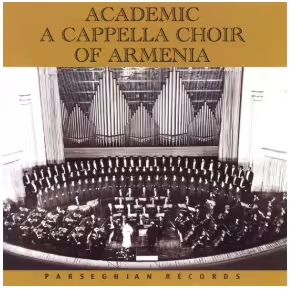
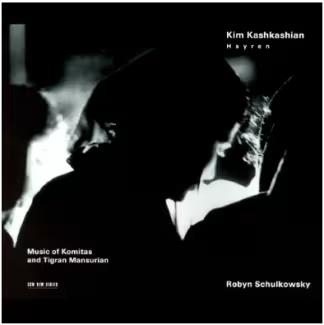
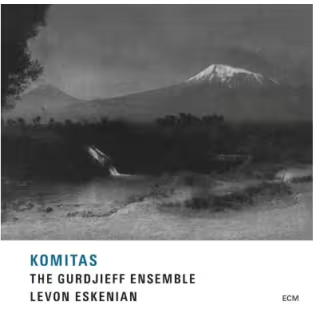
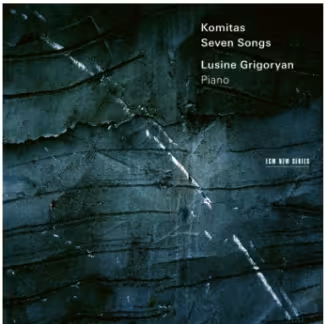
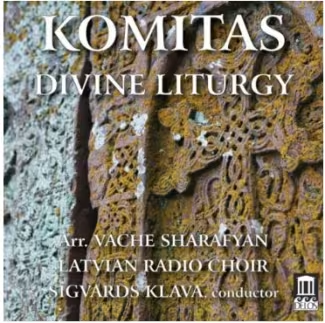
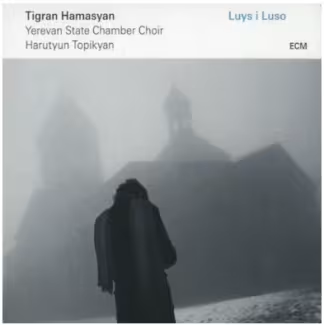
Komitas's enduring musical legacy relies on approximately 80 choral pieces, a setting of the Divine Liturgy, and a few dances for piano, as much of his work was destroyed. Today, performers interpret these pieces using either his authentic scores or by crafting new arrangements based on his traditional folk field recordings.

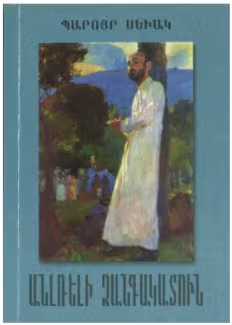
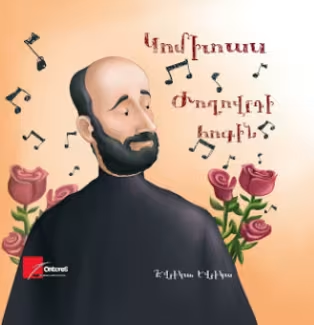
Bilingual Reading Guide
This list captures the essence of Komitas’ profound legacy and tragic life: his field research into Armenian folk and sacred music, his preservation of thousands of cultural dances, his purification of the Divine Liturgy, his vast influence on subsequent composers, and the heartbreaking decline of his mental health.