Interview With an Author: Kasey Lansdale

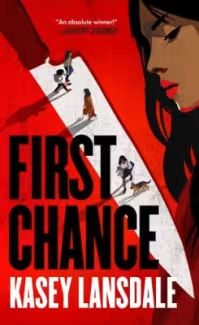
Kasey Lansdale has been in the fiction world since birth as a writer, editor, audiobook narrator, and creative professional. Lansdale is based in L.A., and currently serves as head editor at Pandi Press. She is also a well-known musician. As an author, she has released numerous short stories and anthologies from publications such as Harper Collins, Titan Books, and more. Lansdale has had her fiction adapted for television and comics. First Chance is her debut novel, and she recently talked with Daryl Maxwell about it for the LAPL Blog.
What was your inspiration for First Chance?
The inspiration came from a lot of places. I’ve been pecking away at short stories for a long time and had toyed with the idea of writing a novel, but never got around to it. When the pandemic hit, my schedule changed, and I think that was the first time I really thought about going for it. It came to fruition a few years later, and it was in part a way of dealing with my mother’s Alzheimer’s diagnosis, and even though she is nothing like the mother of the main character, it gave me an opportunity to work through some of those complicated feelings of things that aren’t always fair in life.
It also was a tip of the hat to both of my parents, as my father, who is also an author, has a long-standing series that is ending this year after 40 years. I’m experiencing a little grief around it if I’m being honest.
First Chance was my way of acknowledging their hard work and sacrifice over the years and allowing for some nods in their direction.
Are Chance, Tia, Izzy, Riley, or any of the other characters in the novel, inspired by or based on specific individuals?
All of the characters are, in one way or another, me. Tia is who I was as an angry teenager, though life gave me a different set of circumstances. Chance is who I am now, and I think Izzy is who I’m trying to be. Sometimes all of those personalities emerge all at once, and sometimes I see flickers of them individually.
Joe Dean and Billie Jean really grew on me, and though I’m still learning about them, they and Harper are the definite parental figures in this story. They are all my parents in one way or another. That said, I definitely see pieces of myself in each character as well. I think Riley might be the only exception. He’s just a sweet guy who means well and is kind of a goober, so as I say that, maybe he’s me as well. The good stuff and the bad stuff is all of us, and getting to explore some of that through characters is helpful to understand how you really feel about things.
Similar questions for Joe Dean & Billie Jean (because I think there may be stories)?
As for specific stories about Joe Dean and Billie Jean, though they are at heart, my family, they are definitely the over-the-top caricature versions. The scene that comes to mind is when Joe Dean tells Chance to quit trying to rationalize certain things. Because it’s hard for her to accept that certain people do bad things for no other reason than doing bad things. And even though my dad is certainly a much different person from Joe Dean, those little moments of wisdom remind me of him.
With Billie Jean, her confidence and swagger, and being sort of unapologetically herself, remind me of my mom.
I also thought it was important to remind people of all the kinds of people that exist. And though in some parts of the world, like where I live in Los Angeles, this may be a more common conversation and certain words are used to put everything together, where I grew up, it’s still less so, and it’s important to be honest about that.
How did the novel evolve and change as you wrote and revised it? Are there any characters or scenes that were lost in the process that you wish had made it to the published version?
The novel definitely changed and involved, and while there is a lot to say on that matter, I think it’s better for it. One of the scenes that I took out was the original ending. There is a cousin mentioned briefly in First Chance that comes looking for Tia, and in the original ending, Tia was taken, and that was the start of the second book.
Ultimately, I decided to close the ending instead, as I felt emotionally that this group deserved that, even if it didn’t look the way they might have first imagined, and second, just practically, I felt like having an open ending gave readers one more reason to not invest if they felt like the story wasn’t over and they might not get some closure for a while.
In your Acknowledgments, you mention receiving input and guidance on portraying police work in the novel. What was the most interesting or surprising thing that you learned about police procedures and processes?
In the acknowledgments, I mentioned specifically my cousin, retired homicide detective, Pamela Lansdale Dunklin, and I think what surprised me most, even though it shouldn’t, is just how dumb criminals are. And I think that was part of what I wanted to show—that policework isn’t all twists and turns and action.
It’s a lot of waiting around, getting lucky, and often waiting for the criminal to do something stupid. You would not believe how many people post their own crimes on social media and are surprised to learn that detectives see it.
I may have overcorrected with that regarding the pacing at times, but I thought it was important to show that realistic side, that not every question has an answer, and sometimes you have to be OK with things not being wrapped up in a tight little bow.
What’s your favorite item on the McDonald's menu (past or present)?
I don’t really eat much fast food these days, but I used to love a Chicken McNugget Happy Meal. That said, I recently was in the Chicago airport, stranded for hours upon hours, and went to McDonald’s, but that will hold me for a while. I also used to work at a Sonic, which I guess they don’t have everywhere, but it was always a point of contention to clean the ice cream machine because you had to take it apart, and so after I saw how much those don’t get cleaned, I was not in a hurry for fast food.
Are Galaxy Donuts and their crullers based on or inspired by a real donut shop? If so, where is it? Are crullers your favorite type of donut? If not, what is?
Galaxy Donuts was originally named after the donut store in my father’s book, The Donut Legion, though that changed through edits due to rights issues. I don’t remember what it was originally, but it was another Easter egg that I eventually changed.
There is an ongoing battle, if you will, amongst the donut shops in my hometown. It’s actually quite fascinating, and was revealed to be a human trafficking ring, and that’s a story for another day. And I’m certain that was also a part of the inspiration for my dad’s book, though that’s not what The Donut Legion is about; there are definite nods in there.
As of this writing, there are about 10 distinct donut shops in my hometown. I also used to work at one; I worked the 4 a.m. shift, and that was where I learned how they fill the donuts with jelly, because I was the jelly filler.
We also could eat as many donuts as we wanted on shift, so it was a dangerous job, but someone had to do it. That’s also the only job I was ever fired from, so I don’t know if there was or was not a correlation.
I was working three jobs at the time, so I think it was more exhaustion and bad math skills at the cash register than my eating the inventory, but only they know the truth.
And yes, crullers are my favorite type of doughnut. I read once that donuts are the worst thing you can eat, because there is zero nutritional value in them, and while these aren’t things I was busy fact-checking, it gave me one more reason to not eat them, as I have a bit of a sugar addiction and I’m trying to put that to bed.
How did Monopoly hurt you, Kasey? Is it a recent hurt or is this a longstanding grudge held since childhood?
Monopoly did hurt me. This is a long-standing grudge, and it’s funny that you picked up on that because I didn’t realize how strong that was coming across. We weren’t really a board game family, but we did play Uno, Clue, and Monopoly from time to time. And the only time we ever played Monopoly as a family, my brother won, and we never played again. I think the fighting between my brother and I was more than my parents wanted to deal with, so it was one and done.
You are the head editor at Pandi Press, a company you formed with your father, Joe R. Lansdale. Can you tell us a bit about Pandi Press?
Pandi Press is a company that was originally intended to quietly sit there until I was in retirement. It was created with the idea of taking some of my father’s backlist, stories that were published with other publishers, but then the rights reverted back to us, and had no home, and put them under one umbrella. During the pandemic, I found myself suddenly retired from my touring musician life, and it seemed like a good time to revive that venture. At the same time, my boyfriend at the time, now my husband, is a certified InDesign expert, and has a background in publishing and design, so his skill set was just what was missing to put the company back in the Zeitgeist. My husband "signed on" and we got to work.
We’ve been going through many changes over the last few years, learning about metadata, promo, online sales platforms, and only in the last calendar year have we really started to get our rhythm. My dad’s been full-time for over 50 years as an author, so there’s lots of work still to do, so I’m grateful we didn’t wait much longer to get this process started.
We have published outside authors other than my father, and it gives me a taste of what that would be like in the future. I hope to be able to sign more folks as the company grows, as there are so many talented people who just need a shot. If I can offer that in some way eventually, it would do my soul good.
Prior to your work in publishing and as a writer, you worked as a country music singer and songwriter. You’re also the founder and host of the East Texas Songwriters’ Workshop. Can you tell us a bit about your career in country music and the workshop?
I’ve had a bit of an identity crisis in the last few years, because I always identified as a musician. I was on the road so much, and then I had a residency in Los Angeles, where I was performing every weekend at the Grove. Then, everything ended overnight with the pandemic.
I’ve been writing since I was eight years old, publishing short stories and comic books, so it’s not like I just said oh I’m going to start writing now—I spent a literal lifetime in the field, growing up in it and my first publication with Random House when I was a child, but this was the first time I looked at it more seriously, and it wasn’t that I didn’t want to do it before it’s that music was what was calling to me.
After a forced hiatus and not being on the road so much, I realized that maybe that lifestyle wasn’t going to hold up as well for me long-term. I’m early to bed, early to rise, never been much of a drinker or party animal, so the road-dog musician lifestyle was not really lining up with my goals anymore, but I don’t think I would’ve been able to see it had it not been forced upon me. I love performing, I love singing, and still do, and will probably do more music in film and TV again, which is what brought me to Los Angeles in the first place, but due to the state of the film industry, that work has changed as well.
The Songwriter’s Workshop specifically was where I hired folks I met during my time living in Nashville to come to my hometown and talk to people about music, songwriting, and the business. We had some great events, but it was another thing that wasn’t really sustainable with my life on the road, and though I would’ve loved to have grown it more, I do have to watch that I don’t become a jack of all trades and a master of none, because I have so many interests that I’d like to pursue.
Does your work and experiences as a singer and songwriter inform or influence your work as a writer? If so, how?
The work as a musician definitely informs my work as a writer. I think first of all, there is a rhythm that happens when you write that either has musicality or it doesn’t. I like to think that my dialogue has a real rhythm there, a musical rhythm, even though it’s not set to music specifically.
This is where the editorial battles start. I know sometimes something is "wrong," but it sounds better, so I care less about being right and more about being truthful. I am constantly engaged in a run-on sentence, but that’s how I speak in real life. I went to speech therapy once after some trouble with my singing voice from overuse. You know what they told me? They told me I had to stop and breathe between sentences.
Seriously. My mom thought that was hysterical.
Another thing you’ll see is music mentioned throughout the book itself. I even put together a Spotify playlist for the book, and it’s because music is such a part of my life and has been, and I find that talking about those songs and musical influences in the book offered me a way to explore some of that, even if it was not absolutely overt. Music does for the soul, what it does depends on who you are and what you’re after, but it gets you one way or another.
If/when First Chance is adapted to film or a series, who would your dream cast be?
I can only hope that my next problem is approving casting for a film or television series for Chance. I really don’t have an idea of casting, and I found this to be better, as in any film project I have been connected to, and there have been several, the cast is never who I imagine them to be. They never look the way I thought.
Harry Bosch would be a perfect example. I never would’ve mentally put Titus Welliver in that role, and now there is no one else who can do that role. It was such a brilliant casting, and I think those decisions are better left to the people who are good at it.
First Chance is your debut novel. What have you learned during the process of getting your novel published that you would like to share with other writers about this experience?
First Chance is my debut novel, and I think the most important thing to share is that no one cares about your book the way you care about your book. You have to take ownership and let people know it’s coming. It’s awkward and uncomfortable to feel like you are pushing your work in this way, but there’s so much noise, and you have to find a way to be heard.
I think if there was an actual piece of advice about the process, for me, I don’t like to talk about what I’m working on until it’s done, and then I want to not shut up about it. So I think get the work done, and understand that not everyone’s going to love you. People are going to misinterpret things about you as a human based on your work; they’re going to associate you with your characters, and sometimes that can be good, and sometimes that can be bad, but you just have to be true to yourself. And get ready for edits. Because everyone’s going to have a thought about something, and some will have an agenda, and some will not, so you have to be very firm in what your message is and do your best not to take it personally.
What’s currently on your nightstand?
On my nightstand are some of the books I picked up at ALA. I’ve got Gary Phillips, Cynthia Pelayo, Becky Spratford, and Jim Sallis’ final work.
I just finished reading the Michael Crichton book released from Blackstone A Murder in Hollywood, written in the 70s under a pen name, and just released. It’s exactly the kind of book I like. It wasn’t so much about the mystery, but about the characters and the place, and the subtle humor. Lots of fun.
Can you name your top five favorite or most influential authors?
Most influential authors, it would definitely have to start with my dad. I learned a lot about the business from him, as well as trusting in your own voice.
I also am a big fan of Michael Connelly, and I read his work almost as a comfort read at this point. When I don’t know what to read, but I want something familiar and tightly written, I grab one of his books.
Influential is different too, because I think about having read every Nancy Drew book, every Babysitter’s Club. The Daniel Pinkwater books, Eric Carl, so I don’t know that I would say I have a favorite author, and the people who influenced me then are not who influence me now, and it changes from day-to-day. This is a tough one.
What was your favorite book when you were a child?
I don’t really remember what my favorite book was as a child; I read a lot, but I do have Gary Paulsen’s Hatchet coming to mind. I think we were required reading on that one, but I really don’t remember. My dad would know more than I would, because I would get obsessed with something, be hyper-focused on it, and then move on to the next thing with the same experience. I think everything was my favorite at the moment that I was reading it.
Was there a book you felt you needed to hide from your parents?
There was never a book I felt I needed to hide. If anything, it was encouraged to read outside of what might be considered appropriate for my age, because I was a bit precocious. I know that’s a thing that was said, but it’s true.
Is there a book you’ve faked reading?
I’ve never faked reading a book, though I definitely didn’t read everything that was assigned to me in high school, so I guess in that way I might’ve faked it, but by that point, I was just reading what I wanted to read. By the time I graduated high school I was a sophomore in college, so I wasn’t really concerning myself with those kind of things. I left college when I got an opportunity to tour musically, and for me, it was the best decision I could’ve ever made. College was fun, I was good at it, and there are moments that I regret having not finished, but they are overshadowed by the fact that I’m glad I followed my dream and got to have so many unique experiences because of it.
Shout out to my sociology professor, Dr. Segady, who follows me on my Facebook fan page. When I see folks from my past who were in positions of authority, and trust me, I was not always easy, it gives me peace that maybe they understood what I was up against sometimes.
Can you name a book you’ve bought for the cover?
I don’t know of any books I’ve bought for the cover, but it would be a lie to say that covers don’t sell books.
Is there a book that changed your life?
I think there have been many books that changed my life, and that’s a very difficult question to answer, but specifically, I’m thinking of reading The Devil Wears Prada.
Which is kind of funny, because it’s outside of my normal realm of interests, but I had been in a reading slump, I was about 19, maybe 18, and I was in Italy. I was staying with a friend of mine who is a wonderful editor and translator, and one of the English books she had on the shelf was The Devil Wears Prada.
I picked it up and read it, mainly because my choices of English reading were slimmer, and I remember having a great time with it. I think it was the right time for me to read something like that, and I actually wrote my very first novel, called One More Than the Devil, and though that book didn’t sell, it let me know that I could finish something. Though I didn’t write another novel for years and years.
Sometimes I think about pulling that one out and giving it a real good pass on editing, and then other times I think no, start something new, let that be what it was.
Can you name a book for which you are an evangelist (and you think everyone should read)?
I think this is a tacky answer, but the truth is, I’m an evangelist for The Bottoms, written by my father. Obviously, I’m biased, but I truly think it is our version of To Kill a Mockingbird. He won the Edgar Award for it, so I’m not in the minority.
Is there a book you would most want to read again for the first time?
I actually mentioned this book in First Chance, and it was Flood, by Andrew Vachss. Andrew was like an uncle to me, and it was always hard for me to read work from people I knew personally because it affected me on such a deep level. No one has said as much, but I’m pretty confident I’m one of those HSP folks.
During pandemic, I spent a lot of time reading works I’d delayed and I’m so glad I was able to read that book, feel its impact, and I got to tell him about it. And I just remember thinking, my God, if this is your first book, where do you even go from there. But anyone who is familiar with Andrew and his work knows he went very far, not only of his book work but the work he did outside of literature. I wish I had been able to read more of them while he was around.
What is the last piece of art (music, movies, TV, more traditional artforms) that you’ve experienced or that has impacted you?
This is unquantifiable. I think I’m impacted by art every day. Each book I read, each show I watch, whatever it is, it spawns ideas and nests in my brain waiting to be released at a later time. It becomes jumbled, but all part of what you draw from. I think it’s less about naming a specific piece and just staying open to other mediums, and other work outside of your go to genres and tastes.
What is your idea of THE perfect day (where you could go anywhere/meet with anyone)?
My perfect day is a memory. Being with my parents and experiencing Ravello, Italy for the first time all together. My dad was on book tour over there, and my connections to Italy are some of the most impactful things in my life even to this day.
If I could crowbar my husband in there, I would, but since I didn’t meet him until later, I think getting to see my parents have moments of joy and success, and though I didn’t understand it at the time, I’m very happy to know that they got to live some of their dreams. And got to live dreams that I don’t know if they even knew they could dream at the time.
What is the question that you’re always hoping you’ll be asked, but never have been?
I can’t think of a question I’m hoping to be asked, because it hasn’t been asked yet. The question I am being asked that I’m really enjoying is, will there be a second book?
And I’m working on it now, so in one way or another, yes.
What is your answer?
I guess I answered the last three questions in one. I’ll also say I have 100 pages of another work in a separate universe, and I peck on it from time to time, but there’s something about Chance that calls to me, and I think it’s because I know her so well at this point. I’ve spent a lot of time with her over the years, and in these rounds of edits, and it’s almost like you have to write the first one to know how to write the second one, because you don’t really know who anyone is, what they’re doing or why they’re doing.
What are you working on now?
I can also add I’m doing edits for Grim at Heart, a collection of short stories from me, out from Bad Hand Books in 2027.