Interview With an Author: Vincent Yu

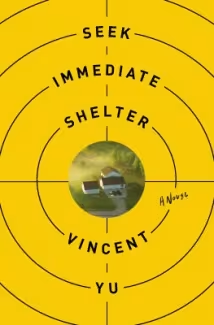
Vincent Yu is a sales manager at W.W. Norton/Liveright and the winner of the 2021 Ashley Bourne Prize for fiction from Ploughshares. His work has been published in Prairie Schooner, StoryQuarterly, Ninth Letter, Able Muse, and elsewhere. He lives in Brooklyn. Seek Immediate Shelter is his debut novel, and he recently talked about it with Daryl Maxwell for the LAPL Blog.
What was your inspiration for Seek Immediate Shelter?
The ballistic missile alert sent to Hawaii in 2018 was the primary inspiration for this novel’s inciting event. We all think about how we’d like to spend our very last moments, but the idea of having to face the realization of it so swiftly, to have just enough time to do something about it, and then to learn that it was all a false alarm, really got my imagination going.
Are any of the many characters in the novel inspired by or based on specific individuals?
I think that everyone in this novel is a different version of me. Perhaps that’s true of everything I’ve ever written. I like to write characters firmly grounded in reality, who seem believable in their flaws and in the ways they behave. I suppose my best sources for that kind of inspiration are all my hypothetical selves.
How did the novel evolve and change as you wrote and revised it? Are there any characters or scenes that were lost in the process that you wish had made it to the published version?
All my work begins as a short story. It’s only when the narrative starts to expand beyond the reasonable confines of the form that I begin considering whether the idea is robust enough for a novel. In this instance, the first story was what eventually became the 7th chapter, that of Russ, who goes looking for his father.
Although I was satisfied with this particular iteration of the scenario, I felt like I needed more characters and more reactions to meaningfully explore the scope of what might really happen. Interwoven stories surrounding this central alert seemed the perfect option.
Thankfully, I have a supremely talented and supportive editor, whose thoughtful notes made such perfect sense that there are no scenes or characters that I feel have been cut unnecessarily from the book.
Out of all of the possibilities available to you, what drew you to set your novel in a small New England town?
I’ve always been fascinated by the ways in which disparate lives and stories can overlap and influence one another. Keeping the inciting incident and the resulting narrative within the confines of a single small town allowed me to explore the possibilities of these connections without straining credulity.
Having grown up in a New England town, I’ve always been able to write more comfortably, and I think, convincingly, about the climate, the landscape, the seasonal rhythms, and the overall personality of such locales.
Is Beckitt, Massachusetts, inspired by, or based on, an actual small town (in Massachusetts or somewhere else)? If so, is it a place you’ve visited or spent time?
It is! It’s based on my hometown of Longmeadow, Massachusetts. The row of "Beckitt Shoppes" is borrowed from the real life row of stores that form the social and economic center of things in town. Its identity as a gathering place that is at once an institution as well as a sign of constant, minute change, was the starting point for me as I built out the rest of Beckitt.
Which of the stories told in Seek Immediate Shelter do you most closely identify with (both in terms of the immediate reaction to the warning and the repercussions)? Is it a single story or elements of several?
To be honest, I think it would be all of them—even Grant’s story at the very end! (Although I’m grateful to say that I’ve never experienced opioid addiction). Each story consisted of a reaction that needed to feel genuine, and my gut check for that was imagining myself behaving in those particular ways, in those particular contexts.
Perhaps in terms of pure plot, I relate most to Nick Chen, the violinist. I was also a violinist growing up, and subject to profound stage fright. Though I never got anywhere close to applying to a conservatory, I can still remember concerts during which my nervousness would cause my bow arm to shake uncontrollably, which led to some pretty disastrous performances.
Your biography says that you live in Brooklyn. What are some of your favorite places? A hidden gem that someone visiting should not miss, but would only learn about from a resident?
For food: Prospect Pizza in the Prospect Lefferts Gardens neighborhood has, hands down, the best wings in the borough.
For books: The Franklin Park Reading Series (in Franklin Park) is an outstanding monthly event that features readings from local and international readers of local to international repute.
If/when Seek Immediate Shelter is adapted to film or a series, who would your dream cast be?
Considering the large number of characters in this book and the continued dearth of mainstream Asian American actors, I think my only goal would be to create as many opportunities for career exposure for as many Asian American actors as possible!
That being said, I recently saw a film called Rosemead, starring Lucy Liu, that was so devastating and beautiful that my tears left me dehydrated by its end. Her performance, in particular, was staggeringly good. So I’d love to have her in a role, perhaps as Nina Chang!
As a debut author, what have you learned during the process of getting your novel published that you would like to share with other writers about this experience?
Your manuscript moves through so many hands and is given the benefit of so much care and input! I began this process wondering why there was such a gap in time between acceptance and publication, but the editors, copyeditors, developmental editors, proofreaders, designers, marketers, salespeople, publicists (and likely even more people whom I don’t know about) are all contributing their expertise and rooting for the success of the book. To other writers, I’d say: treasure it, and be patient.
What’s currently on your nightstand?
-
All Our Evenings, Ruthvika Rao
Can you name your top five favorite or most influential authors?
Oof, these questions always trip me up because of how many tremendous writers there are and have been. If it’s okay, I’m going to limit this list to those who are living and who most inspired this particular novel:
Jonathan Franzen, Elizabeth Strout, Louise Erdrich, Lorrie Moore, Andrea Barrett
What was your favorite book when you were a child?
I really loved the Animorphs series. I’ll admit I was drawn mostly to the covers at first (remember, with the kids gradually turning into animals?), but the stories wound up being full of such incredible moral complexity and high stakes: a group of teenagers with the power to change into any animal fight a shadow war with a race of mind-controlling slug aliens! I became very quickly obsessed. The fact that each book had a separate first-person narrator, each with his or her own particular traits and manner of speaking, introduced me early on to the storytelling potential of character and voice.
Was there a book you felt you needed to hide from your parents?
No, fortunately! My parents encouraged any and all reading. Their only real imposition was ensuring that I had enough light. Poor vision runs in my family, and eye strain is no joke. I was always allowed to read, but never under the covers by the aid of a flashlight.
Is there a book you’ve faked reading?
Ha! No books, but I was a biology major in college, and there were several scientific papers we were expected to read that were simply incomprehensible to me. I could understand the individual words, but the sentences never coalesced into anything intelligible, though I had to nod along and pretend I understood.
Can you name a book you’ve bought for the cover?
Animorphs! Other than that, no. A good cover is wonderful for grabbing attention and showcasing fantastic artwork and design, but I need to be convinced by the actual pitch of the book before I commit to reading it. There is truly just too much good work out there.
Is there a book that changed your life?
If I can be a bit maudlin, here, I think every book has changed my life to some degree. It’s a lonely thing, having only your own head and perspective to look out from. The process of reading grants you access to another human being’s thought processes, and that, by its very nature, manages to expand you, regardless of your thoughts on the book itself.
Can you name a book for which you are an evangelist (and you think everyone should read)?
Nine Shiny Objects by Brian Castleberry needs to be read by everyone. It is a sprawling, multigenerational book that follows a series of interwoven lives, all of which are affected by a UFO sighting. It is a work full of big ideas, whose unifying project is to render the American soul in novel form.
Is there a book you would most want to read again for the first time?
I think I’d have to say Jane Eyre. I will never forget how moved I was when I finished that book. It is, to me, the perfect love story—one in which the obstacles between the two main characters are rooted in their individual flaws and incompleteness, as opposed to some misunderstanding of each other.
Each has developed and grown in self-knowledge by the time of their reunion. When the blind, wounded Rochester instantly recognizes the size and shape of Jane’s hand in his, I was done for.
What is the last piece of art (music, movies, TV, more traditional art forms) that you’ve experienced or that has impacted you?
It has to be the 2025 film, Rosemead. It was a difficult, incredibly emotional watch for me.
Without including any spoilers, the driving action of the film forced me to inhabit a deeply uncomfortable viewpoint—one in which unadulterated love and senseless destruction motivated the same shocking act.
Watching it allowed me to empathize with the unfathomable, which, I think, is kind of the point of art as a whole.
What is your idea of THE perfect day (where you could go anywhere/meet with anyone)?
I’m with my partner. We’ve had a pizza delivered, and reruns of Frasier are playing from, my laptop. I’m in the thick of a novel full of complex, contradictory characters whose actions I can’t even begin to predict. It’s chilly and overcast and drizzling outside, so there’s the perfect excuse to stay in. I’ve gotten nine blissful hours of sleep the evening prior.
What is the question that you’re always hoping you’ll be asked, but never have been?
What does success mean to you when it comes to the publication of this, your debut novel?
What is your answer?
It would mean that this book reached and hopefully resonated with people enough so that I’d get the opportunity to write and publish another.
What are you working on now?
I’m working through a novel about three best friends who experience something troubling in their teenage years, grow estranged, and then decide to revisit the incident in adulthood.
Right now it’s more a book of ideas I want to explore, including: the emotional and psychological effects of modern "ghosting," the (un)reliability of memory, and the ways in which our increasing dependence on subscriptions manifests in the ways we approach our lives.
On this last point, in particular, I want to explore the thesis that our personal histories are simply stories we subscribe to for the sake of self-preservation.