
An Extreme Life Hazard: Part 3 of the Central Library Director Series

The Los Angeles Public Library is celebrating 100 years of the Central Library, making this the perfect time to spotlight the exceptional librarians who have overseen this remarkable building and all that it houses: its collections, programs, services, and staff. Over several weeks, we’re highlighting the individuals who have served as the Director of Central Library. Check out Part 1 and Part 2 if you missed them.
Last time, we met John B. Phillips, the first official director of Central Library. His tenure lasted less than two years, from January 1961 to December 1962. After his departure, the Library launched a nationwide search for his successor. Recruitment advertisements appeared in newspapers across the country in December 1962, offering a salary of $9,564 to $11,904 per year.
The top candidate was Ernest Irving Siegel, a managing librarian from the San Diego Public Library. Siegel had been in San Diego for many years, but was originally from the East Coast. He was born on May 23, 1923, in Boston and attended English High School there. In school, he was involved in cadets, the current events club, and the tennis team. He had ambitions for aeronautical engineering, which, thankfully for the library profession, he didn’t pursue.
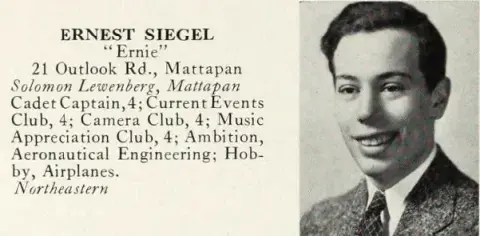
Siegel married Beatrice "Bea" Berman on August 1, 1945, in New York. Later that month, he enlisted in the U.S. Army and was discharged just under a year later. He then attended Washington Square College of New York University, earning a B.A. in psychology in 1950. By then, the Siegels were living in New Jersey and had two young sons, Eric and Peter. Siegel continued his education at Pratt Institute's School of Library Science, where he completed a thesis titled A Core Collection of Reserve Books for College Libraries. After brief stints as a catalog librarian at New York University and Hunter College, the family moved west.
Siegel's first stop was Reno, Nevada, where he worked as a children's librarian at the Washoe County Library. The family soon relocated to Southern California, where Siegel advanced through a series of increasingly responsible positions at the San Diego Public Library between 1955 and 1959. In 1960, he was named the first director of the system's new Central Library, which had opened only a few years earlier.
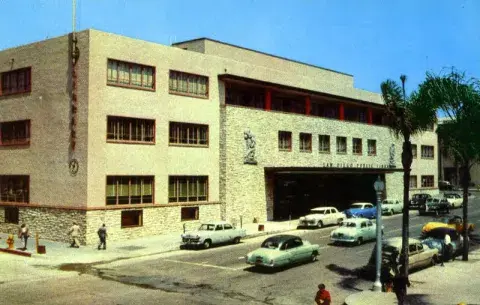
Managing a Central Library of another large city was likely ideal preparation for Siegel's new role in Los Angeles. Beginning in May 1963, he oversaw approximately 200 employees and eleven specialized subject departments at LAPL's Central Library, as well as the Municipal Reference Library, a now-defunct branch housed in City Hall. A forward-thinking administrator, Siegel was active and well-regarded in the library profession. He contributed articles to California Librarian and served on the California Library Association's Long Range Planning Committee.
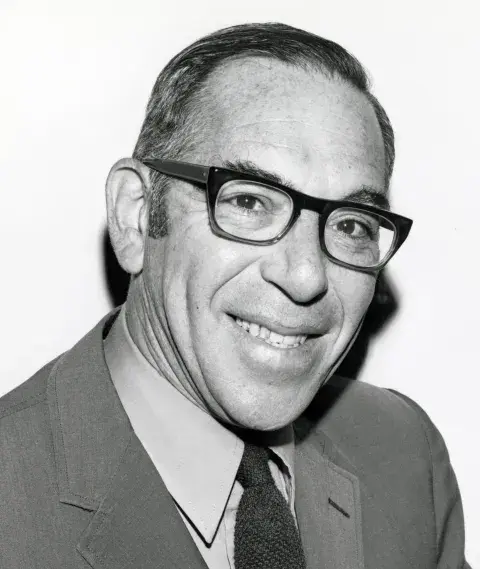
Siegel got to represent LAPL at the 1964 New York World’s Fair, when the American Library Association selected him as one of a small group of "unusually competent" librarians from across the country to staff the Information Center in the United States Pavilion. After two weeks of computer training at IBM, Siegel and his colleagues demonstrated the new UNIVAC 400, which spit out computer-generated essays and on-demand bibliographies for curious fairgoers. Yet despite the excitement surrounding the technology, Siegel later said his greatest satisfaction came when a visitor posed a question the computer couldn't answer, and the librarians solved it the old-fashioned way—using a reference book.
In the January / February 1965 issue of The Broadcaster, the librarians’ union newsletter, Siegel received a warm assessment after his first twenty months on the job:
"Somehow, the stereotype of an executive doesn’t fit Ernie Siegel. Neither does the image of a librarian. Yet he is both of these—and more—to the Central Library. He is simultaneously an administrator, a leader, an adviser, a sympathizer, and a solver of millions of problems."
In the same piece, Siegel assessed the staff and conditions of Central Library:
"I am impressed with the overall excellence of the book collection and its heavy use by the public. I am more impressed by the quality of the work done by the staff under an excessively heavy workload in antiquated working quarters... my efforts during the following years will be directed toward defining and agitating for the Central Library’s need for enlarged and improved quarters. Any suggestions are welcome, of course, through channels."
Siegel's comments reflected a difficult reality: while Central Library boasted exceptional collections and a dedicated staff, he had inherited a building in serious decline. By the mid-1960s, its deteriorating condition and chronic lack of space had been recognized for decades. In 1966, the Library Board of Commissioners commissioned a comprehensive study of the building's physical condition. Siegel was an uncredited coauthor of the resulting report, informally known as the Green Report because of its faded green covers. It concluded that the building was so deteriorated, overcrowded, and ill-suited to the city's future needs that the most practical solution was to raze it and construct an entirely new Central Library.
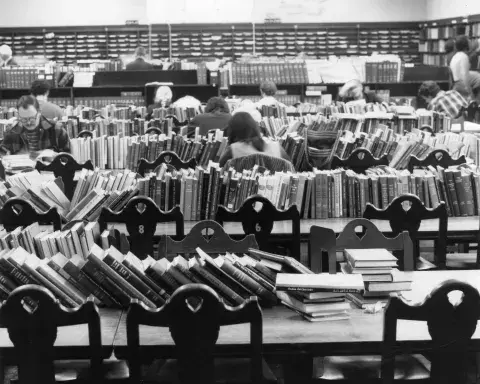
Today, that recommendation seems almost unimaginable. Yet in 1966, many employees who worked in the aging building considered replacement the only realistic solution. Others, however, fought to preserve the landmark. In March 1967, the City's Cultural Heritage Board designated the Central Library building and its grounds as Historic-Cultural Monument No. 46 in an effort to protect them. Even so, plans for a new Central Library continued to move forward.
In May 1967, Angelenos were asked to approve Measure A, a $57.8 million bond issue for library improvements, including $26 million for a new Central Library. Siegel became one of the measure's strongest advocates, illustrating the desperate conditions with vivid examples. A 1685 Fourth Folio of Shakespeare and other rare volumes, he noted, were being stored wrapped in blankets inside a staff lavatory because the library had no safe space to house them.
Voters, however, rejected Measure A. In the aftermath, the Los Angeles Times described Central Library in a headline as "a neglected dowager begging for survival." Instead of receiving the long-needed infusion of bond funding, the library was now in a position to beg the City Council for funds just to keep the rats and water beetles at bay. An attempt to solicit donations from the business community, a principal user of the library, also failed.
Siegel lamented that libraries "don't tug at the heartstrings the way muscular dystrophy does, and we don't have the glamor of The Music Center." Yet financial neglect did little to diminish the library's importance. A UCLA study found that 66 percent of Central Library's patrons came from outside downtown Los Angeles, underscoring its role as a citywide resource. Although funding remained uncertain, efforts to replace the aging building continued. In January 1968, Mayor Sam Yorty appointed a group of city executives to the newly formed Central Library Development Coordinating Committee to evaluate options for a new Central Library.
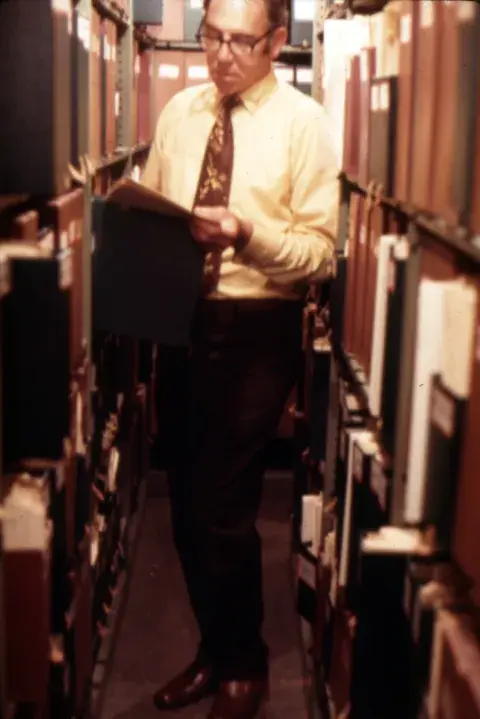
Even as he battled the challenges facing Central Library, Siegel continued to champion innovative library services. A strong advocate for cooperation among library systems, he believed that sharing resources was the best way to improve public access to information. In 1968, he proposed the Information Center of Southern California Libraries (INFO), an interlibrary cooperative bringing together public, academic, special, and school libraries. Headquartered at Central Library, INFO served as a clearinghouse for library resources throughout Southern California.
Two years later, Siegel helped establish the Southern California Answering Network (SCAN), which linked 24 public library systems to provide in-depth reference service. Questions that could not be answered at local branches were transmitted by closed-circuit teletype to Central Library, where specialized subject librarians, whom Siegel proudly called the "cream of the crop," used the library's extensive research collections to track down answers.
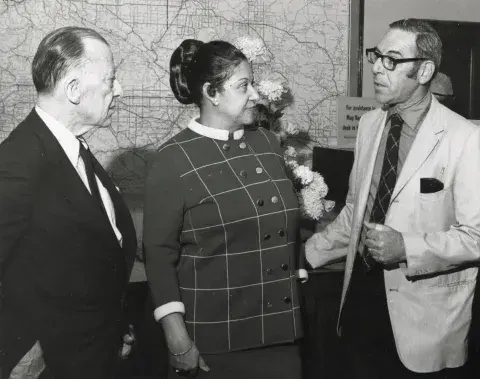
Siegel's leadership earned recognition beyond the Central Library directorship. In 1970, he was one of the finalists to succeed Harold L. Hamil as Los Angeles City Librarian, though the position ultimately went to Wyman Jones, director of the Fort Worth Public Library. Two years later, the Council on Library Resources awarded Siegel a fellowship that enabled him to spend six months visiting twenty-two major public libraries in Europe and Canada, studying their operations and exchanging ideas with their staff.
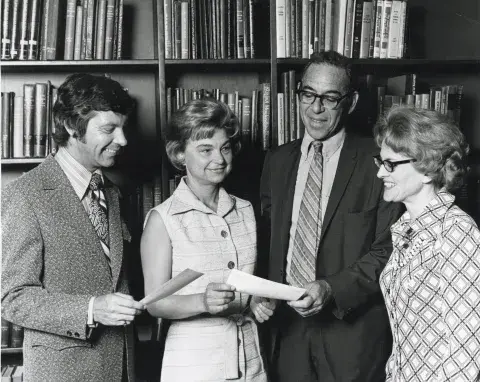
Even as Siegel expanded library services and collections during the early 1970s, conditions at Central Library continued to deteriorate. In 1973, the Los Angeles Fire Department cited the building for twenty-six fire and safety violations, declaring it an "extreme life hazard." The following January, 1500 library employees signed a petition placing city executives and elected officials "on notice" about the "conditions hazardous to life and property existing in the Central Library." Staff members also took their concerns public. In The Broadcaster, articles appeared under ominous headlines such as "Central Library: The Burning Issue." Employees attended Library Commission hearings and City Council meetings to demand action, prompting a Los Angeles Times reporter to observe that "this new breed of librarian is angry and militant."
The Los Angeles Fire Department’s citations were reversed in July 1974 after the installation of a smoke detection system and other minor corrections. Library staff had hoped for a greater response to their plight. The Broadcaster article title, "It’s Risky, But It’s Cheap!" alluded to what was considered mediocre measures to improve safety. Siegel agreed that the response was meager, but was optimistic that Mayor Tom Bradley and members of the City Council were showing a commitment to replacing the old building. In the meantime, all Siegel could do was remind staff to take cigarette breaks outdoors while continuing to advocate for a solution.
In the spring of 1975, Siegel announced that he had accepted the position of director of the Enoch Pratt Free Library system in Baltimore, Maryland. The post came with a $35,000-per-year salary, which may have been too good to pass up. Perhaps Siegel was just burnt out by the Central Library issue. In any case, he advocated for Central Library—albeit a new one—until the very end of his tenure.
On June 19, Siegel delivered his final message to Los Angeles, in what he described as "one more crack at telling why the Central Library is needed." In a feature article for the Los Angeles Times, he laid out the case for a new Central Library, explaining the value of a centralized facility, the shortcomings of the existing building, and warning that "any solution other than a single building large enough to house all collections and services under one roof will result in the loss of a dimension of library services which would be instantly regretted and difficult to retrieve." He also expressed frustration that issues he believed had been settled years earlier were once again being debated, fearing that efforts to replace the Central Library were circling back to square one. Siegel urged the City Council to approve the mayor's recommendation to hire architect Charles Luckman to conduct a feasibility study for a new Central Library, including an evaluation of potential sites identified by the Central Library Development Coordinating Committee.
Two days later, Siegel and his wife, Bea, were honored at a farewell dinner at the Sheraton West Hotel.
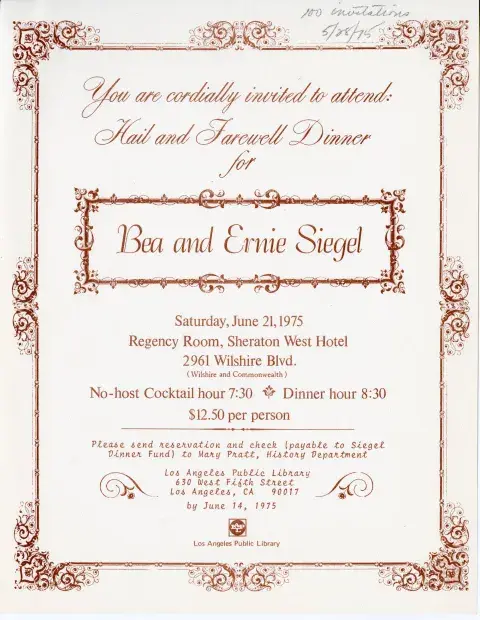
Siegel began his new position in Baltimore on July 14, 1975, serving as library director there until 1981. He then returned to California to become director of the Contra Costa County Library system, where he remained until his retirement in 1990. Siegel died of natural causes the following year. His family requested that memorial donations be made to the Freedom to Read Foundation.
Check back next time to learn about the next Central Library director after Ernest Siegel’s 1975 departure.

