Interview With Author Audrey Leishman

In 2015, author Audrey Leishman was stricken when what she thought was the flu turned out to be sepsis. What is sepsis? According to the Centers for Disease Control and Prevention (CDC), "Sepsis is the body's extreme response to an infection. It is a life-threatening medical emergency. Sepsis happens when an infection you already have triggers a chain reaction throughout your body."
Sepsis affects approximately 1.7 million Americans annually, approximately 18,000 of them children. Fortunately, Leishman eventually recovered, but during her illness, she worried about how devastating it would have been if her children came down with the disease. She and her husband, Marc Leishman, decided to start a nonprofit organization to educate individuals and families about sepsis and its symptoms. Begin Again Foundation also "provides emergency financial assistance to sepsis survivors and to families affected by sepsis, toxic shock and acute respiratory distress (all of which Leishman suffered)."
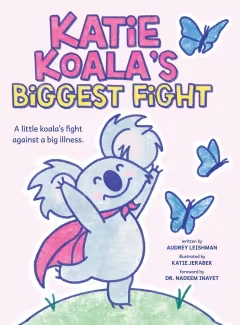
Katie Koala’s Biggest Fight: A Little Koala’s Fight Against a Big Illness is Leishman’s first children's book.
You contracted sepsis in 2015; how long did it take for you to recover?
I was in the hospital for 10 days, but my recovery took about a year after I originally got sick. My immune system was very compromised. I had repeated infections and spent a lot of time at the doctor’s, and lots of rounds of antibiotics.
Then about a year later, I had a tonsillectomy, and it wasn’t until after that I actually started to recover.
How long after that did you get the idea for the book?
The book wasn't until this past year, so a good 10 years after I got sick. I spent the first 10 years really building our charitable foundation, and this past year I've realized that most of our programs are—they're self-sufficient. We have wonderful, amazing grants we give. I wanted to pour more into the awareness side of our mission, and that is why I wrote the book.
You developed this foundation to help parents and families advocate for sepsis education. Can you tell me how that works?
So, the craziest, the saddest, and the most frustrating thing is that sepsis is nothing new, and unfortunately children and families have been affected by it for years. More children actually die from sepsis than pediatric cancer. What is changing now is that we're talking about it and we're naming it. I'm sure you would read in the news occasionally that someone died from the flu or however many flu deaths per year or COVID deaths per year, or that strange story of someone who had strep throat and then ended up an amputee.
All of those were sepsis cases, but the media just didn't talk about what sepsis is. So, people weren't given the opportunity to learn what it is. That is where the Begin Again Foundation comes in, and other sepsis advocacy and awareness groups come in, to raise awareness so that children, families, and people don't have to die from sepsis.
Is it not contagious?
No.
But did you start thinking that your children could also get it?
Absolutely. I definitely had… It's post-sepsis syndrome, and PTSD is part of it, and knowing that any infection can become sepsis made me, for a while, pretty scared of that first cold and flu season after I got sick. It was a really scary time for me because any kind of sniffle or any bad cold, I was… Yeah, very concerned that it could turn into sepsis. As time has passed and through therapy and other things that I've done throughout my healing journey, I have learned to cope with those kinds of anxieties and focus more on the things I can do. And what I know to be true is that early intervention saves lives.
I know that if, God forbid, one of my children does have an infection that turns into sepsis, I will recognize it and they will get treatment as soon as possible. Like, they will never be in the state that I was in before I received treatment.
We talked a little bit about the kinds of illnesses. Can you name a few, just, you know, on the record?
Absolutely. So, you know, sepsis can happen from any infection, and that is why in Katie Koala’s Biggest Fight it says something as simple as a scratch. However, the most common causes of sepsis are pulmonary infections, kidney infections, and UTIs.
So approximately how long from injury to illness to full-blown sepsis?
So every case is very different, but each hour that sepsis goes untreated, your mortality rate increases by up to 8%. And that is why I stressed, or I tried to stress and convey in the book, that Katie recognized that she wasn't well and she trusted herself to talk to her mom. Then her mom trusted her instincts and took her to the doctor.
If a parent or a loved one believes that their child has the symptoms of sepsis, how should they communicate that? How do you communicate that to a doctor?
I always tell parents that I do not want to scare them. I want to empower them with knowledge. And simply asking your doctor, ‘Could this be sepsis?’ could change the course of their treatment. If it's not sepsis, that is the best news ever. But if it is, it could just send the doctor on a slightly different path. Maybe they'll run a different lab or just look at the case a little differently. It's something as simple as a question.
Any questions around that subject?
‘Could this be sepsis?’ That is the simplest way to ask it. In the last 11 years since I got sick, I will say that sepsis awareness has increased a lot, and it's one of the main focuses in hospital systems. But that doesn't necessarily translate to your regular, everyday medical care provider or to urgent care. And while it is still improving, there is definitely work that still needs to be done. And that's where, you know, advocating for your child is important.
There are long-term physical and financial impacts of sepsis.
Can you talk about that a little bit?
Yes. So, sepsis is one of the most expensive hospitalizations in the country. And that is why, as a foundation, we provide grants to help ease the burden of medical bills. Physically, there is something called post-sepsis syndrome, which includes fatigue, brain fog, and weakness. In severe cases, it can include hallucinations during post-ICU care. And in extreme cases, people can become amputees from sepsis. The medication that they put you on to save your life, to make sure that blood is going to your major organs, can sometimes leave your limbs at risk. And so unfortunately, there are children and adults alike who are amputees because of septic shock.