Revisión
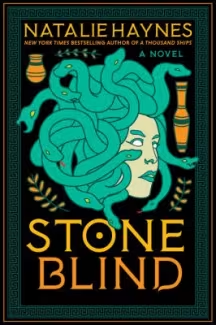
Stone Blind
Revisión
"I only see them for an instant. Then they're gone. But it's enough. Enough to know that the hero isn't the one who's kind or brave or loyal. Sometimes -- not always, but sometimes -- he is monstrous. And the monster? Who is she? She is what happens when someone cannot be saved. This particular monster is assaulted, abused and vilified. And yet, as the story is always told, She is the one you should fear. She is the monster.
We'll see about that."
In Stone Blind, Natalie Haynes retells the story of Medusa, one of the three Gorgon sisters from Greek mythology, who could turn someone to stone by simply looking at them. Haynes questions history’s portrayal of Medusa and her sisters as villains, while simultaneously making a compelling argument to challenge Perseus’, the demi-god who beheads her, casting as a hero.
Haynes fills in some of the narrative gaps in the original stories, to present a more rounded portrayal of these mythological characters. She provides potential motivations for actions that in the original story simply happen, while she also looks closely at the consequences of those actions. She also holds characters accountable for those actions, in spite of being deemed deities. Zeus is therefore portrayed as a serial philanderer and rapist, who forces himself on mortals and gods alike whenever the mood strikes him. Hera is cast as a jealous spouse, who tolerates Zeus’ actions because of the power and comfort her marriage affords her, who also seeks out those with whom Zeus has coupled for retribution, whether or not they were willing participants. While Haynes is certainly not the first author to question the morality of Greece’s mythological pantheon, it does lead nicely into the focus of the novel which is to ask who and why do we call some characters monsters and others heroes?
Stone Blind is a fascinating reappraisal of the Greek myths, their characters’ actions, and a challenge for readers to really question what we’ve been told before, and why we may have been told it in a particular way.
Read an interview with Natalie Haynes here.