Review
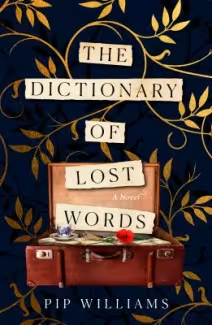
The Dictionary of Lost Words
Synopsis:
Williams tells the story of a life, of a woman who inherited a love of words from her father (who worked on the Oxford English Dictionary), and sought to find and keep the hidden and censored words that spoke to her own experiences as she lived through some calamitous events.
Review
According to their website, the Oxford English Dictionary “is widely regarded as the accepted authority on the English language. It is an unsurpassed guide to the meaning, history, and pronunciation of 600,000 words— past and present—from across the English-speaking world.” Serially published in portions, or fascicles, the first fascicle, covering “A to Ant,” was published in 1884, 27 years after the project had begun. The first complete edition was finished in 1928. It took 71 years to complete the initial edition. To celebrate the occasion, 150 men gathered in London to celebrate. While there were multiple women significantly involved in the indomitable task of documenting the English language, not a single one was invited to share in the festivities. In her debut novel, The Dictionary of Lost Words, Pip Williams speculates on issues integral to the project: the lives and contributions of the women who worked on the OED, the power of words, and the importance of language to represent everyone and not only those in power.
Esme Nicoll’s entire life has been spent in the presence of, surrounded by, and shaped by words. Raised by her widowed father, her mother having been absent from her young life, Esme spends her childhood in the scriptorium, a small building in Oxford where a group of scholars labor to create the first comprehensive dictionary of the English language. One afternoon, while hiding beneath the “sorting table” where the men work, Esme finds a slip for the word “bondmaid”. This begins a search for other words, the words that have been neglected, or, in some cases, rejected by the lexicographers compiling the words for the dictionary.
These words ignite a spark of curiosity in Esme. She begins to wonder, and question her father, about the words that are not being included in the dictionary, and why they are being omitted. As she learns the methodology being applied, she begins to seek out the language of those who are not represented and whose words are being omitted: the poor, the uneducated, and most shockingly women of all ages and classes. Esme begins a lifelong search to save the words discarded by those who do not understand how valuable and insightful those words can be in understanding the experiences of those outside the scriptorium.
In this novel, Pip Williams follows a young woman whose life begins near the end of the Victorian era and follows her through suffrage and the first World War. Williams also provides a glimpse into the effects that can manifest from the smallest, personal actions.
Williams has populated her novel with quirky, curious, and eclectic characters, a number of whom are based directly on the actual staff who worked in the scriptorium on the OED. Those of her own creation are equally compelling, especially the women, whom Williams uses to explore and challenge,the societal and classist mores women had to navigate while living their daily lives.
It is also clear that Williams loves language. The Dictionary of Lost Words provides her with the opportunity to examine cultural attitudes about words, why some are considered “acceptable” while others are not for use in “polite company” and how even the most “questionable” words have their times and uses.
While the Oxford English Dictionary was a monumental task, and continues to be an awe-inspiring accomplishment, it was also problematic in its approach to documenting the English language. Williams explores the potential losses that result from such a myopic approach. It is hard not to wish that someone like Esme Nicoll was there to document the words, language and experiences of those overlooked by the men undertaking the task.
Read an interview with Pip Williams here.